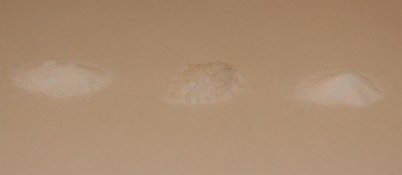
But you missed part of my 1973 presentation.
Actually, I have the Peterson's issue with your 1973 article around somewhere.
When you buy this KBr, for example, you usually pay for a certain total weight. The volume of that total weight in ml divided by 5 tells how many teaspoons are in that container. So what if it is different from the last you bought? Now, of course, you would be depending on the packager of the KBr to give you the weight you paid for if you did not have a means of weighing.
From what I can tell, NIST covers the methods and accuracy requirements for dry materials like powdered developers. See Fourth Edition NIST Handbook 133 (2005), Checking the Net Contents of Packaged Goods January 2005:
Dead Link Removed
Look in Chapter 2. As powdered developers are sold in seal containers, we don't need to worry about variation in wieght due to water uptake/loss.
The way I read this, we are to use the sampling plan in Table 2.1 for non-food consumer products. We could determine the maximum allowable variance (MAV) with 6 samples, and not have any significant correction to the variance that we measure. The number of Minus Package Errors Allowed to Exceed the MAV is zero.
Since our packages are labelled by weight, we then go to Table 2-5. Part B of Xtol, in the 5 litre size says it weighs 248 grams. For packages that range from 208 to 263 grams, NIST says that we can have a MAV of 12.7 grams. That works out to 5.1% MAV.
Now that said, those are appear to be the requirements laid out by NIST. Kodak may actually have a smaller MAV for their packaging requirements. And these requirements also do not cover the variation of the product contained in the package.
There's even a section on your old friend Borax there! (Section 2.4) You get a lot of allowance with Borax since NIST says it can loose up to 23% of its weight in moisture.
There is no question that the probable composition of a sample from any random mixture of solid particles varies with the size of the sample, no matter if the particles are uniform in weight and size. Suppose there are 4 substances required, as in D-76. There is a minimum number of particles that will have any chance of giving you D-76 when you dissolve them. That would be 109. The probability that any random sample of 109 particles will have the correct number of particles of each substance is practically nil. I suppose that there was a time when I could have calculated that probability, but that would have been at least 40 years ago.
I don't understand how you get "109" particles. Particles?? What?
I tied for second place. I was 13 years old. The winner was a girl, and I shared second place with a girl.
I hope the US Army hired them!

not uncommon in industrial processes.