
• Welcome to Photrio!
    Registration is fast and free. Join today to unlock search, see fewer ads, and access all forum features.
    Click here to sign up

How film cameras won over a younger generation

Moment of Spin

A
Moment of Spin

  • 2
  • 0
  • 71
Bad patch

H
Bad patch

  • 2
  • 1
  • 45

Recent Classifieds

Forum statistics

Threads
203,103
Messages
2,849,873
Members
101,669
Latest member
JeremiahPeterson
Recent bookmarks
1
It is a new camera, thus meets the needs of those that value that fact more than those of us who feel confident buying used cameras, as well as the needs of retailers who need new goods to sell.
As I understand it, the quality is quite decent. Results that are at least as good as the millions and millions and millions of basic 126 cameras that were sold over the years, and gave very satisfying results to those who used them.
Particularly considering how much film has improved since 126 was current.

I am not familiar with 126. Where have I been? I know about 110 and still have my old Kodak Pocket Instamatic that has the shutter release of a rusty guillotine.

Good on Kodak for staying in the game. The F9 is not a bad-looking camera. Wonder if it will evolve into a dual lens camera like my Fuji FZ6 TELE?
 
Oh really? I imagine an enterprising soul could determine the typical parts needs of the more popular camera lines and profit from that if the demand for these cameras remains high. Maybe one of these tech-savvy youngsters?

Found the guy on Instagram. I think he also refurbs the whole camera and does parts as a side gig.
 
126 Kodachrome (I think) from 1968 - I'm in the blue jacket.
Probably a mid-level Kodak 126 camera.
 

Attachments

  • G-01a-1970s.jpg
    G-01a-1970s.jpg
    396.6 KB · Views: 141
I am not familiar with 126. Where have I been? I know about 110 and still have my old Kodak Pocket Instamatic that has the shutter release of a rusty guillotine.

Good on Kodak for staying in the game. The F9 is not a bad-looking camera. Wonder if it will evolve into a dual lens camera like my Fuji FZ6 TELE?

126 Istamatic was the first film camera that had a drop in film cartriage. It was introduce around 1965.
 
I am not familiar with 126. Where have I been? I know about 110 and still have my old Kodak Pocket Instamatic that has the shutter release of a rusty guillotine.

Good on Kodak for staying in the game. The F9 is not a bad-looking camera. Wonder if it will evolve into a dual lens camera like my Fuji FZ6 TELE?

Cassette type 126 was the predecessor of type 110.

Type 126 was Kodak's result in an endeavour to make a foolproof-loading cassette. It cought the few competing manufacturers on the wrong foot. Over night Agfa had to react and then revived and pimped their Karat cassette, named it Rapid and designed new cameras for it. This all was a great endeavour. But in the long run Agfa failed abroad and Kodak set a new world standard. Competitors finally had to get it licenced. Sure it was not the technical superior cassette, but the actually foolproof one.
 
The only photographic shortcoming with 126 was that it didn't hold film as flat as 35 (which Kodak wanted to vanish).
 
Kodak didn't want 135 to vanish.
They wanted the consumer difficulties with loading and rewinding film to vanish.
 
126 film was a great advance for amateur photography, the point and shoot person. It basically reinforced the old Kodak tag line "you press the button, we do the rest".
  • Because it was square, portrait or landscape was irrelevant.
  • The cartridge was just drop in, no fiddly loading and it then not taking up.
  • If the camera back was opened by mistake (it happened a lot) the cartridge had a simple light trap to avoid the frame getting a light leak.
  • The customer wound the film on and it stopped at the first and every number after that.
  • At the end it just wound out.
  • It made photography simple for a mass audience.
The only disadvantage, that I can think of, was that 126 cameras were bulky and hence the later reason for 110 packet camera.
 
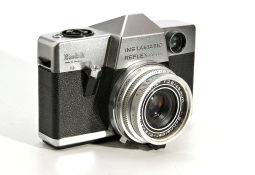
At least some of my father's 126 slides were shot using the Instamatic Reflex he borrowed from the Kodak lab where he was Customer Service Manager.
Essentially, a Retina Reflex modified for 126 film.
Note the flashcube receptacle!
 

Attachments

  • 1654889482469.png
    1654889482469.png
    1.5 MB · Views: 98
The only photographic shortcoming with 126 was that it didn't hold film as flat as 35 (which Kodak wanted to vanish).

Agfa then remained at the established, technically better, 35mm system, just with a new cassette, but basically same film. In spite of not being foolproof it was a success in West-Germany, with such cameras still ubiqueous today. And even after cancelling these cameras and switching over themselves to type 126 the Rapid cassettes still were offered by Agfa for many years in Germany.
 
As to why younger people might possibly be attracted to film, I admit that I have little inkling why young people do anything. So whatever I say may be irrelevent speculation. I recall that in the pre-digital age it was common when consumers got film processed they also got small prints of all the images. Occasionally there might be some they really like of which would order larger prints. But the small prints when frequently the main way that people saw the outcome of a photo. The limited size of such prints obviously has drawbacks. I think is safe to say that the main way the young people today observe their digital images as well their friends' is on phone. Phones often have a smaller screen than small photo prints and have similar drawbacks.

But there was another way back in day for people to see photo images--slide projection. This provided a big, bright view of the pic. I remember when my mother got a Kodak projector being dazzled by the first slide that it displayed. I suspect this echos a similar reaction people had going all the way back to the Magic Lantern projectors. I recall the use of slides being rather popular, so much so that it sometimes got a bad reputation from people being subjected to their relatives lame vacation slide shows. The similar thing today would be to display digital images on a big TV etc. But if people are wanting to go the analog route why not go with slides? It can be hard for more than one people to view a small photo print or phone image. But numerous people can experience a slide simultaneous. Yes, one would have to invest in projection gear. One could have parties to share slide shows, which adds a social dimension. But E-6 film is probably less available, maybe more costly and probably not loaded into single use cameras. So it is not be on the radar screen of young people as is C-41. But maybe it could be.
 
I tried to make a slide projection festival in the past, but saw zero interest from anyone.
 
As to why younger people might possibly be attracted to film, I admit that I have little inkling why young people do anything. So whatever I say may be irrelevent speculation. I recall that in the pre-digital age it was common when consumers got film processed they also got small prints of all the images. Occasionally there might be some they really like of which would order larger prints. But the small prints when frequently the main way that people saw the outcome of a photo. The limited size of such prints obviously has drawbacks. I think is safe to say that the main way the young people today observe their digital images as well their friends' is on phone. Phones often have a smaller screen than small photo prints and have similar drawbacks.

But there was another way back in day for people to see photo images--slide projection. This provided a big, bright view of the pic. I remember when my mother got a Kodak projector being dazzled by the first slide that it displayed. I suspect this echos a similar reaction people had going all the way back to the Magic Lantern projectors. I recall the use of slides being rather popular, so much so that it sometimes got a bad reputation from people being subjected to their relatives lame vacation slide shows. The similar thing today would be to display digital images on a big TV etc. But if people are wanting to go the analog route why not go with slides? It can be hard for more than one people to view a small photo print or phone image. But numerous people can experience a slide simultaneous. Yes, one would have to invest in projection gear. One could have parties to share slide shows, which adds a social dimension. But E-6 film is probably less available, maybe more costly and probably not loaded into single use cameras. So it is not be on the radar screen of young people as is C-41. But maybe it could be.

Good point about the small screen and C-41 prints!

35mm shots look amazing on cellphones. B&W shots look crisp and contrasty. I never thought much into it other than the scans tended to look pretty good on smartphones. I think you're onto something.
 
Today my grandson had a Culmination ceremony at school and he asked my to take photographs. When others pulled out their cell phones he said. "I want good photographs this time."
 
Today my grandson had a Culmination ceremony at school and he asked my to take photographs. When others pulled out their cell phones he said. "I want good photographs this time."

He was probably making a reference to your skills as well since your pictures with a digi would probably trump anyone else's there, too.
 
He was probably making a reference to your skills as well since your pictures with a digi would probably trump anyone else's there, too.

During the lockdowns I was out on a bluff taking pictures of seagulls and some girls approached me. All 20 somethings, hadn't seen each other in 6 months so were hiking together, you know the deal. Wanted me to take a cellphone snap of the group.

I did my pro thing. Teased the overly stiff tall one until she smiled and got the short one to laugh and step forward so she wasn't shaded, then waited until birds flying up along the bluffs behind them came into the frame and shot a couple more. Got a couple of really nice shots with genuine smiles, good composition, everyone well lit, and movement and life. I handed the phone back and just walked on my way when I heard behind me "Ohh... oh my god, that's great." then "Look at the bird!" etc as they were passing around the iphone. Job well done.

There IS a difference. Any time you see people standing with their backs to the sun to take a sunset shot, you know a genuine photography enthusiast could do better. Sirius certainly could, regardless of gear.

But I still bet the film has extra cachet.
 
Oh really? I imagine an enterprising soul could determine the typical parts needs of the more popular camera lines and profit from that if the demand for these cameras remains high. Maybe one of these tech-savvy youngsters?
We should probably start new a thread to discuss it, but there are a number of specialty camera parts that have become available new in just the past couple years, off the top of my head I've seen Rolleiflex 2.8 meter knobs, back latches for a few different cameras (injection molded, not 3d printed), and FPCs for a few early Canon and Minolta AF lenses (think 1980s). Not to mention all of the 'custom' bellows availabe for almost every LF camera you could think of, a quick search shows newly manufactured bellows for Ansco and Deardorff 8x10s. I wouldn't be surprised to see new ICs produced for specific cameras such as the F3 or OM4, as the supply of parts cameras dwindles.
 
126 film was a great advance for amateur photography

My earliest film developing was Instamatic and 828. We did our own developing at first because it was cheaper to do our own BW than have color done for us at the store. The making of pictures was our first concern, not technical matters. I remember cracking open those cartiridges in the dark - plastic shards everywhere! After that, handling 126 was much the same as 35 mm or 828, except for the square negative. It took a year before my friend and I could rustle up the money for 35 mm cameras (Ricoh Singlex TLS and Yashica TL electro X).
 
He was probably making a reference to your skills as well since your pictures with a digi would probably trump anyone else's there, too.

I am strictly a film users.
 
There are a number of specialty camera parts that have become available new in just the past couple years, off the top of my head I've seen Rolleiflex 2.8 meter knobs, back latches for a few different cameras (injection molded, not 3d printed), and FPCs for a few early Canon and Minolta AF lenses (think 1980s).

Interesting, as I was not aware of this. But what are FPC's?
 
Interesting, as I was not aware of this. But what are FPC's?

Flexible printed circuits, those orange colored flex boards that are common in cameras post 1980; in fact the first photo is of an Olympus Stylus that is mainly made up of one. Lenses use them to connect different boards and contacts together, but they can tear or get damaged due to careless disassembly or sometimes just over time/use.

Back to the article, I was at a camera swap show today, and I'd guess about 75% of the buyers were under 30, although most of the sellers were over 50. The crowds at these shows have definitely started to skew younger in the past couple years.
 
During the lockdowns I was out on a bluff taking pictures of seagulls and some girls approached me. All 20 somethings, hadn't seen each other in 6 months so were hiking together, you know the deal. Wanted me to take a cellphone snap of the group.

I did my pro thing. Teased the overly stiff tall one until she smiled and got the short one to laugh and step forward so she wasn't shaded, then waited until birds flying up along the bluffs behind them came into the frame and shot a couple more. Got a couple of really nice shots with genuine smiles, good composition, everyone well lit, and movement and life. I handed the phone back and just walked on my way when I heard behind me "Ohh... oh my god, that's great." then "Look at the bird!" etc as they were passing around the iphone. Job well done.

There IS a difference. Any time you see people standing with their backs to the sun to take a sunset shot, you know a genuine photography enthusiast could do better. Sirius certainly could, regardless of gear.

But I still bet the film has extra cachet.

Give me some wisdom.

How do you better in a sunset situation? With modern digital cameras you can shoot with the sun behind and not lose any info. What is a better way in you opinion?
 
Actually point the camera at the sunset? Instead of turning their back to it?

I assumed he meant to put subject between camera and sunset.

People take photos at sunset of the sunset facing away from the sun? I mean I guess if you want that golden light on a squinting face that would be good? Or if the sun is really low you can get the sunlight without the bright?
 
Photrio.com contains affiliate links to products. We may receive a commission for purchases made through these links.
To read our full affiliate disclosure statement please click Here.

PHOTRIO PARTNERS EQUALLY FUNDING OUR COMMUNITY:


Ilford ADOX Freestyle Photographic Stearman Press Weldon Color Lab Blue Moon Camera & Machine
Top Bottom