• Welcome to Photrio!
    Registration is fast and free. Join today to unlock search, see fewer ads, and access all forum features.
    Click here to sign up

How do I have more contrast without developing myself the film ?

Forum statistics

Threads
203,279
Messages
2,852,255
Members
101,756
Latest member
rsj1360
Recent bookmarks
0
It's still unclear to me whether you print (optically, in darkroom) or scan & print digitally. If you scan&print digitally, you MUST increase contrast and apply an S curve to match the darkroom version, because digital printers compensate for the paper toe and shoulder, which does not happen in darkroom, and because scanning a neg does not give a good histogram straight out. It's more cheating NOT to fix this. If this is the case, seek for more specific help in hybridphoto.com, or if you feel that's cheating, stop the scanning now and start printing optically, and voila, it's much easier and more fun!

Good luck!

Sorry ! I do scan and print digitally : well, I do print in a lab ( not at home ) but still a printer ( and not in the darkroom ).
 
Overdeveloping ("pushing") your film will increase its contrast. You can do this with or without underexposing it. The method with normal exposure makes the shadows darker upon printing the negative down, and the method with underexposure makes the shadows darker upon printing the negative normally (because with the latter method, the shadows are actually thinner on the film itself). The former gives you the option of more shadow detail when printing, if you should decide that you want it after all, and it also gives you more "meat" (meaning exposed silver) to push in the first place. The latter simply lowers the values of the low tones, while keeping the mids and highs roughly similar.

In flat lighting, I will usually use the former method (normal exposure and push). The more exposure the negative has, the more the push will affect it. As such, it can be harder to get enough of a push in a flat lighting situation if you underexpose the film first.
 
Last edited by a moderator:
Proenca:

whenever I scan film, it seems, TO ME; to gain contrast. This is one advantage(IMO) that the hybrid process has over the standard analog method, CONTRAST CONTROL in the software(pre-scan preferably).

even with high(er)-end scanners like the Imacon's(Hasselblad film scanners), a negative that will give me a great grade 2 print in the darkroom might be equivalent to a gr3-3 1/2 on the screen and what I get when I look on a calibrated CRT monitor(still the best IMO for contrast adjustments vs LCD's).

so, if you don't plan to print in the darkroom ever, you might want to run tests(just as others have mentioned here) to find your true film speed(depending on the developer used by the lab), the roll-->roll consistency(like 2 weeks separated between trips to the lab), and the skill of the film scanner operator(BIG part IMO). most labs(particularly professional labs, NOT 1hr mini-mall labs) are willing to work with you to fine-tune your process to the way they do things normally(normal process time).

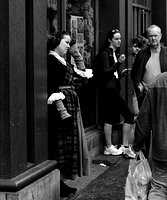
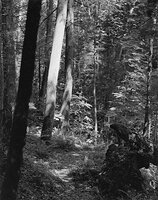
but in general, from the 1st two images you posted, I would say that a 1/3-1/2 stop(minimum, possibly more, hence testing) UNDERexposure would help to give a bit more contrast, and darker blacks in the end.

keep the exposure "golden rule" in mind:

"exposure for the shadows, develop for the highlights"

remember that camera meters(even the ones in Leicas) are calibrated to expose for MIDDLE(18%) grey. So you have to either 1. set the camera to purposely UNDEREXPOSE a given amount(with shutter speed preferably), or set your camera to a faster ISO than what your true film speed is(say your TFS is 400(TRI-X), but you expose it at 500, hence, a 1/3 stop UNDER exposure)

and lastly, the amount of manipulation that the scanner operator does with contrast adjustment( you might want to ask them to NOT do any adjustments from now on to the scans they do for you, just STRAIGHT scans). this will keep 1 more variable out of the game of getting the results that you want.

sorry, just thought about 1 more thing: depending on where you are in the world, your local library(big city library's mostly) might have a copy of "The Negative" by Ansel Adams. this book is kind of the de-facto standard for learning about how exposure and development adjust the density and contrast of your negative(or positive)

best of luck, and welcome back to the "dark side" :D!

-Dan
 
So the compromise in pushing is that you lose shadow detail, and you can never get those tones back. Ever.

- Thomas

Sure, and that's well understood. However, an increase in contrast is not going to let said coveted shadow detail sneak on by at the same level either. If someone wants more contrast and blacker blacks, something will be sacrificed to get it.
 
So the compromise in pushing is that you lose shadow detail, and you can never get those tones back. Ever.

- Thomas

This is the compromise with underexposing, not the compromise with pushing. One does not need to underexpose to push.
 
Splitting hairs? We mean the same thing 2F/2F, but word it differently. In my vocabulary, giving a normally exposed roll of film more development is called over-developing. And pushing, to me, means that you deliberately underexpose and bring whatever is salvageable back to normal printable levels.

That is good to know in discussions moving forward.
 
I'm always willing to learn more than I know. But perhaps we should start a new thread, as I think we're drifting from the original question a bit.

Or send me a PM. Either way, as much as I probably won't use it, as I have my method figured out, I'd love to hear how you take b&w film and bring back shadow details that don't normally appear to printable levels. Please educate us!

Thanks,

- Thomas


Overdraft, but we're not talking about money and banks.

Film isnt a bank.

The analogy is false, because that information is actually there on the exposed film. The range of information a latent image can hold is far greater than that of a visible developed image.

Which you can choose a certain range to develop within an extent, some of the information is developable and some undevelopable normally - even though the information is actually there even though you cant develop it (*) - some of that can be also made developable before developing to boot.

* - So it is not a case of not recording it.
 
I am splitting hairs, because it is very important to do so.

Regardless of how it has been exposed, giving a film more development than normal (via one or more of various methods) is always "overdeveloping". "Pushing"is simply a slang word for the same. It is something that takes place entirely in the processing stage. Exposure is just one of the controls one has over what a push will do to what tones.

The assumptions of underexposure that go along with the word "push" are why I prefer not to use the word without first using the word "overdevelop", and then introducing the word "push" as a shorthand term for it...as I did in my initial post in this thread (#27).

At any rate, pushing and overdeveloping both simply mean, "increasing contrast via non-standard development".

To me, the biggest difference is that "overdeveloping" implies a mistake, and "pushing" implies intent. One reason I like to use "push" is because "overdevelop" can sound like a mistake, without the word "purposefully" used before it.
 
Last edited by a moderator:
proenca

sometimes light meters + shutters are off, so you may think you are doing
one thing, but the camera is actually doing something else.
why don't you bracket a roll of film to see
which exposures look the best through your lab's chemistry.


john
 
This is the problem with using slang words as part of normal vocabulary. They take on a million possible meanings, many of which are wrong. Connotations and implications are not part of definitions, but they almost entirely constitute slang words. If something is preceded by "to me", it is not a definition. So, since we all have our own connotations and implications for certain terms, and we are sticking with them, "purposefully overdevelop" = "push" in my book...for discussions moving forward...and I will always argue that it is also the definition.
 
Last edited by a moderator:
Do not underexpose. Ask that they increase development 10% and print on the same grade of paper.

If you are scanning, leave them soft and increase in photoshop. High contrast negs are difficult to scan.
 
If you're printing analogue you can add contrast to B&W films post processing with chromium intensifier or selenium toner... visual inspection in room light. I'm sure there are other methods but these are the only two I used a million years ago.

If you're scanning, as Ronald said and provided the shadow detail is there, just increase contrast in PS.
 
so, if you don't plan to print in the darkroom ever, you might want to run tests(just as others have mentioned here) to find your true film speed(depending on the developer used by the lab), the roll-->roll consistency(like 2 weeks separated between trips to the lab), and the skill of the film scanner operator(BIG part IMO). most labs(particularly professional labs, NOT 1hr mini-mall labs) are willing to work with you to fine-tune your process to the way they do things normally(normal process time).

Dan:

I think the term "true film speed" is a bad choice of terms, better would be preferred film speed. It's funny though, I have always found the film speed on the box works pretty well for me, using a standard developer following the manufacturers directions.

I can see one problem here, a lab may not always use the same developer, and your preferred film speed may therefore vary. Some shops and even some labs may farm out B&W and the place they farm out to, may change at any time.
 
Photrio.com contains affiliate links to products. We may receive a commission for purchases made through these links.
To read our full affiliate disclosure statement please click Here.

PHOTRIO PARTNERS EQUALLY FUNDING OUR COMMUNITY:


Ilford ADOX Freestyle Photographic Stearman Press Weldon Color Lab Blue Moon Camera & Machine
Top Bottom