
• Welcome to Photrio!
    Registration is fast and free. Join today to unlock search, see fewer ads, and access all forum features.
    Click here to sign up

How do I have more contrast without developing myself the film ?

Forum statistics

Threads
203,279
Messages
2,852,255
Members
101,756
Latest member
rsj1360
Recent bookmarks
0

proenca

Member
Allowing Ads
Joined
Jun 2, 2009
Messages
26
Format
35mm RF
Hi there,

Been a Leica M8 user I was gathering money and discussing with my black market friend how much a kidney and a sort of barely used wife would fetch so I could buy the M9.

But and I dont really dont know why, I bought a Leica MP Anthracite and starting using film.

So I'm learning again. It feels nice.

For now, I just want to understand the film and how it reacts, later on I will start developing the film at home.

There are a few b&w stores here in Lisbon which are run by experienced photographers and they do a good job.

The problem is me : I like contrasty b&w images and my images tend to turn out flat.

Easy with digital : you pump the contrast and fiddle with the channel mixer in Lightroom until its done.

Film, its different : I want to get it right FROM the camera, not in post processing.

My question is : is it possible ?

How can I increase my contrast in my camera ? Only using filters ?

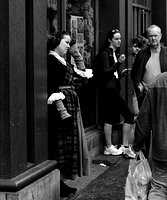
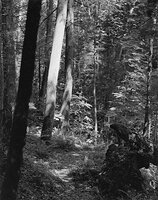
For example I prefer this : ( not my image )
Dead Link Removed


But what I usually get is this ( not my image ) :
Dead Link Removed

I use digital for years and tend to expose to the highlights.. should I expose to the shadows ? Or what I'm doing wrong ? please help a b/w newbie :smile:
 
Oh I know if I use Ortho film ( Agfa Ortho 25 ) which has deep blacks ( what I really want ) I will get that look but the film is :

1 - slow ( I use a Noctilux a lot but ISO 25 is really a daylight film only )
2 - expensive ( it is ! )

So what are my options ? Should I buy "xxx" film which is contrasty by nature and under/over expose ?
 
Most films have deep blacks. And white whites. There is no magic bullet there. It's all about how you expose, develop, and then 'post process', whether that be on the scanner or in the darkroom. As far as contrasty B&W film, this is something that is controlled by development. And what is on the neg is further modified by the printing process. You can take a flat negative and print it contrasty.

Are you scanning or printing in a darkroom?

All images need some post processing. If scanning, you need to adjust the raw scan (or have your software do it). If in the darkroom, selecting a grade of paper, at the very minimum, is 'post processing'. As well as choosing an exposure time.

If you really want contrastier negatives, push the film. Underexpose some and develop longer. However, I question the need to do it on film all the time when you can easily bump up the contrast 1/2 or 1 grade in the darkroom. Unless you always want that look. Again, with the scanner, its simply a matter of setting your levels/black point to the point where you want. Whether you do this, or have your software do this, it's still is being done.
 
Take the two pictures above with you the next time you get your film developed and show them to the laboratory worker as an example of what you want.

You can bump the contrast of the negative by underexposing 1 stop and requesting a '1 stop push' when you get the film processed, but they are quite likely to print it down to a muddy grey.
 
Take the two pictures above with you the next time you get your film developed and show them to the laboratory worker as an example of what you want.

You can bump the contrast of the negative by underexposing 1 stop and requesting a '1 stop push' when you get the film processed, but they are quite likely to print it down to a muddy grey.

Correct me if I'm wrong but wont be the same if I underexpose by 2 or 3 stops and dont say anything and they process the film at its "normal" speed ?

For example, I load the film ( 400 ISO )and set it to 800 ISO, so my camera assumes a 800 ISO filme. Take the pictures happily and go to the lab and they develop it at 400 ISO.

Wont it be the same ?
 
No. The film will be underexposed by one stop. The one stop push "overdevelops" the film to pull detail out of the shadows that would otherwise be lost. You can also control contrast in B&W at the time of shooting by using filters. A #8 yellow will reproduce the approximate contrast your eye sees (and require a 1 stop increase in exposure) and a #25 red will dramatically increase contrast, particularly in scenes with blues (it requires a 2 or 3 stop increase in exposure -- I forget which.) Also a polarizer will increase contrast in some settings.
 
If you can't change processing, my first suggestion would be to expose less.
 
No. The film will be underexposed by one stop. The one stop push "overdevelops" the film to pull detail out of the shadows that would otherwise be lost.

Actually, you will never be able to 'pull detail out of the shadows that would otherwise be lost' due to underexposure. If you didn't record it in the first place, there is nothing to 'pull out'.

When you underexpose your film, you sacrifice shadow detail.

When you subsequently push process your film, you lift the tones that actually were recorded on the film up to their normal place in the tonal scale, as if the film was normally exposed and processed. But your lost shadow details will remain lost.

So the compromise in pushing is that you lose shadow detail, and you can never get those tones back. Ever.

- Thomas
 
You haven't responded what your final output is. If the lab is giving you prints, most likely they are scanning anyway and then printing. Just ask them for constrastier prints. It's probably a 2 click operation in their software. Those changes would go for the scans too if that's what you are getting, though you could easily do that at home on your computer.
 
Re: filters - these don't really increase total contrast in your negative either, other than increasing contrast between the color of the filter and its complimentary color. So if you use a red filter, anything red in your scene will become brighter, and anything green or near green will become darker.

You will then process your film such that your highlights and mid-tones are still printable, and the total contrast of your scene remains relatively unchanged.

The color filters are there to enhance or tone down certain parts of a scene that are of a particular color.

What many people use an orange or red filter for is to darken a blue sky, and this is probably where the belief that the red filter increases total contrast in a scene comes from.

The best way to adjust contrast is to alter processing. If you agitate more often and more vigorously, you will increase total contrast in a negative. It's the best way to do it. There is also a lot that can be done at the printing, and eventually at the toning stage.

- Thomas
 
The problem is me : I like contrasty b&w images and my images tend to turn out flat.
...
Film, its different : I want to get it right FROM the camera, not in post processing.

If you want to look at the raw image FROM the camera, you have a NEGATIVE image. It's probably not what you want so forget that "no post processing" thing. There's always post processing. In analog, you cannot omit it. Turning the image to positive is post processing AND it does a lot more than "invert" in Photoshop. It affects contrast and curve shape.

Do you print your negatives optically? If you just scan, that's the problem.

Negative films are DESIGNED to be printed. In printing, toe and shoulder regions of curve are partly discarded and the S curve of the paper is applied to the linear part of film curve. If you make raw scans, you have the whole tonal range of the film and have to emulate the paper. Well, it's just applying an S curve and increasing contrast.
 
Congrats on the camera. Shoot with it forever.

Find a B&W lab and talk to them. Show them what you like.
They would probably be happy to make you happy.

Easy.
 
Actually, you will never be able to 'pull detail out of the shadows that would otherwise be lost' due to underexposure. If you didn't record it in the first place, there is nothing to 'pull out'.

When you underexpose your film, you sacrifice shadow detail.

When you subsequently push process your film, you lift the tones that actually were recorded on the film up to their normal place in the tonal scale, as if the film was normally exposed and processed. But your lost shadow details will remain lost.

So the compromise in pushing is that you lose shadow detail, and you can never get those tones back. Ever.

- Thomas


"If you didn't record it in the first place, there is nothing to 'pull out'."

I disagree 100%, it doesn't work that way with simple developing via extended time, but you can do it, in several different ways, an exposed piece of film.. think of it as a HDR and developing tonemapping.

I've gained 3 stops out of colour neg, and also pulled it 14 stops.

I've seen a guy on flickr gain shadow detail on colour transparency night exposures with the use of mercury.
 
Think about what you're saying.

If you put no money in the bank, how can you still make a withdrawal?
 
Think about what you're saying.

If you put no money in the bank, how can you still make a withdrawal?

Overdraft, but we're not talking about money and banks.

Film isnt a bank.

The analogy is false, because that information is actually there on the exposed film. The range of information a latent image can hold is far greater than that of a visible developed image.

Which you can choose a certain range to develop within an extent, some of the information is developable and some undevelopable normally - even though the information is actually there even though you cant develop it (*) - some of that can be also made developable before developing to boot.

* - So it is not a case of not recording it.
 
"If you didn't record it in the first place, there is nothing to 'pull out'."

I disagree 100%, it doesn't work that way with simple developing via extended time, but you can do it, in several different ways, an exposed piece of film.. think of it as a HDR and developing tonemapping...

Well, I just developed a roll of Tri-X, which was shot at EI1600. I wanted to see what really happens when push processing. It's not that I didn't already know what to expect, I've done this before, but this time I included 11 exposures of a grey card +-5 stops from the normal exposure. I've done this before with normal processing and even though I haven't made a contact print of it yet, it's obvious that I've lost 2 stops in shadow detail. The midtones and highlights look like they have "normal" density, but shadows are gone.

EDIT: What you usually gain from push processing like that is just a bit (like 1/3 stop) of shadow detail.
 
Last edited by a moderator:
That's because you're merely pushing. And I havent any experience with Tri-X (I have a few rolls in 120 yet to use) so I cant comment about recovery, or gaining a couple of stops.
 
Proenca

Personally I think that you are trying to make life difficult for yourself. Looking at the second picture you have posted, there is absolutely nothing wrong with your exposure technique, and in your words, it would be easy for you to 'pump the contrast' in the darkroom, or lightroom for that matter. It is far better to start with a negative with full detail throughout, so that you can take it any way you wish in the future.

All that said, the boys have touched on the real truth, that only testing will give you the negative that you so desire, that's the real bottom line, depressing though it may seem.

Just my thoughts

Good luck

Stoo
 
That's because you're merely pushing. And I havent any experience with Tri-X (I have a few rolls in 120 yet to use) so I cant comment about recovery, or gaining a couple of stops.

We could continue the conversation, although I don't believe that what you say can be done, but that would be thread hijacking. If you want to tell us more, start another thread.
 
Well thanks everyone for their answers - most informative.

Bottom line is - I have lot to learn. While I shot for years and years , I used very little film and jumped on the dSLR bandwagon really early - now few years ago, I changed to the M8 and that lead me to the MP and film.

I just will have to experiment a lot and see the results. That's it.

My output is to print - not that big actually - 15x20" or bit lower usually ( biggest blurb photobook ) but I do feel like cheating of shooting black and white, scanning the file and then adjusting the thing in photoshop for contrast, touch on exposure, etc - just wanted to get it more "right" from the start of the image.

That's all :smile:
 
It's still unclear to me whether you print (optically, in darkroom) or scan & print digitally. If you scan&print digitally, you MUST increase contrast and apply an S curve to match the darkroom version, because digital printers compensate for the paper toe and shoulder, which does not happen in darkroom, and because scanning a neg does not give a good histogram straight out. It's more cheating NOT to fix this. If this is the case, seek for more specific help in hybridphoto.com, or if you feel that's cheating, stop the scanning now and start printing optically, and voila, it's much easier and more fun!

Good luck!
 
I will read this thread later in another time, because i also like the contrasty B&W, and because of that i am going with film now as film B&W look is better than digital B&W.
 
Photrio.com contains affiliate links to products. We may receive a commission for purchases made through these links.
To read our full affiliate disclosure statement please click Here.

PHOTRIO PARTNERS EQUALLY FUNDING OUR COMMUNITY:


Ilford ADOX Freestyle Photographic Stearman Press Weldon Color Lab Blue Moon Camera & Machine
Top Bottom
