• Welcome to Photrio!
    Registration is fast and free. Join today to unlock search, see fewer ads, and access all forum features.
    Click here to sign up

How come Michael Kenna's nighttime shots always look so bright?

Cemetery Chapel

H
Cemetery Chapel

  • 2
  • 0
  • 28
2 bath test

A
2 bath test

  • 3
  • 0
  • 51

Recent Classifieds

Forum statistics

Threads
202,770
Messages
2,845,334
Members
101,514
Latest member
Luc Tourwé
Recent bookmarks
0

ted_smith

Member
Allowing Ads
Joined
Feb 19, 2008
Messages
493
Location
uk
Format
Multi Format
OK, so I've been wowed and amazed by the work of Michael Kenna (http://www.michaelkenna.net/). Inspired by his nighttime shots, I've headed out a couple of times at night, several hours past sunrise so it's properly black as night.

On one occasion, I walked along some of the flood plains of The River Derwent as it winds through a fairly rural part of Derbyshire. As it had not been snowing or anything (I note a lot of MK's shots are taken at night but in snow. but not all are), it was basically just very dark (and wet as we have had heavy rain here recently), despite the full moon. My light meter couldn't register even 1 EV (I using Ilford Pan 50+, ISO50). And after a while, I started to get the creeps and I also had it in the back of my mind "I am 2 miles from the road...if this river starts to swell due to heavy rain further north, I might get stranded!!".

So I took a few shots anyway using guess work (10 seconds, 15 seconds, 20 seconds etc) but I have no idea how they'll come out, if they'll come out at all. And I then hurried back to the road.

So I found myself thinking "With the exception of the snow scenes, how does MK get such well lit scenes when taken at night?"
 
Last edited by a moderator:
Yes the exposures need to really long in darkness like that. I did photos once at night with snow and city street lights and it seemed pretty bright but the exposure even with all that light was 15 to 20 minutes.
 
i don't know what MK does but you could set up on a tripod a little before dark and take a partial exposure and then take the rest of the exposure after dark especially if there are lights that come on after dark.

Dead Link Removed
 
Just yesterday I viewed an exhibit of works at the James A. Michener Art Museum in Doylestown, PA, that included photos taken by Susan Fenton. She has done a whole series of still life arrangements that were recorded by moonlight in exposures ranging up to six hours! Selenium toned gelatin silver prints too, by golly!
 
Holy smokes! Several hours?! I've heard and understand to some extent the reciprocity failure rule for 30 seconds+, but how do you work out the exposure for scenes requiring exposure of several hours?
 
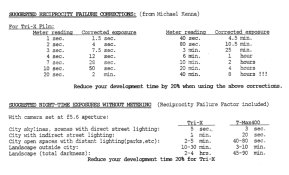
Ted -- When MK was a faculty member of a workshop I assisted at, he passed out a sheet with suggested times based on the one's meter readings (times for Tri-X and Tmax400). And included were suggested times for both films at f5.6 under different night lighting conditions. I assume he created the times through personal experience. I hand them out to our students all the time...great starting points.

MK would often have more than one camera making exposures at the same time.
 
Guess. Then experience. Unexpected, and sometimes wonderful, things can happen when the shutter is open for hours. Plan for the unplanned.
 
Search online and you can find some articles by him discussing his printing routine. He makes very liberal use of dodging and burning. I think that's part of the effect, too.
juan
 
Reciprocity effects are probably more important when shooting colour at night. With B&W I would tend to experiment and keep notes. To avoid reciprocity problems, it is often suggested that you use a set speed and vary aperture. This is not very helpful if you are making images which require front to back focus. I would tend to use an aperture of f8-16 and try to calculate a base exposure time. You can then bracket plus one or two stops. There are some books on low light photography that contain useful exposure charts for various subjects. You could also try a faster film. I have had good results with Delta100 in 35mm for night work. If you are using 120 you could go to 400ASA. Get a locking cable release and a stopwatch to help with long exposures. I use a keyring LED torch to see what I'm doing. One approach that has worked for me with urban night images is simply using aperture priority auto and letting the camera choose the speed. It's not very scientific, but it has produced some usable negatives. Alex
 
Holy smokes! Several hours?! I've heard and understand to some extent the reciprocity failure rule for 30 seconds+, but how do you work out the exposure for scenes requiring exposure of several hours?

Easy answer is use Pinhole Assist (iphone app).
 
Ted -- When MK was a faculty member of a workshop I assisted at, he passed out a sheet with suggested times based on the one's meter readings (times for Tri-X and Tmax400). And included were suggested times for both films at f5.6 under different night lighting conditions. I assume he created the times through personal experience. I hand them out to our students all the time...great starting points.

MK would often have more than one camera making exposures at the same time.

Can you share said sheet by any chance? Perhaps send a link via PM if it's not something that can be posted publically?
 
Holy smokes! Several hours?! I've heard and understand to some extent the reciprocity failure rule for 30 seconds+, but how do you work out the exposure for scenes requiring exposure of several hours?

If you've an iPhone there are some reciprocity calculators available. I have one called called film timer.

My iPhone is fast becoming my most indispensable tool in my photo bag.
Light meter, Depth of field calculator, golden hour calculator, posing app.
Not to mention the massive dev chart app which is brilliant as well.
:smile:
 
He's just lucky like that?

I suppose the only possible explanation is that he makes really long exposures. How else? Unless NASA make his lenses and his film was manufactured in Zeta Reticuli - which also happens to be where Ansel came from, look it up. :whistling:

But anyway, Kenna always talks about making day look like night and vice versa. He seeks out unusual atmospheric conditions. Many of his pictures, being devoid of direct sunlight and having limited tonal range could, for all we know, have been shot at night or day. There's very little reference to time of day, which makes his pictures so evocatively 'still'. But due to the practicality of shooting wild landscapes at night, I'd assume very few of his pictures are. It's more to do with his cleverness in the darkroom.
 
Photography as an art is not an exact science. Brassai would time his night exposures with how long it took him to smoke certain cigarettes. – A Gauloise for a certain light, a Boyard if it was darker. Forget the reciprocity charts an experiment.
 
Can you share said sheet by any chance? Perhaps send a link via PM if it's not something that can be posted publically?

I MADE MY OWN TABLE USING HIS DATA, SO IT SHOULD BE COOL -- I WILL TRY TO SCAN IT TONIGHT.

Sorry for the caps...the original document I made got eaten by the computer, I only have paper copies. Reading it right now, using Tri-X, a meter reading of 10 minutes yields a corrected exposure of two hours. A meter reading of 40 minutes should be exposed for 8 hours! (reduce dev times by 20%)
 
Photography as an art is not an exact science. Brassai would time his night exposures with how long it took him to smoke certain cigarettes. – A Gauloise for a certain light, a Boyard if it was darker. Forget the reciprocity charts an experiment.

Brassai's night photos of Paris are amazing; well worth looking at for night photo inspiration. I was just thinking of his interiors shots of people (in bars, clubs) the other day and plan to look at them again soon. All pretty amazing for the time (or any time).

His cigarette technique sounds very practical, though I hate to have to take up smoking just for that.
 
Hopefully this is readable.

Vaughn
 

Attachments

  • Night_Exp.jpg
    Night_Exp.jpg
    146.7 KB · Views: 1,336
Thanks Vaughn!

There is nothing quite so amazing as to see how you answered ted_smith's specific question completely and thoroughly! I didn't think the answer would exceed speculation.

I'd just become acquainted with Michael Kenna's work this year and so the question caught my attention. I never realized he taught.

Thanks for sharing this, I was about to try to puzzle out a similar series of TMY2's reciprocity characteristics, this gives me a starting point (or maybe it is all I needed).
 
Yes thanks that's awesome!

~Stone

Mamiya: 7 II, RZ67 Pro II / Canon: 1V, AE-1, 5DmkII / Kodak: No 1 Pocket Autographic, No 1A Pocket Autographic | Sent w/ iPhone using Tapatalk
 
Last edited by a moderator:
OK, so I've been wowed and amazed by the work of Michael Kenna (http://www.michaelkenna.net/). Inspired by his nighttime shots, I've headed out a couple of times at night, several hours past sunrise so it's properly black as night.

On one occasion, I walked along some of the flood plains of The River Derwent as it winds through a fairly rural part of Derbyshire. As it had not been snowing or anything (I note a lot of MK's shots are taken at night but in snow. but not all are), it was basically just very dark (and wet as we have had heavy rain here recently), despite the full moon. My light meter couldn't register even 1 EV (I using Ilford Pan 50+, ISO50). And after a while, I started to get the creeps and I also had it in the back of my mind "I am 2 miles from the road...if this river starts to swell due to heavy rain further north, I might get stranded!!".

So I took a few shots anyway using guess work (10 seconds, 15 seconds, 20 seconds etc) but I have no idea how they'll come out, if they'll come out at all. And I then hurried back to the road.

So I found myself thinking "With the exception of the snow scenes, how does MK get such well lit scenes when taken at night?"

I don't think anything will come out at such a short time, Pan F+ is great, but, a 50 ASA is very slow, heck sometimes I need 30 seconds or more with a 400 ASA film. I would suggest pushing that to 3200 if you expect to get any image at all, it will be grainy and contrasted to hell, but it won't be blank :wink:


~Stone

Mamiya: 7 II, RZ67 Pro II / Canon: 1V, AE-1, 5DmkII / Kodak: No 1 Pocket Autographic, No 1A Pocket Autographic | Sent w/ iPhone using Tapatalk
 
Photrio.com contains affiliate links to products. We may receive a commission for purchases made through these links.
To read our full affiliate disclosure statement please click Here.

PHOTRIO PARTNERS EQUALLY FUNDING OUR COMMUNITY:


Ilford ADOX Freestyle Photographic Stearman Press Weldon Color Lab Blue Moon Camera & Machine
Top Bottom