• Welcome to Photrio!
    Registration is fast and free. Join today to unlock search, see fewer ads, and access all forum features.
    Click here to sign up

Home Made 35 mm Film

Recent Classifieds

Forum statistics

Threads
202,886
Messages
2,847,062
Members
101,529
Latest member
Flo18
Recent bookmarks
0

Mark Osterman

Member
Allowing Ads
Joined
Sep 7, 2011
Messages
75
Format
Large Format
Many of you may know that in the past year I have been working on making the 35 mm cine film that was available to Oscar Barnack when he invented the Leica camera. Last year was the centennial of the announcement of the Leica and while I didn’t quite make that, my wife and I will be going to Wetzlar Germany this June (2026) to demonstrate the film we make, formula MO-1925. Along the way we were also made custodians of an extremely rare roll fo film shot by Barnack in 1914 for our research. We’ll be presenting that roll to the Leica Museum when we’re there in June.

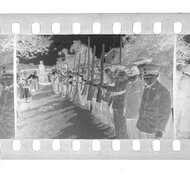
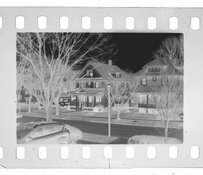
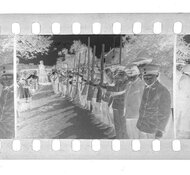
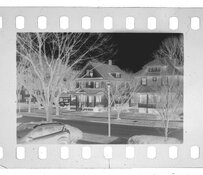
Here is a nice comparison of a frame from the Barnack 1914 roll … and a frame taken last week from a batch of film I made. Note too that the Barnack film was made by Kodak here in Rochester. We were gifted the vintage Bell & Howell perforator which has the same B&H shaped holes.
 

Attachments

  • IMG_3235.jpeg
    IMG_3235.jpeg
    257.4 KB · Views: 73
  • IMG_6881.jpeg
    IMG_6881.jpeg
    788.8 KB · Views: 60
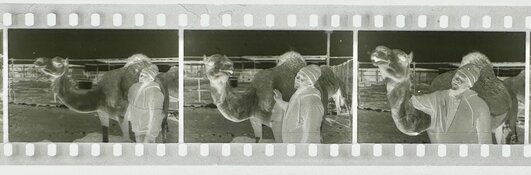
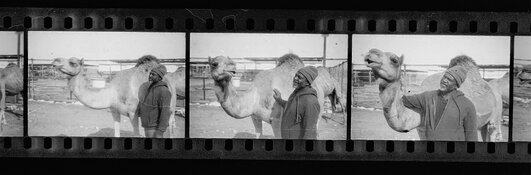
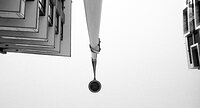
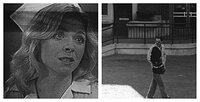
Here are a couple of frames from film I shot in Doha, Qatar in January (2026). They were shot in a 1928 Leica I camera with film I made like the fine grain film available in the mid to late 1920s. This is roughly ISO 8-12. Hard to pinpoint since it is only blue violet sensitive. Not isochromatic / orthochromatic
 

Attachments

  • IMG_6375.jpeg
    IMG_6375.jpeg
    767.5 KB · Views: 56
  • IMG_6375.jpeg
    IMG_6375.jpeg
    768.3 KB · Views: 50
  • IMG_2651.jpeg
    IMG_2651.jpeg
    74.9 KB · Views: 57
Very nice! Is the original on nitrate or acetate stock? What are you using for MO-1925? Good to see the B&H perfs. Looking forward to your updates! So in 1914 Barnack would have needed to load the camera in a darkroom or something similar because the Leica magazines came much later, is this the case???
Best Regards Mike


Interesting link to a bit of Bell and Howell history
 
For a year now I’ve been working on a special project; making the same type 35 mm cine film that was used by Oscar Barnack for his prototype Leica camera. It was originally sourced through Eastman Kodak based on the early B&H sprocket holes. I was lucky that Eastman Kodak gifted us an original B&H perforator and along with our exPolaroid film coating machine and slitter we’ve made, exposed and developed film that seems to be on the money. For the past year we were also made custodians of an original roll of film shot by Barnack in 1914, invaluable for our research.

In June we go to Leica Company in Wetzlar Germany to demonstrate our film in a 1928 Leica I camera. We will also donate the Barnack film the Leica Museum. Shown here are a comparison frame of the Barnack roll showing children with wooden guns during the first world war … and a frame of my film shot last week for comparison.
 

Attachments

  • IMG_3235.jpeg
    IMG_3235.jpeg
    257.4 KB · Views: 36
  • IMG_6881.jpeg
    IMG_6881.jpeg
    788.8 KB · Views: 32
I’ve been following your project on Facebook, and am fascinated by it. Incredible work. Are there any plans beyond the demo in Wetzlar?
 
Moderator note: I've merged the contents of 3 threads together which all reported on the same project. This is to keep everything in one place, which towards the future ensures that materials are easier to find - having several parallel threads tends to result in difficulty locating that one post you remember somewhere along the road...
 
Very nice! Is the original on nitrate or acetate stock? What are you using for MO-1925? Good to see the B&H perfs. Looking forward to your updates! So in 1914 Barnack would have needed to load the camera in a darkroom or something similar because the Leica magazines came much later, is this the case???
Best Regards Mike


Interesting link to a bit of Bell and Howell history

I used to demonstrate making nitrate film base when I worked at George Eastman Museum. It is very expensive and difficult to do by hand for long sheets. For this project the emulsion is more important than the base so I am using subbed acetate provided to me by both the Eastman Kodak and Ilford Co research labs. It is 5” wide and perfect for my coating machine.

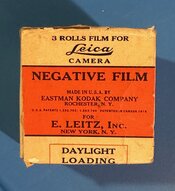
In regards to loading raw film Barack loaded his camera under red safelight since the film was not panchromatic. By the time the Leica was commercially available a special reloadable cassette was available for Leica owners to load in the darkroom and then daylight load the cassette in the camera when needed just as we do today. Those cassettes evolved into four distinct styles. Here is a box of three lengths of film sold by the Kodak Company for Leica cameras in the 1920s. Nearly identical to the film I’m making.
 

Attachments

  • IMG_6719.jpeg
    IMG_6719.jpeg
    747.3 KB · Views: 20
Moderator note: I've merged the contents of 3 threads together which all reported on the same project. This is to keep everything in one place, which towards the future ensures that materials are easier to find - having several parallel threads tends to result in difficulty locating that one post you remember somewhere along the road...

I am so sorry. I don’t come on this forum very often and am usually confused as to where my content should go. I put it in two places that seemed to be for people who might enjoy the content. In the future where do you think I should post it? Pretty sure I’m the only one making 35 mm film.

Maybe I’m not replying properly. My response don’t seem to end up under the messages. Maybe we should delete the duplicates …
 
Last edited:
I’ve been following your project on Facebook, and am fascinated by it. Incredible work. Are there any plans beyond the demo in Wetzlar?

Well, that was a major target for me. I will step up the speed and make it orthochromatic after our June deadline. I also want to slit to other sizes to allow us to try in other rare cameras like our 1889 string set Kodak. We already made the double gelatin layer stripping film (called American Film) for that last year.
 
I am so sorry. I don’t come on this forum very often and am usually confused as to where my content should go. I put it in two places that seemed to be for people who might enjoy the content. In the future where do you think I should post it? Pretty sure I’m the only one making 35 mm film.

Maybe I’m not replying properly. My response don’t seem to end up under the messages. Maybe we should delete the duplicates …

No worries at all! Your posts are really very welcome indeed. All three of the places you posted in were relevant; we ended up leaving the one in the emulsion-making subforum because I felt that this was the most defining characteristic of your project. Sometimes a post fits well in multiple places.
Your replies come through A-OK. Keep in mind that on this forum, posts are listed in chronological order, as opposed to the hierarchical tree view that's used in some other places.
You're doing great!
 
Many of you may know that in the past year I have been working on making the 35 mm cine film that was available to Oscar Barnack when he invented the Leica camera. Last year was the centennial of the announcement of the Leica and while I didn’t quite make that, my wife and I will be going to Wetzlar Germany this June (2026) to demonstrate the film we make, formula MO-1925. Along the way we were also made custodians of an extremely rare roll fo film shot by Barnack in 1914 for our research. We’ll be presenting that roll to the Leica Museum when we’re there in June.

Here is a nice comparison of a frame from the Barnack 1914 roll … and a frame taken last week from a batch of film I made. Note too that the Barnack film was made by Kodak here in Rochester. We were gifted the vintage Bell & Howell perforator which has the same B&H shaped holes.

Apologies, as this is unrelated to the actual creation of the film--the frame you shared that Oscar Barnack shot is incredible. Have you thought about uploading all of the images from that roll to Flickr or elsewhere for hobby historians to enjoy?

- Bill
 
I used to demonstrate making nitrate film base when I worked at George Eastman Museum. It is very expensive and difficult to do by hand for long sheets. For this project the emulsion is more important than the base so I am using subbed acetate provided to me by both the Eastman Kodak and Ilford Co research labs. It is 5” wide and perfect for my coating machine.

In regards to loading raw film Barack loaded his camera under red safelight since the film was not panchromatic. By the time the Leica was commercially available a special reloadable cassette was available for Leica owners to load in the darkroom and then daylight load the cassette in the camera when needed just as we do today. Those cassettes evolved into four distinct styles. Here is a box of three lengths of film sold by the Kodak Company for Leica cameras in the 1920s. Nearly identical to the film I’m making.

Excellent!
 
Apologies, as this is unrelated to the actual creation of the film--the frame you shared that Oscar Barnack shot is incredible. Have you thought about uploading all of the images from that roll to Flickr or elsewhere for hobby historians to enjoy?

- Bill

We are actually going to present the roll to the Leica Museum in June when we are there to demonstrate our film. I will document the frames while I still have possession of the roll though all I have is my iPhone at the moment. Will also make some prints using our 1926 Leitz enlarger.
 
I will document the frames while I still have possession of the roll though all I have is my iPhone at the moment. Will also make some prints using our 1926 Leitz enlarger.

Awesome, thank you so much. Even just pictures of the frames on the light table are more than we had before. It's really neat to see a group of kids with muetzen of various ranks/styles, in a non-costume/dress-up context.

- Bill
 
For a year now I’ve been working on a special project; making the same type 35 mm cine film that was used by Oscar Barnack for his prototype Leica camera.

This is awesome! Can we know the developer used by you to develop your film? Is it Leitz two bath developer by any chance? :smile:
 
Found a nice article that describes the project in good detail:

 
Photrio.com contains affiliate links to products. We may receive a commission for purchases made through these links.
To read our full affiliate disclosure statement please click Here.

PHOTRIO PARTNERS EQUALLY FUNDING OUR COMMUNITY:


Ilford ADOX Freestyle Photographic Stearman Press Weldon Color Lab Blue Moon Camera & Machine
Top Bottom