
• Welcome to Photrio!
    Registration is fast and free. Join today to unlock search, see fewer ads, and access all forum features.
    Click here to sign up

High contrast fine grain 35mm film?

Forum statistics

Threads
201,613
Messages
2,827,203
Members
100,850
Latest member
timpanic
Recent bookmarks
0

Alan Johnson

Subscriber
Allowing Ads
Joined
Nov 16, 2004
Messages
3,369
Some use acutance (1) to refer to the slope of the density/distance line at a knife edge.
Others use acutance (2) to refer to apparent sharpness which is a combination of the above with edge effects, aka adjacency effects aka border and fringe effects.
T-Max has high acutance type (1), but shows little adjacency effect.
Kentmere 100 is the other way round.
See around p214 here:
 

BHuij

Member
Allowing Ads
Joined
Oct 12, 2016
Messages
960
Location
Utah
Format
Multi Format
I don't find I have trouble getting the contrast I want even with HP5+ developed normally, cloudy day or no. Just print at Grade 3 or 4 if needed.

But if I had to pick a single 35mm film that has fine grain and can give you high contrast on an overcast day, it would probably be Delta 100.
 

Nicholas Lindan

Advertiser
Advertiser
Joined
Sep 2, 2006
Messages
4,312
Location
Cleveland, Ohio
Format
Multi Format
In my experience, the reason that TMX may sometimes appear to have somewhat lower apparent sharpness isn't due to a lack of acutance, but rather a lack of visible grain.

Agreed. I once toured Glacier National Park taking shots with 4x5 Tech Pan. The result looked horrid - there was no grain to catch my eye, instead I saw the lens' aberrations. And an Apo-Sironar W doesn't have much in the way of aberrations.

I use home-brew Microdol 1:3 for TMX - the grain is at Tech Pan levels, though the prints lack Tech Pan's creaminess. Kodak seems to have done some magic to TMX as I no longer get dichroic fog when using 'X-less' Microdol.

There is debate about using Microdol at 1:3 - I find there is no increase in grain with dilution, strangely the grain is crisper at FS and a bit mushy and less apparent at 1:3. However, there is no speed loss at 1:3, unlike the 1 stop loss at FS.
 

koraks

Moderator
Moderator
Joined
Nov 29, 2018
Messages
26,588
Location
Europe
Format
Multi Format
See around p214 here:

Thanks for posting that reference; unfortunately it requires an account to be able to read that page. In the hopes of not asking too much, but would you mind making a screencap from the bit where these two definitions appear and post it here? I think it'd be useful to have this source (including the reference) on here somewhere. Thanks!
 

DREW WILEY

Member
Allowing Ads
Joined
Jul 14, 2011
Messages
14,831
Format
8x10 Format
Part of the dilemma is that you need to look at the question two ways - are you starting with a high contrast scene and wanting it to look that way, or are you trying to dramatically boost the contrast instead? If you want to have the ability to do both, you want a film with a long dynamic range to being with, yet also capable of boosted development without skewing the film curve over the shoulder and losing highlight texture. Good choices in that respect would be TMax100 and Delta 100. Pan F would be a horrible choice because it has an exaggerated S-curve with a very limited dynamic range.

If you want dramatic blacks rather than soggy mud down in the shadows, you want a film with a rather long straight line which you can lop off crispy through underexpose if desired, while overdeveloping the rest. Films with relatively long toe sections, like HP5 or especially Pan F, don't have that characteristic, although even those can be bullied to an extent during printing at least.

The ultra-fine grained slow speed films tend to go either "soot and chalk" (devoid of both shadow and upper highlight gradation), like disappointing ole Tech Pan, or else muddy instead of bold. The sole exception I can think of is Efke 25, which is now discontinued.
 

gealto2

Member
Joined
Dec 7, 2025
Messages
77
Location
Peoria, IL, USA
Format
Multi Format
Mackie lines do not define acutance or the lack thereof.
Acutance is the impression of sharpness caused by adjacency effects and with chemical sharpening will give mackie lines to some degree. XTOL does give modest sharpness when used 1:3 or more, like most solvent developers.
If you want your work to look like oversharpened iPhone pics, that’s your prerogative.
You've got this turned around. Digital sharpening, which I would call AS (artificial sharpening) is an attempt to mimick chemical sharpening that occurs with film developed in non-solvent developers. So iphone photographers are trying to make their work look like film photographs processed for acutance. Just as with intelligence, sharpening can be artificial or real but not both at the same time. I prefer real to artificial.
 

Pieter12

Member
Allowing Ads
Joined
Aug 20, 2017
Messages
8,132
Location
Magrathean's computer
Format
Super8
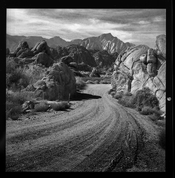
I haven't seen Agfa Cora mentioned.

Alabama Hills #6 Agfa Cora copy.jpg
 

MattKing

Moderator
Moderator
Allowing Ads
Joined
Apr 24, 2005
Messages
55,003
Location
Delta, BC Canada
Format
Medium Format
I see very weak to nonexistant mackie lines.

So there is no artificially added subjectively apparent sharpness.
Mackie lines don't contribute acutance, they merely enhance the subjective appearance of sharpness that acutance also supports.
Adding extra lines doesn't increase the contrast of an imaged edge - the nature of acutance - it merely (artificially) adds to its visibility.
 

MattKing

Moderator
Moderator
Allowing Ads
Joined
Apr 24, 2005
Messages
55,003
Location
Delta, BC Canada
Format
Medium Format
Acutance is the impression of sharpness caused by adjacency effects and with chemical sharpening will give mackie lines to some degree. XTOL does give modest sharpness when used 1:3 or more, like most solvent developers.

That is a very unusual definition for acutance, not one consistent with my understanding of it.
 

Alan Johnson

Subscriber
Allowing Ads
Joined
Nov 16, 2004
Messages
3,369
Thanks for posting that reference; unfortunately it requires an account to be able to read that page. In the hopes of not asking too much, but would you mind making a screencap from the bit where these two definitions appear and post it here? I think it'd be useful to have this source (including the reference) on here somewhere. Thanks!

R. Henry in the book linked in post 26 does explain the difference in the two uses of the word acutance but it takes him two pages. He suggested that the definition of the one that includes both native acutance and adjacency effects could be given a separate name but this never happened. Hard to condense his explanation I am afraid.
 

Paul Howell

Subscriber
Allowing Ads
Joined
Dec 23, 2004
Messages
10,077
Location
Scottsdale Az
Format
Multi Format
I think Barry Thornton does a good of outlying the factors to high acutance and why fine grain works against acutance. My 1964 edition of The Encyclopedia of Photography has a section explaining how film manufacturers did measure acutance using a micro densitomrer and the edge of a razor blade to work out the ratio of light to dark measurements. Seems that at the time although measured, few if any producers included the data in there data sheets. I don't recall ever seeing it included in a data sheet.

As OP wants higher contrast with small to moderate grain the key will be a match of a fine grain film and moderate to high contrast developer.
 

julio1fer

Member
Allowing Ads
Joined
Jul 5, 2008
Messages
29
Location
Montevideo,
Format
35mm
From the combinations that I have tried, TMX or Pan F, in Beutler developer, will deliver what the OP wanted. An as a contrarian idea, Ilford XP2 processed in C-41. Contrast is, however, a function of exposure, development and printing or scanning, more than film used.
 

Milpool

Member
Allowing Ads
Joined
Jul 9, 2023
Messages
956
Location
n/a
Format
4x5 Format
Regarding Richard Henry’s work referenced above, he used the definition/ calculation of acutance as put forth by the original researchers (Perrin, Wolfe, Jones, Higgins etc.).

Acutance was defined to be the average gradient across a sharp edge imaged on a photographic material. Edge effects are not considered in the measurement.

Work on edge effects came later and there is acknowledgement that edge effects should most likely also be accounted for in a more complete objective correlate to the overall impression of sharpness, but there is no definition of acutance that incorporates or accounts for the magnitude of edge effects.

Just to be clear, Henry did not use TMX in his testing (his work pre-dates TMax by a few years).
 

GregY

Member
Allowing Ads
Joined
Apr 12, 2005
Messages
3,950
Location
Alberta
Format
Large Format
Looking back at the image in post #1 there's nothing there that couldn't be achieved with most standard films & printing controls.....
 

Paul Howell

Subscriber
Allowing Ads
Joined
Dec 23, 2004
Messages
10,077
Location
Scottsdale Az
Format
Multi Format
Tmax 100 matched to DDX, Tmax developer, or Rodinal, the trick to increase contrast without blocking highlights, if printed by enlarger increase VC contrast by one to one and half grade, or split contrast grade, which might work the best. If scanned, don't see any reason to change current film and developer as of course contrast can be adjusted in post.
 

Paul Howell

Subscriber
Allowing Ads
Joined
Dec 23, 2004
Messages
10,077
Location
Scottsdale Az
Format
Multi Format
In the landscape shot in the fog posted by OP a contrast filter will have little effect as there is no sky to speak of, contrast filter work by absorbing blue.
 
Photrio.com contains affiliate links to products. We may receive a commission for purchases made through these links.
To read our full affiliate disclosure statement please click Here.

PHOTRIO PARTNERS EQUALLY FUNDING OUR COMMUNITY:


Ilford ADOX Freestyle Photographic Stearman Press Weldon Color Lab Blue Moon Camera & Machine
Top Bottom