
• Welcome to Photrio!
    Registration is fast and free. Join today to unlock search, see fewer ads, and access all forum features.
    Click here to sign up

Help with PVA chiba over cyanotype

Recent Classifieds

Forum statistics

Threads
201,768
Messages
2,829,823
Members
100,936
Latest member
rdbirt
Recent bookmarks
0

imgprojts

Member
Allowing Ads
Joined
May 24, 2024
Messages
182
Location
Seattle WA
Format
Multi Format
Has anyone noticed how the cyanotype layer is still active or photosensitive after the cyanotype is made?

Maybe thats not the question, im sure its noticeable, that's why people recommend the print to be stored in a dark room to recover it. Or maybe I misread that.

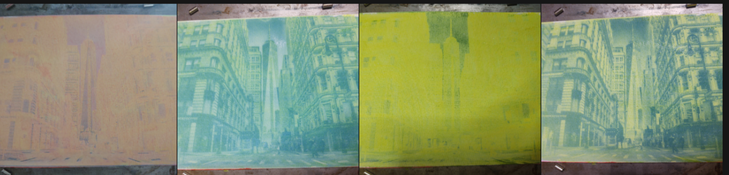
After watching some Analogue Andy videos on gum over cyanotype I thought to give it a try with PVA chiba. It works but has a weird side effect and I don't know to to expand the dynamic range. Each time you expose the new layer over the cyanotype, the cyanotype layer bleaches out and then comes back during development. Its both neat and annoying. But I didn't see that happening with Andy's gum prints. The dynamic range is too small using mica powder as pigment. I use mica because its what I have but also it florecess under UV for easy manual registration.

You can see the images below starting right to left after I applied the yellow layer, exposed it, then applied magenta and exposed that. I got very little to zero experience. I'm trying the calibrate the process at the same time. At this particular size and full aperture a square grid of linearly increasing gray shades produces a generally solid yellow that only shows shades from 0 to square 25. I'll post those images tomorrow.

Questions: what, why? do I add more pigment to block the light? Less pigment to increase dynamic range? Do I close down the aperture to reduce exposure? Decrease exposure time? Increase sensitizer amount to prevent light passing layers?

As a reference, the light source is a projected image at 850nm that can take Mike Ware's New Cyanotype to prussian white in 5 minutes with added citric acid, 15 minutes without.

I need to stick to making grid exposures until I can figureout how to extend the dynamic range. Once this system can make an acceptable image, I want to summarize it.
 

Attachments

  • Screenshot_20260115-083432.png
    Screenshot_20260115-083432.png
    590.9 KB · Views: 10

koraks

Moderator
Moderator
Joined
Nov 29, 2018
Messages
26,807
Location
Europe
Format
Multi Format
I'm not sure if your question is about the cyanotype image or the pigment-in-PVA layers that you're placing on top. I assume you're trying to solve the pigment part, right? What happens if you test that part separately; do you get better contrast?

At this particular size and full aperture a square grid of linearly increasing gray shades produces a generally solid yellow that only shows shades from 0 to square 25.
I don't know what kind of test chart you're using; it might help to see an example.

Generally with pigment processes: more pigment = higher density = higher contrast, but evidently exposure does something, too. Then there's the issue of potential self-masking depending on the sensitizer you use. In your case that would be ferric ammonium citrate (FAC), yes?

Must be a typo; 350nm? Or 450nm? Neither sounds very plausible; IIRC you're working at 385nm, yes?
 
OP
OP

imgprojts

Member
Allowing Ads
Joined
May 24, 2024
Messages
182
Location
Seattle WA
Format
Multi Format
Oops on the wavelength, my dislexia. Its 385nm. I am using Ferric Ammomium oxalate, but I have Ferric Ammonium Citrate available to try/experiment with. I'm going to try a different pigment, I ordered Magenta (Quinacridone rose 266) and Lemon Yellow from "Van Gogh Watercolor Paint". I'll post the chart when I get home.
 

koraks

Moderator
Moderator
Joined
Nov 29, 2018
Messages
26,807
Location
Europe
Format
Multi Format
Magenta (Quinacridone rose 266) and Lemon Yellow from "Van Gogh Watercolor Paint"
The quinacridone pigments are popular, and with reason; they generally work well. For magenta (when I use it, which is rare) I generally also use a quinacridone; PR122.
For yellow, the popular choice at this point I think are the benizimidazolones; e.g. benzimidazolone yellow medium PY154. I think these are also used in some of the Van Gogh (=Talens IIRC) paints.

(If those pigment names don't trigger your dyslexia, I don't know what will, LOL!)
 

FotoD

Member
Joined
Dec 15, 2020
Messages
428
Location
EU
Format
Analog
Each time you expose the new layer over the cyanotype, the cyanotype layer bleaches out and then comes back during development. Its both neat and annoying.

Do you mean it looks like the right image after exposure, and like the left image after developing it?

SmartSelect_20260115_202700_Firefox.jpg


That's the way it looks when I use fish glue. The pigment layer becomes opaque with exposure and hides what's below until developed / cleared.

Maybe that's what's happening with your process too?

Sorry if I misunderstood your question.
 
OP
OP

imgprojts

Member
Allowing Ads
Joined
May 24, 2024
Messages
182
Location
Seattle WA
Format
Multi Format
Do you mean it looks like the right image after exposure, and like the left image after developing it?

View attachment 415800

That's the way it looks when I use fish glue. The pigment layer becomes opaque with exposure and hides what's below until developed / cleared.

Maybe that's what's happening with your process too?

Sorry if I misunderstood your question.

Yes you understood it exactly. But I was 100% sure that at least in my situation, the uv is driving the cyanotype to prussian white and then returning. This is because it has the same reaction to hydrogen peroxide spray (thats how I apply it because im cheap) as overexposed cyanotype.

But maybe it reacts to hydrogen peroxide but only because the oxalate was reduced to ferrous from ferric and that does something to the coating? I think I can test for this by scraping away an exposed image to look for the blue pigment underneath. But this is good to know, it happens too using fish glue!
 

FotoD

Member
Joined
Dec 15, 2020
Messages
428
Location
EU
Format
Analog
Ok!

I will check next time I print with fish glue over cyanotype. Maybe there is some bleaching / redeveloping going on there too.

Let us know what you you figure out.
 
OP
OP

imgprojts

Member
Allowing Ads
Joined
May 24, 2024
Messages
182
Location
Seattle WA
Format
Multi Format
OK here is the grid I am using. I made this from a python script attached here.
numbered_grid_with_gaps.png
 

Attachments

  • numbered_grid_maker.zip
    1.3 KB · Views: 0
OP
OP

imgprojts

Member
Allowing Ads
Joined
May 24, 2024
Messages
182
Location
Seattle WA
Format
Multi Format
Here is the first grid I made in yellow:
1768539021451.png

Which when viewed with a UV blue filter looks like below. I literally just learned this on purpose a few minutes ago. Not just any filter, ZWB2. In person it makes the yellow color look almost black.

1768539149359.png
 
OP
OP

imgprojts

Member
Allowing Ads
Joined
May 24, 2024
Messages
182
Location
Seattle WA
Format
Multi Format
I made some notes on these:
1768539513472.png

1768539592099.png

It feel like the time variable has done the most change. I just got a tiny scale today to be able to measure my proportions more accurately. I hope to run more experiments like this to understand the system better. I also received the yellow pigment to try.
 
OP
OP

imgprojts

Member
Allowing Ads
Joined
May 24, 2024
Messages
182
Location
Seattle WA
Format
Multi Format
alright, point #4 for Lemon yellow using the blue filter with the new pigment. it certainly seems to have better sharpness:
1768543933025.png

1768544000640.png

Since this pigment is not fluorescent it looks a little dimmer int he photo but this time I can read all the numbers up to 99 which is a big improvement. I've reduced the exposure and the sensitizer. I also used a scale with sensitivity 0.001g to measure all the values. unfortunately the dynamic range is still very low/unchanged.
 
Photrio.com contains affiliate links to products. We may receive a commission for purchases made through these links.
To read our full affiliate disclosure statement please click Here.

PHOTRIO PARTNERS EQUALLY FUNDING OUR COMMUNITY:


Ilford ADOX Freestyle Photographic Stearman Press Weldon Color Lab Blue Moon Camera & Machine
Top Bottom
