
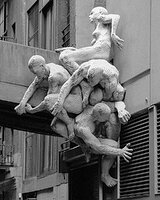


In that HCB was not working alone in some cases.
In this case he was being assisted to find certain locations.
Very common for photojournalists to have infrastructure in place....contacts in foreign places
Last edited:
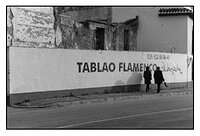
In that HCB was not working alone in some cases.
In this case he was being assisted to find certain locations.
Very common for photojournalists to have infrastructure in place....

That’s not the issue under discussion. The issue is rather whether those with an art degree (or better credentials), but no experience as photographers, have anything valid to say.
yes, but he wasn't his assistant. An assistant implies he works like a fashion photographer with lots of people. Also the photograph is not that good.


Something's wrong if you have to check with an art critic to determine whether you should like a picture or not.
art should be viewed as a "presentation," rather than a "representation" that requires further explanation and explication. This comes up in the context of HCB as a counter to the idea that his pictures require a critique of their "content."

Anytime.
Right you are. I did mean "through photography," but should have added it for clarity's sake.
I agree. When Stephen Shore put a photo of his breakfast in Uncommon Places, he was making a statement—or rather, statements—about photography, about the use and meaning of photography in everyday life, about looking, about photobooks, about photography as art vs photography as witness to everyday life, etc. It was a pretty radical statement back then. Not that much because nobody took photos of their breakfast in those days, but because those photos of their breakfast were only seen by a very small number of people—poor family and friends who had to sit through the slide show in the living room—not by hundreds or thousands or millions of people, as is the case today.
So it's not only that you are now looking at yourself looking at the world, it's also that you're asking—"expecting" might be a better word, and a sadder reality—hundreds of people to look at yourself looking at the world.
It's not only the use and meaning of photography that has changed, but, even more fundamentally, the view of the self within the world.
But that's for a philosophy thread.
P.S. To keep this within a Cartier-Bresson-themed thread, lets call this type of photo The Uneaten Moment.

Good points. Photography strides the gap between art and journalism (documentation), but the aesthetic impact is dependent on that flash of recognition, as described by Walter Benjamin, and perhaps Oscar Wilde. Anyway, HCB is no de Kooning.It's noteworthy that photography is probably more than any other form of art one that regularly defies being pure presentation (in that sense). Most photography not only seems to be but demands us to think of it as a photo of something - that something is not itself the photo. And photography can be both art and documentary at the same time. Some painting is that way, also. A painting of Queen Elizabeth is instantly recognizable as a likeness and as a work of art. A painting can depict a known event or moment in history and also be seen as a work of art. There is nothing contradictory about a photo being both a representation and a presentation at the same time. While it's sensible to restrict criticism of abstract art as a presentation (and not criticize its failure to represent anything), it can be difficult to approach a photo obviously of something and not address that in your critical understanding.
Shore’s work is like literally a billion times better than HCB’s.
Only billions? Why not trillions, like the US economy and Elon Musk's paycheck.

Shore’s work is like literally a billion times better than HCB’s.
I don't think it makes sense to say which photographer is better or not. Important is which one resonates for each one of us and which one we hold a very special place for them in our "Imaginary Museum" that we build with the works of art we love and admire.
For example in my own "imaginary museum" HCB has a prominent place and Stephen Shore is not there at all
Obviously. As long as your museum is filled with what honestly "resonates" with you vs what you have been told should be there.
aesthetic impact is dependent on that flash of recognition
the aesthetic impact is dependent on that flash of recognition
It's an experience, relying on many factors that seem to coalesce. It might be something like Roland Barthes" concept of "Punctum," or a psychic event that profoundly resonates for the viewer.I genuinely don’t understand what is meant by this. Could you explain it further? What is one recognising, if not the scene photographed?
It's an experience, relying on many factors that seem to coalesce. It might be something like Roland Barthes" concept of "Punctum," or a psychic event that profoundly resonates for the viewer.
It is possible that not everyone is capable of this experience. It's sort of like, "I'll believe it when I see it," and I'm sure it varies from person to person. For a non-photographic example in my case, one look at the de Kooning in the Frick Museum in NYC "knocks my socks off." Put another way, "it's a painting to die for."
While that's a nice sentiment, the reality is there will almost always be an expectation that is met or thwarted by first viewing an artwork - and that expectation is generally prior knowledge of the artist, the content, the genre, the style, the significance, etc. You will look for something when you are given a photo by Cartier-Bresson - and in a way you will not look for something in a random photo from the Photrio gallery (or some random person on Instagram).
At the start of the process, the artist (HCB) recognises the picture he wants to capture with “yes!…yes!…yes!” (as he put it).
Most people look at an image for about 2 or 3 seconds. However, when you look at an image by HCB you need to look at it for at least a minute to appreciate its artistic quality.
| Photrio.com contains affiliate links to products. We may receive a commission for purchases made through these links. To read our full affiliate disclosure statement please click Here. |
PHOTRIO PARTNERS EQUALLY FUNDING OUR COMMUNITY:  |


