
-
Welcome to Photrio!Registration is fast and free. Join today to unlock search, see fewer ads, and access all forum features.Click here to sign up
You are using an out of date browser. It may not display this or other websites correctly.
You should upgrade or use an alternative browser.
You should upgrade or use an alternative browser.
HCB Appreciation
-
A
- Thread starter cliveh
- Start date

Recent Classifieds
-
For Sale Jobo CPE 2 Plus with Lift, - Tanks, Reels, accessories
- Started by nbagno
-
For Sale Multiple Large Format Lenses for sale
- Started by nbagno
-
For Sale Canon 2X EF Telextender
- Started by davela
-
For Sale Olympus OM 24mm F2.8 Lens Hood
- Started by davela
-
For Sale Original Rolleiflex SL35, SL35M, and Contax G2 Manuals
- Started by davela
Forum statistics
To put it in another way: how is this photograph more about Henri Cartier-Bresson than it is about Black people celebrating Easter in Harlem?
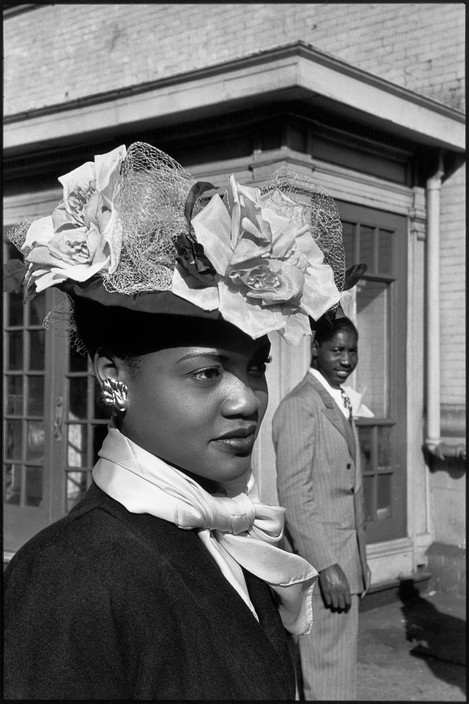
And by the way this photo says nothing about Black people celebrating Easter in Harlem.
It could be about a young girl contemplating before getting married to the guy looking at her, or about a normal Sunday morning before going to church. The reality of a photograph is a fake reality. And I am not sure it is meant to document the Easter in Harlem. In my opinion it speaks about nothing but also about a lot more. I am not sure if I am understood but I have a feeling that that is what HCB was drawn too. And he gave a context of the photo as vague as possible, letting the photo speak for itself.
Indeed, my liking of Bresson is because he embodies my own values of composition and timing, but photography has many values and different people will rate different photographers after their own values.
Yes but Clive the problem is that many people rate photographers on values that have nothing to do with photography e.g. cultural significance, overstructured concept to be communicated, or personal background of the artist.|
I very much respect your opinion because you always approach photographers on purely photographic terms
OP
OP

cliveh
Subscriber
- Joined
- Oct 9, 2010
- Messages
- 8,002
- Format
- 35mm RF
Yes but Clive the problem is that many people rate photographers on values that have nothing to do with photography e.g. cultural significance, overstructured concept to be communicated, or personal background of the artist.|
I very much respect your opinion because you always approach photographers on purely photographic terms
I would also like to think that the general public appreciate asthetic values, otherwise why have art galleries.
I would also like to think that the general public appreciate asthetic values, otherwise why have art galleries.
You are very romantic

OP
OP
cliveh
Subscriber
- Joined
- Oct 9, 2010
- Messages
- 8,002
- Format
- 35mm RF
You are very romantic
Thanks.

values that have nothing to do with photography e.g. cultural significance
Cultural significance most definitely has a great amount to do with photography. It is why you ever end up seeing these photos in the first place: they are meaningful, they are significant - even if only within the appreciation of photography itself (which does constitute something like a culture).

Alex Benjamin
Subscriber
And by the way this photo says nothing about Black people celebrating Easter in Harlem.... And I am not sure it is meant to document the Easter in Harlem... And he gave a context of the photo as vague as possible, letting the photo speak for itself.
Title of the photo is literally Easter Sunday in Harlem, New York.
Sometimes a cigar is just a cigar.
Henri Cartier-Bresson. Easter Sunday in Harlem, New York. 1947 | MoMA https://share.google/MsyMKDC1vMEc8joGG
Title of the photo is literally Easter Sunday in Harlem, New York.
Sometimes a cigar is just a cigar.
Henri Cartier-Bresson. Easter Sunday in Harlem, New York. 1947 | MoMA https://share.google/MsyMKDC1vMEc8joGG
Yes but the title is not there to "explain" the photo. We, as viewers do not really need it, right?
the title is not there to "explain" the photo. We, as viewers do not really need it, right?
That's debatable. A title given to the photo by the photographer can contextualize the subject of the photo and make it more easily understood. There is no reason to think that the artistic merit of a photograph is not entangled with a referent. A photo is normally understood as "a photo of _____"
That's debatable. A title given to the photo by the photographer can contextualize the subject of the photo and make it more easily understood. There is no reason to think that the artistic merit of a photograph is not entangled with a referent. A photo is normally understood as "a photo of _____"
Hmm.. I think we disagree there. I will give you an example:
Look at the photo below: If I am not mistaken is called "Funeral of a Kabuki Actor".
If you don't know anything about it does it change anything?
And by giving the context do you really help the photograph?
In my opinion not, you actually do the opposite, spoil the "magic".
Attachments


It gives me context and thus helps me to interpret the photograph. In this case it seems to be a literal caption for the action that's photographed. In the realm of arts, titles can sometimes be more indirect references to context, concept or philosophical underpinnings. Thus, the utility of a title can range from giving direct clues to aid the viewer in their interpretation, to a linguistic extension of the artwork itself that serves to enrich it (cf. Courbet's "l'Origine du monde"). As such, the title can sometimes be an integral part of the work as such. It's somewhat similar to how some photographs being inherently linked to the physical frame or even space they're presented in. A title can therefore range in its relevance from being a convenient addition to an essential part of the presentation.If you don't know anything about it does it change anything?
It gives me context and thus helps me to interpret the photograph. In this case it seems to be a literal caption for the action that's photographed. In the realm of arts, titles can sometimes be more indirect references to context, concept or philosophical underpinnings. Thus, the utility of a title can range from giving direct clues to aid the viewer in their interpretation, to a linguistic extension of the artwork itself that serves to enrich it (cf. Courbet's "l'Origine du monde"). As such, the title can sometimes be an integral part of the work as such. It's somewhat similar to how some photographs being inherently linked to the physical frame or even space they're presented in. A title can therefore range in its relevance from being a convenient addition to an essential part of the presentation.
OK I get your point but another question: Suppose you knew Japanese and you could read the sign in the photo do you think that would change your view on the photograph?
Alex Benjamin
Subscriber
Yes but the title is not there to "explain" the photo.
Who says the photo needs to be explained?
Photographs don't need to be explained. The need to be looked at.
Most often then not, a photo is about what you see, about what the photographer saw, about the viewer figuring out why the photographer found interesting enough what he saw to photograph it. Most often then not, a photo is about its surface. Most often then not, the only clue the photographer can give you is the title of the photograph, or of the book the photograph is part of. Sometimes, the surface is so obvious that the photographer will just give you a place as title.
In photography, the subject is transformed by it being made surface. To psychoanalyse it — "You're telling me you like to go swimming but what you really mean is you long for the time you were in your mother's womb" — is to go in the opposite direction the photograph is going.
That's what makes photography so interesting, fascinating, and terrifying. That it can be about the surface. That there is no hidden meaning, no "depth", no unconscious level of understanding.
Let me amend that. It's not even about the surface. It is surface. Just like a piece of music is sound through time, and all that that implies: it is form, it is tension, it is harmony, etc.
I remember having a conversation about this with a great concert pianist. What he said sort of went this way: "There nothing more superficial than 'depth'. 'Depth' is easy: we know what it sounds like, and you don't have anything to prove. There is no challenge, no risk in being 'deep'. But try to just do what Chopin wrote in his Fourth Ballade, trying to just understand that, the sound of it, how the beauty is just there, just in what he wrote and in the sound of it and how it unfolds through time, now that's difficult. And that's putting yourself at risk because it's easy to understand depth and give it meaning, but with sound you're always at risk of realizing you don't understand anything."
Who says the photo needs to be explained?
Photographs don't need to be explained. The need to be looked at.
Most often then not, a photo is about what you see, about what the photographer saw, about the viewer figuring out why the photographer found interesting enough what he saw to photograph it. Most often then not, a photo is about its surface. Most often then not, the only clue the photographer can give you is the title of the photograph, or of the book the photograph is part of. Sometimes, the surface is so obvious that the photographer will just give you a place as title.
In photography, the subject is transformed by it being made surface. To psychoanalyse it — "You're telling me you like to go swimming but what you really mean is you long for the time you were in your mother's womb" — is to go in the opposite direction the photograph is going.
That's what makes photography so interesting, fascinating, and terrifying. That it can be about the surface. That there is no hidden meaning, no "depth", no unconscious level of understanding.
Let me amend that. It's not even about the surface. It is surface. Just like a piece of music is sound through time, and all that that implies: it is form, it is tension, it is harmony, etc.
I remember having a conversation about this with a great concert pianist. What he said sort of went this way: "There nothing more superficial than 'depth'. 'Depth' is easy: we know what it sounds like, and you don't have anything to prove. There is no challenge, no risk in being 'deep'. But try to just do what Chopin wrote in his Fourth Ballade, trying to just understand that, the sound of it, how the beauty is just there, just in what he wrote and in the sound of it and how it unfolds through time, now that's difficult. And that's putting yourself at risk because it's easy to understand depth and give it meaning, but with sound you're always at risk of realizing you don't understand anything."
Beautifully said. Somehow I think we are trying to say the same things. A photo (and any work of art) resists explanation. It is as you say the surface of the reality yet sometimes something happens through a play of form, time, memories, tension, and light and the photo is carved in our memory. This usually cannot be explained and if it can usually we won't be able to even come close it.
I cannot agree more to that you say here: "That there is no hidden meaning, no "depth", no unconscious level of understanding."
What I was trying to say is that we don't really need an explanation to the photo. And sometimes explanation in my opinion can justify a photo. No a photo doesn't need to be justified by anything. It just needs to be looked at as you nicely said

Even people who try to sell their photography as Art don't expect their photography to be merely a form of artistic expression.
Photography is a lot more important, a lot more consequential, a lot more varied and a lot more fun than just those photos that show up in the Art world. And in particular, photography communicates.
Even the purely abstract photograph contains a lot more than Art.
Photographers who participate in the Art world also take photos of their kids' birthday parties too.
And when they do, sometimes they imbue those photographs with lots of Art, and sometimes they don't.
Photography is a lot more important, a lot more consequential, a lot more varied and a lot more fun than just those photos that show up in the Art world. And in particular, photography communicates.
Even the purely abstract photograph contains a lot more than Art.
Photographers who participate in the Art world also take photos of their kids' birthday parties too.
And when they do, sometimes they imbue those photographs with lots of Art, and sometimes they don't.
OP
OP
cliveh
Subscriber
- Joined
- Oct 9, 2010
- Messages
- 8,002
- Format
- 35mm RF
When I worked in education, I once recieved a booklet from a University photography art department that ran to about 36 pages and contained part of one photograph. To me photographic art is about visual representation, not mainly words. I don't want to be told what I'm seeing, as I can see for myself to judge its aesthetic value.
If you don't know anything about it does it change anything?
What you do know dictates your viewing. You can't unring a bell, as the expression goes. Everything is potentially relevant - but mainly relevant to your appreciation. Your knowledge has no influence on the photograph itself but it completely shapes your experience of it. One of the heaviest influences on how someone regards a photo is knowing who took it.
What you do know dictates your viewing. You can't unring a bell, as the expression goes. Everything is potentially relevant - but mainly relevant to your appreciation. Your knowledge has no influence on the photograph itself but it completely shapes your experience of it. One of the heaviest influences on how someone regards a photo is knowing who took it.
Which makes @Don_ih 's "Let's all Print the same negative" project even more interesting
.| Photrio.com contains affiliate links to products. We may receive a commission for purchases made through these links. To read our full affiliate disclosure statement please click Here. |
PHOTRIO PARTNERS EQUALLY FUNDING OUR COMMUNITY:  |