• Welcome to Photrio!
    Registration is fast and free. Join today to unlock search, see fewer ads, and access all forum features.
    Click here to sign up

HCB Appreciation

Recent Classifieds

Forum statistics

Threads
201,661
Messages
2,828,126
Members
100,876
Latest member
Coconut_Head
Recent bookmarks
0

Alan Edward Klein

Member
Allowing Ads
Joined
Aug 29, 2017
Messages
10,138
Location
New Jersey formerly NYC
Format
Multi Format
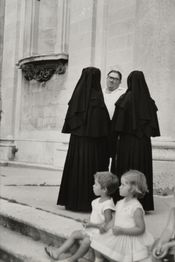
Agreed. He has also cut off the feet of the girl on the right. It was surely anticipation and quick reaction, rather than millimetre composition, that made this one a keeper.

There's more latitude in a street photo for quirks and composition "errors" than in, let's say, a landscape shot. With a street, it's supposed to tell a story or make a point. Maybe tell a joke. Landscapes are for beauty, so composition, beauty, and harmony count more. We're looking for awe.
 

Alan Edward Klein

Member
Allowing Ads
Joined
Aug 29, 2017
Messages
10,138
Location
New Jersey formerly NYC
Format
Multi Format
I will try to "read" or "evaluate" this photo (please understand very personal evaluation following):
This photo is interesting. The two women tell a story. Especially the woman with the suitcase that looks at something which we don't know what it is and seems skeptical. The other woman's face is also perfect, it wouldn't be the same if she looked at the first woman. Instead she is looking at something else.
The photos is already pretty interesting to me. And now comes the part which I like to call "HCB showing off".
The two soldiers looking at the women. Totally spoil the mystery. Throws some self-evident associations to the photo (the contrast between the two men and the two women) all these kind of "tricks" that sometimes HCB resorts to. Totally unnecessary in my opinion.
I would personally like the photo more without the soldiers.
I know that the audience will like the photo more like that as it offers some easy "reading" in the form: "Aha two nice women and two soldiers, oh look how they look at them I guess they miss women in the camp, now I get it".
But the power of the photo imo resists easy interpretations and always flirt with the realm of the abstract

P.S. Please be kind in your replies as this is totally personal and very arbitrary evaluation full of leaps and possible prejudices. Just an opinion.

All the possibilities you mention can work. Who says there is only one right approach or meaning? Some soldiers like blondes, others brunettes. :smile:
 

Alan Edward Klein

Member
Allowing Ads
Joined
Aug 29, 2017
Messages
10,138
Location
New Jersey formerly NYC
Format
Multi Format
Ask Life Magazine

View attachment 409838

They clearly thought it was worthy of being on the cover. That you don't like the photo is a-ok, though.

Life Magazine was clearly telling a joke as well and being lighthearted. Check the caption, " Military Appraisal at Moscow Trolley Stop" Today, that comment would raise many objections.
 

nikos79

Member
Allowing Ads
Joined
Mar 9, 2025
Messages
1,047
Location
Lausanne
Format
35mm
There is a reason I referred to it as a "trick". HCB had the obsession of photographing these kind of dualities that to me is simply a funny image or a joke and nothing more.
For me it was his "geometric" way of creating the so much interesting elements of contrast and dialogue in the photography, alas too apparent (at least for my taste)
 

Attachments

  • Screenshot 2025-10-22 at 15.41.10.png
    Screenshot 2025-10-22 at 15.41.10.png
    387.5 KB · Views: 41
  • Screenshot 2025-10-22 at 15.44.31.png
    Screenshot 2025-10-22 at 15.44.31.png
    500.6 KB · Views: 42
  • Screenshot 2025-10-22 at 15.45.44.png
    Screenshot 2025-10-22 at 15.45.44.png
    306.2 KB · Views: 47

gary mulder

Member
Allowing Ads
Joined
Nov 29, 2006
Messages
343
Format
4x5 Format
There is a reason I referred to it as a "trick". HCB had the obsession of photographing these kind of dualities that to me is simply a funny image or a joke and nothing more.
For me it was his "geometric" way of creating the so much interesting elements of contrast and dialogue in the photography, alas too apparent (at least for my taste)

There is nothing that requires you to like the photos. So what is the point you are trying to make?
 

nikos79

Member
Allowing Ads
Joined
Mar 9, 2025
Messages
1,047
Location
Lausanne
Format
35mm
Except that you don't like the photos, no.

But it is not about liking or not liking. Independent of my taste I want to make a point that HCB as all photographers has some weaker photos which don't deserve de facto appraisal just because the person who produced them happened to be called HCB, Eugene Atget, or Bill Brandt
 

nikos79

Member
Allowing Ads
Joined
Mar 9, 2025
Messages
1,047
Location
Lausanne
Format
35mm
Is there something wrong with having a smattering of humour in your portfolio/personality?

No, not at all. But I prefer the hidden humour (see Garry Winogrand for example or Charles Traub) than the very evident one

P.S. BTW from all the inteviews I have seen HCB was a very rigid character with a very calculated sense of humour
 

snusmumriken

Subscriber
Allowing Ads
Joined
Jul 22, 2021
Messages
2,760
Location
Salisbury, UK
Format
35mm
No, not at all. But I prefer the hidden humour (see Garry Winogrand for example or Charles Traub) than the very evident one

P.S. BTW from all the inteviews I have seen HCB was a very rigid character with a very calculated sense of humour
I think I see what you mean, but you are very unforgiving, and once again you are comparing photographers as though judging a competition. Humour changes through the decades, in literature and on the street, as well as in photography. HCB was one of the first to make any kind of visual joke with a camera. Joking with a camera has evolved hugely since then (not always in admirable ways), and those early ones can seem only mildly amusing with today's eyes. Still fun, though.
 

Alex Benjamin

Subscriber
Allowing Ads
Joined
Aug 8, 2018
Messages
2,940
Location
Montreal
Format
Multi Format
all photographers has some weaker photos which don't deserve de facto appraisal

Who says photography needs a value system? Who says photographs need to be evaluated, or appraised? Why should that value system be determined by you, or me, or Larry, Curly and Moe?

Appraising photos and photogaphers — essentially ranking them — has nothing to do with criticism. Cheap psychology would state that it has often more to do with the ego, or insecurities, of the person insisting on the value of their own judgement. Thank goodness there aren't no cheap psychologists here 🤓.
 
  • Milpool
  • Deleted
  • Reason: Ok

nikos79

Member
Allowing Ads
Joined
Mar 9, 2025
Messages
1,047
Location
Lausanne
Format
35mm
Who says photography needs a value system? Who says photographs need to be evaluated, or appraised? Why should that value system be determined by you, or me, or Larry, Curly and Moe?

Appraising photos and photogaphers — essentially ranking them — has nothing to do with criticism. Cheap psychology would state that it has often more to do with the ego, or insecurities, of the person insisting on the value of their own judgement. Thank goodness there aren't no cheap psychologists here 🤓.

You got me wrong. I don't think photography or art has nothing to do with ranking or competition. It is all about pleasure and each photographer/artist has something different to show or offer.
But art also needs comparisons. Comparisons without ranking but to understand what you see and what makes you draw pleasure out of it.
Otherwise we couldn't understand what makes HCB so great
 

Alex Benjamin

Subscriber
Allowing Ads
Joined
Aug 8, 2018
Messages
2,940
Location
Montreal
Format
Multi Format
But art also needs comparisons.

No it doesn't. Art doesn't "need" anything. Honestly, it barely needs us.

And what you are doing is not comparison. This is good, this is bad, this is better, this is worse — all this is not comparison, it's evaluation, and serves no other purpose than establishing an arbitrary hierarchy between works (and sometimes artists).

If you want to compare, take value out of it. Don't compare Cartier-Bresson and Winogrand and Friedlander, ask yourself why Cartier-Bresson does this and why Winogrand does that and why Friedlander does something unlike Cartier-Bresson and Winogrand.

Ask without value, without judgement.

Otherwise we couldn't understand what makes HCB so great

Understanding what makes HCB so great is unimportant and uninteresting. Greatness is unimportant, irrelevant, uninteresting. What's interesting is why did Cartier-Bresson take this photo? What did it mean for him? What did it mean for those who looked at it then? What does it, or can it mean for us today?

The only path to understanding is asking questions.

The tough part is learning to ask the right questions.

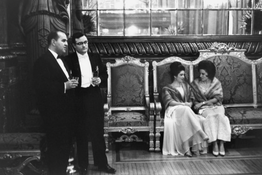
Take the aforementioned photograph of the two soldiers eyeing the two ladies at the tram station. Photos from that essay were taken in Russia in 1954. These were the very first images coming out of post-WWII Russia in the West — remember that Cartier-Bresson was the first Western photographer to be admitted in the USSR after the death of Stalin. He was there to document the daily lifes of Russans under communism. In France, any information that came out of the USSR was immensely significant, as the French intellectual left, starting with Sartre, was internally conflicted about its allegeance to communism and couldn't accept the idea of the inhumanity and cruelty of Stalinism. This photo essay by Cartier-Bresson is both part of Russian—I should say USSR — and of French history (even if published in Life Magazine).

Talking about the composition of an individual photo within it is totally irrelevant to the meaning of the photo. Whether or not it's a "great", "good", "poor", "bad" Cartier-Bresson photograph is totally irrelevant to any meaning the photograph may have had or may still have. And even should one decide to play that game and consider that from a compositional point of view that photo isn't one of Cartier-Bresson's "best" work. Shouldn't one start by asking why? (again, asking the right question). Shouldn't one consider the possibility that in post-Stalinist Russia — this was the Cold War, after all — a reporter openly taking photographs might be seen as a spy by a couple of Russian soldiers, even if only in the mind of said photographer? If so, then it's entirely plausible that, just to be on the safe side, Cartier-Bresson felt he had to work swiftly and unnoticed, and that capturing for his audience this tranche de vie was more important to him in this case than coming up with a nicely composed photographed.

Comparison is futile. This photo, as others in this essay, is incomparable.

 
OP
OP
cliveh

cliveh

Subscriber
Allowing Ads
Joined
Oct 9, 2010
Messages
7,775
Format
35mm RF
The first time I saw " Military Appraisal at Moscow Trolley Stop" was when it appeared as a double page spread in the Guardian newspaper (not with any of the graphics used in Time magazine). What I believe he has done here is sacrifice composition for timing. But for me the balance between the two makes it a very interesting image. The balance between the geometry of composition and timing, is like finding some small detail of order in the universe.
 
Last edited:

nikos79

Member
Allowing Ads
Joined
Mar 9, 2025
Messages
1,047
Location
Lausanne
Format
35mm
No it doesn't. Art doesn't "need" anything. Honestly, it barely needs us.

And what you are doing is not comparison. This is good, this is bad, this is better, this is worse — all this is not comparison, it's evaluation, and serves no other purpose than establishing an arbitrary hierarchy between works (and sometimes artists).

If you want to compare, take value out of it. Don't compare Cartier-Bresson and Winogrand and Friedlander, ask yourself why Cartier-Bresson does this and why Winogrand does that and why Friedlander does something unlike Cartier-Bresson and Winogrand.

Ask without value, without judgement.


Understanding what makes HCB so great is unimportant and uninteresting. Greatness is unimportant, irrelevant, uninteresting. What's interesting is why did Cartier-Bresson take this photo? What did it mean for him? What did it mean for those who looked at it then? What does it, or can it mean for us today?

The only path to understanding is asking questions.

The tough part is learning to ask the right questions.

Take the aforementioned photograph of the two soldiers eyeing the two ladies at the tram station. Photos from that essay were taken in Russia in 1954. These were the very first images coming out of post-WWII Russia in the West — remember that Cartier-Bresson was the first Western photographer to be admitted in the USSR after the death of Stalin. He was there to document the daily lifes of Russans under communism. In France, any information that came out of the USSR was immensely significant, as the French intellectual left, starting with Sartre, was internally conflicted about its allegeance to communism and couldn't accept the idea of the inhumanity and cruelty of Stalinism. This photo essay by Cartier-Bresson is both part of Russian—I should say USSR — and of French history (even if published in Life Magazine).

Talking about the composition of an individual photo within it is totally irrelevant to the meaning of the photo. Whether or not it's a "great", "good", "poor", "bad" Cartier-Bresson photograph is totally irrelevant to any meaning the photograph may have had or may still have. And even should one decide to play that game and consider that from a compositional point of view that photo isn't one of Cartier-Bresson's "best" work. Shouldn't one start by asking why? (again, asking the right question). Shouldn't one consider the possibility that in post-Stalinist Russia — this was the Cold War, after all — a reporter openly taking photographs might be seen as a spy by a couple of Russian soldiers, even if only in the mind of said photographer? If so, then it's entirely plausible that, just to be on the safe side, Cartier-Bresson felt he had to work swiftly and unnoticed, and that capturing for his audience this tranche de vie was more important to him in this case than coming up with a nicely composed photographed.

Comparison is futile. This photo, as others in this essay, is incomparable.
Thanks for a thorough reply. A lot of food for thought. I don't think I agree with all you said but I don't have any good arguments against the parts I don't. I wish I had but you said it very nice. You offered me many other perspectives which I will think carefully upon.
My main problem is the
"Ask without value, without judgement." Because for some other things like movies I know very well why I dislike some movies. Because they reproduce Hollywood cliches, play easily with cheap effects to impress the audience, have weak plot, indifferent cinematography, repetition of known recipes etc. But with photographs why can't I approach them the same way? Is their purpose very different because of their inherent relation with time that gives their value?
Sometimes I think critique is dead. No-one dares to touch the artist, see what happened to the critics who didn't praise Taylor Swift's last album - death threats by angry fans. I somehow miss the articles of Louis Stettner at Camera 35. Where he wasn't afraid to openly criticize big names such as Meatyard or when people were not afraid to backlash big names such as Diane Arbus or Garry Winogrand. And people such as Szarkowsky or Stieglitz or Sid Grossman shaped the medium with their often fierce critique. I don't think I know nowadays of anyone photo critic that does it.
 
Last edited:

MattKing

Moderator
Moderator
Allowing Ads
Joined
Apr 24, 2005
Messages
55,047
Location
Delta, BC Canada
Format
Medium Format
Why should that value system be determined by you, or me, or Larry, Curly and Moe?

I for one would like to learn more about the value system determined by Larry, Curly and Moe.

On the rest of the discussion, I think it important to remember that this thread is about "HCB Appreciation" (emphasis added).
And "Appreciation" is much more complex than "like" or "enjoy".
In fact, there are many examples of things we don't enjoy or like, but we still have an appreciation of.
For example, the value of homework and exercise, or hard work leading to acquisition of knowledge or a skill.
 

gary mulder

Member
Allowing Ads
Joined
Nov 29, 2006
Messages
343
Format
4x5 Format
monalisa.jpg


Yes it’s became a cliché. Or a trick as you call it. Does it mean that we have to go to the Louvre to remove the painting from the wall and burn it?
 

Alex Benjamin

Subscriber
Allowing Ads
Joined
Aug 8, 2018
Messages
2,940
Location
Montreal
Format
Multi Format
for one would like to learn more about the value system determined by Larry, Curly and Moe.

You'll have to ask Larry. He was the photographer in the group.

I believe this photo is a good example of The Decisive Nyuk Nyuk!

Stooges Yellowstone Park.png
 

nikos79

Member
Allowing Ads
Joined
Mar 9, 2025
Messages
1,047
Location
Lausanne
Format
35mm
"I enjoy taking pictures, to be present. It's a way to say: yes, yes, yes! And there's no maybe. All the maybes should be thrown in the trash. Because it's a moment. It's a presence. It's there. And it's respect and joy, tremendous joy to say: yes! Even if it's something you hate: yes!. It's an affirmation: yes!"

HCB

p.s. he is referencing James Joyce book ending...
 

snusmumriken

Subscriber
Allowing Ads
Joined
Jul 22, 2021
Messages
2,760
Location
Salisbury, UK
Format
35mm
"I enjoy taking pictures, to be present. It's a way to say: yes, yes, yes! And there's no maybe. All the maybes should be thrown in the trash. Because it's a moment. It's a presence. It's there. And it's respect and joy, tremendous joy to say: yes! Even if it's something you hate: yes!. It's an affirmation: yes!"

HCB

p.s. he is referencing James Joyce book ending...

Ulysses, in fact.
 
OP
OP
cliveh

cliveh

Subscriber
Allowing Ads
Joined
Oct 9, 2010
Messages
7,775
Format
35mm RF
1762639680905.png


The Lionel Messi of composition.
 
Last edited:
Photrio.com contains affiliate links to products. We may receive a commission for purchases made through these links.
To read our full affiliate disclosure statement please click Here.

PHOTRIO PARTNERS EQUALLY FUNDING OUR COMMUNITY:


Ilford ADOX Freestyle Photographic Stearman Press Weldon Color Lab Blue Moon Camera & Machine
Top Bottom