But art also needs comparisons.
No it doesn't. Art doesn't "need" anything. Honestly, it barely needs us.
And what you are doing is not comparison. This is good, this is bad, this is better, this is worse — all this is not comparison, it's evaluation, and serves no other purpose than establishing an arbitrary hierarchy between works (and sometimes artists).
If you want to compare, take value out of it. Don't compare Cartier-Bresson and Winogrand and Friedlander, ask yourself why Cartier-Bresson does this and why Winogrand does that and why Friedlander does something unlike Cartier-Bresson and Winogrand.
Ask without value, without judgement.
Otherwise we couldn't understand what makes HCB so great
Understanding what makes HCB so great is unimportant and uninteresting. Greatness is unimportant, irrelevant, uninteresting. What's interesting is why did Cartier-Bresson take this photo? What did it mean for him? What did it mean for those who looked at it then? What does it, or can it mean for us today?
The only path to understanding is asking questions.
The tough part is learning to ask the right questions.
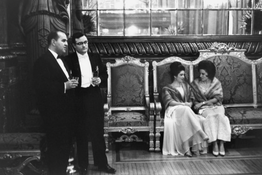
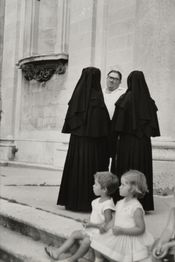
Take the aforementioned photograph of the two soldiers eyeing the two ladies at the tram station. Photos from that essay were taken in Russia in 1954. These were the very first images coming out of post-WWII Russia in the West — remember that Cartier-Bresson was the first Western photographer to be admitted in the USSR after the death of Stalin. He was there to document the daily lifes of Russans under communism. In France, any information that came out of the USSR was immensely significant, as the French intellectual left, starting with Sartre, was internally conflicted about its allegeance to communism and couldn't accept the idea of the inhumanity and cruelty of Stalinism. This photo essay by Cartier-Bresson is both part of Russian—I should say USSR — and of French history (even if published in Life Magazine).
Talking about the composition of an individual photo within it is totally irrelevant to the meaning of the photo. Whether or not it's a "great", "good", "poor", "bad" Cartier-Bresson photograph is totally irrelevant to any meaning the photograph may have had or may still have. And even should one decide to play that game and consider that
from a compositional point of view that photo isn't one of Cartier-Bresson's "best" work. Shouldn't one start by asking why? (again, asking the right question). Shouldn't one consider the possibility that in post-Stalinist Russia — this was the Cold War, after all — a reporter openly taking photographs might be seen as a spy by a couple of Russian soldiers, even if only in the mind of said photographer? If so, then it's entirely plausible that, just to be on the safe side, Cartier-Bresson felt he had to work swiftly and unnoticed, and that capturing for his audience this
tranche de vie was more important to him in this case than coming up with a nicely composed photographed.
Comparison is futile. This photo, as others in this essay, is incomparable.






 .
.


