



• Welcome to Photrio!
    Registration is fast and free. Join today to unlock search, see fewer ads, and access all forum features.
    Click here to sign up

Hasselblad 500C Viewfinder + Calibration

Recent Classifieds

Forum statistics

Threads
202,687
Messages
2,844,246
Members
101,467
Latest member
kpm3
Recent bookmarks
0

12557

Member
Allowing Ads
Joined
Mar 11, 2026
Messages
9
Location
germany
Format
Medium Format
Hi everyone,

I recently got a Hasselblad 500C (1966) from a friend for a very good price. When I inspected the camera, I noticed that the focusing screen had been installed incorrectly and rotated.

I’m a fairly experienced precision mechanic, so I carefully removed the four screws, disassembled the screen assembly, and reinstalled everything in what seemed to be the correct order and orientation.

Inside the finder assembly I found the following parts:

  • a ground glass focusing screen
  • a line/grid screen
  • a spring frame
  • a metal retaining frame
  • and additionally a ~0.8 mm thick plexiglass spacer
The plexiglass spacer confused me a bit, because I’m not sure if it actually belongs there or if it was added later.

So my questions are:

  • What is the correct order of these elements in a Hasselblad 500C?
  • Where should the spacer go, if it belongs there at all? Or should it be removed?
  • How do you properly adjust the focus afterwards so that the ground glass matches the film plane? Is there a simple trick to check or calibrate it?
Thanks a lot for your help — I really appreciate the knowledge and experience in this forum.
 
Is this helpful?

1773223908758.png


1773224037367.png


Welcome to Photrio!
 
How do you properly adjust the focus afterwards so that the ground glass matches the film plane? Is there a simple trick to check or calibrate it?

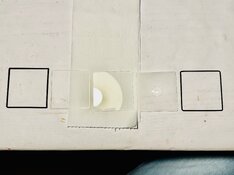
Taping a ground glass on the film gate of the camera back, seeing if the focus point on both glasses agree with a magnifier, using a shallow depth of field lens with a high contrast target, is one way to do it.

If someone put a spacer there they likely did it for a reason (to fix the focus offset). I don't see anything in the service manual that looks like a plexiglass spacer.
 
Last edited:
Hey @loccdor Thank you so much! I know this pdf and the strange thing is there is no plexiglass spacer the question is is my glas a original one?

And Should I tape the ground glass directly onto the metal edge? Is that where the film plane is?

Greets!
 
I've never touched a Hasselblad, but I have a feeling this spacer was added by someone trying to make the focusing screen more accurate. Do you have a picture of it?
 
Taping a ground glass on the film gate of the camera back, seeing if the focus point on both glasses agree with a magnifier, using a shallow depth of field lens with a high contrast target, is one way to do it.

If someone put a spacer there they likely did it for a reason (to fix the focus offset). I don't see anything in the service manual that looks like a plexiglass spacer.

Taping a ground-glass is something you can't do with a Hasselblad body, because the magazine is the gate !
You'd need a focussing screen attachment to do this ( ... the type usually used for SWC bodies )

John S 😎
 
Hey John! I thought so. Can you tell me what such a ground glass looks like?
 
Hi, I have similar issue with 1000F model. I'm looking for proper procedure to install focusing screen with "spring spacer" under it.
Specifically, how to evenly screw 4 screws that determine screen height.
Is you plexiglass spacer (just a thin "frame"on the picture?) looks like simple shim to me.
Recently, they have been using full plexiglass inserts (with pattern similar to fresnel lenses") under regular Hasselblad screen with Fuji Instax film "polaroid" backs, to offset difference in focusing plane. I don't think that is the case with your camera.
This is the newest ground back adapter
 

Attachments

  • IMG_8159.jpg
    IMG_8159.jpg
    930.2 KB · Views: 8
Oh, that adapter is interesting. Where can you buy it and how much does it cost?

Yes, exactly — it is just a very thin frame, but I don’t know where it belongs or if it should be there at all.

According to the Hasselblad manual and the exploded diagram, it actually shouldn’t be there.
 
Oh, that adapter is interesting. Where can you buy it and how much does it cost?

Yes, exactly — it is just a very thin frame, but I don’t know where it belongs or if it should be there at all.

According to the Hasselblad manual and the exploded diagram, it actually shouldn’t be there.

Can you have sharp infinity in viewfinder (let's say over 250m+ distance) if you put in this order: Plexiglass shim, spring washer frame, focusing screen, the frame, screws. If not, take out plexiglass shim first adjust height with adjusting screws up or down. How to do it right? No idea?
Will be nice to have some original instruction.
Issue here is how to evenly tighten screws to have spring frame hold focusing screen at right height and parallel.
If on processed negative you have infinity in focus, than you most likely do not need this adapter.

You can find them maybe in your local second hand photo store or Ebay.
They are not cheap, there are also some made in China, not sure how good they are?
 
How do distant trees look in the ground glass at infinity? Assuming you have a lens for it.
 
Exactly, thanks for the tip. That’s exactly how I did it.


So far I have adjusted and calibrated everything and then checked whether I can get infinity focus at long distance, and I can get everything perfectly sharp.


My order was the following:


metal washer spring frame → Fresnel screen with focusing aid → grid screen → frame → four screws


The result was best when I tightened the four screws relatively firmly and evenly.


I actually think that whether it is slightly tilted probably doesn’t matter too much, as long as the center is sharp, because for the viewfinder preview that should be the most important part.


When you say second-hand, do you mean other focusing screens?

What exactly do you mean I should search for on eBay?

Thank you guys!
 
I happen to have a 1966 500C like yours, and although I have the standard screen, I can maybe provide some photographs of the ground glass if that helps. AFAIK 500C's didn't come with split-prism screens standard, so this is likely a later addition (genuine, or quite possibly aftermarket). I cannot see any plastic shims anywhere by the focusing screen on mine.

When you say the focusing screen had been rotated, which way was it? It may be that the shim was someone's attempt to correctly space the focusing screen without the fresnel lens (part 20902 in the manual) underneath the ground glass (20904). The fresnel lens happens to be about 0,8mm....

P.S. — Regarding the repair manual linked by loccdor, the 1966 model has a serial number starting with TT, which is a bit later than the CU-CE model in the pictures above. In this case the assembly is very similar, so it shouldn't be much of an issue.
 
If you have an older back with the peephole, you can rig it up to hold a piece of frosted something where the film would be and check the focus through the peephole. Cheaper than buying the gg attachment.
 
That was for Hasselblad focus screen adapter.
Excellent! Glad that it worked for you!
What do you mean?
If you have an older back with the peephole, you can
Ah goood idea!!

Yes, exactly, my model also starts with TT. So the diagram should be correct then?

The screen was rotated vertically, meaning the split-image was vertical instead of horizontal.

Thanks for checking on your camera, but please don’t go to too much trouble. I’m not knowledgeable enough about whether split-image focusing screens were installed back then or not.

As I said, I can focus sharply at long distances even without the shim.
 
The Hasselblad focus screen adapter from message #9 in the thread – there are several versions, but I would probably suggest Don's idea of using a film back instead. Save some money, you know? It might even be possible to take out the film insert from the magazine, press a ground-glass against the film gate, and peep through the hole for a better view of your focus.

The diagram is close enough, but TT is covered on a different page (p.28-29 - numbered 12 in the document itself). CE - US (1959-70) covers TT (1966), while the page linked above was for 1957-59.

With the split-prism, I know some people like to have it oriented vertically with waist-level finders, so that may have been intentional. If you get a sharp image at infinity when the lens is at the infinity stop, it should be fine how you have it now.
Screenshot 2026-03-11 at 21.27.46.png
 
Last edited:
Ah, I didn’t know that. I thought it always had to be horizontal.

Yes, I think the diagram is probably correct.


I’ll try the method with the film back, but first I’ll shoot my first roll of film.

So far I actually haven’t run a single roll through the camera yet.
 
Photrio.com contains affiliate links to products. We may receive a commission for purchases made through these links.
To read our full affiliate disclosure statement please click Here.

PHOTRIO PARTNERS EQUALLY FUNDING OUR COMMUNITY:


Ilford ADOX Freestyle Photographic Stearman Press Weldon Color Lab Blue Moon Camera & Machine
Top Bottom
