• Welcome to Photrio!
    Registration is fast and free. Join today to unlock search, see fewer ads, and access all forum features.
    Click here to sign up

Half-Frame lens field of view and crop factor

Cone and Hoop

A
Cone and Hoop

  • 0
  • 0
  • 14
Snow on Willoughby

A
Snow on Willoughby

  • 0
  • 0
  • 17

Forum statistics

Threads
202,758
Messages
2,845,205
Members
101,511
Latest member
hkoepke
Recent bookmarks
0
35mm half-frames are not 18x24 (the exact half of 24x36, but in general a little more than 17x24 because you need at least 1mm to separe two adjascent frames. It depends on the camera.
POLKa
 
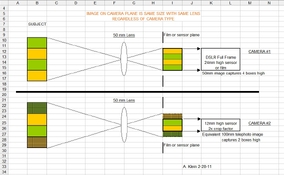
I put together this detail to explain crop factor.
 

Attachments

  • Crop factor illustration.jpg
    Crop factor illustration.jpg
    163 KB · Views: 117
And since 24x36 is actually a crop of all the larger formats, the 'crop factor' is proven to be a mental crutch for FL 'equivalence' to change from format to format for those unaccustomed to working in different formats. (I shot in 4 formats but never previously used any 'crop factor' -- except initially when going from 135 to digital APS-C...using the same set of lenses for both, which had never happened before.)

That's why I think we should not use the crop factor any more. We had all the different formats before and didn't need the crop factor. One thing I don't like about the crop factor because it makes the 35mm format as the one all other formats are measured by. I often joke that I only use full frame because I can't figure out the crop factor.
 
Nothing has created more confusion in the world of photograph than "crop factor" (no, not even the zone system.) I used to frequent a mostly digital forum and almost every day I'd see one or the other strange misreading of what it was and how it worked. One person was asking some questions about using an 25mm APS-C lens on a Micro 4/3 camera and was convinced that he needed to do two calculations--APS-C to FF, then FF to M4/3 because a APS-C 25mm was different than a FF 25mm--so (25*1.5)/2. People on the forum tried to patiently explain that 25mm was an unalterably real world physical value that was independent of sensor size, but he kept arguing and arguing until I decided never to click on that thread again.

Today I just tell people to look in the viewfinder to figure it out, and learn that each sensor/film size has its own view of a focal length.
 
Nothing has created more confusion in the world of photograph than "crop factor" (no, not even the zone system.) I used to frequent a mostly digital forum and almost every day I'd see one or the other strange misreading of what it was and how it worked. One person was asking some questions about using an 25mm APS-C lens on a Micro 4/3 camera and was convinced that he needed to do two calculations--APS-C to FF, then FF to M4/3 because a APS-C 25mm was different than a FF 25mm--so (25*1.5)/2. People on the forum tried to patiently explain that 25mm was an unalterably real world physical value that was independent of sensor size, but he kept arguing and arguing until I decided never to click on that thread again.

Today I just tell people to look in the viewfinder to figure it out, and learn that each sensor/film size has its own view of a focal length.

As a joke I told those people that I only use FF because it has no crop factor.
 
As a joke I told those people that I only use FF because it has no crop factor.

Actually, FF does have a "crop factor". It's about 2X. The original "35mm" format (1889) was 25.4 x 19mm. When Leica came out with the 24x36mm image size, it was often called "double-frame" or "Leica format". It was much later that the terms "half-frame" and "full-frame" evolved.
 
Last edited:
Actually, FF does have a "crop factor". It's about 2X. The original "35mm" format (1889) was 25.4 x 19mm. When Leica came out with the 24x36mm image size, it was often called "double-frame" or "Leica format". It was much later that the terms "half-frame" and "full-frame" evolved.

It has no crop factor although it's larger than the original 35mm movie frame. Why? because those people who talk crop factor take the 24mm x 36mm as GOD which all other format are measured by. (strangely many of them never used a 35mm camera) They would say a medium format camera has the crop factor of say 0.65 or something like that.
 
It has no crop factor although it's larger than the original 35mm movie frame. Why? because those people who talk crop factor take the 24mm x 36mm as GOD which all other format are measured by. (strangely many of them never used a 35mm camera) They would say a medium format camera has the crop factor of say 0.65 or something like that.

The MF digital users usually take 6x4.5 (54mm x 40mm in MF digital) as “full frame” and things like 44x33 are crop frame MF sensors. But the rest of the universe seems to have internalized 35mm/36x24 focal lengths so much so that I’ve seen digital system that use the 35mm focal lengths to display to the user, despite the fact that the actual sensor is smaller than the fingernail on your smallest finger.
 
But the rest of the universe seems to have internalized 35mm/36x24 focal lengths so much so that I’ve seen digital system that use the 35mm focal lengths to display to the user, despite the fact that the actual sensor is smaller than the fingernail on your smallest finger.

Which doesn't make a lot of sense because a lot of people who use the 35mm equivalent focal length never actually use the 24x36mm format.
 
Which doesn't make a lot of sense because a lot of people who use the 35mm equivalent focal length never actually use the 24x36mm format.

Absolutely. I’ll use crop factor as a short term crutch if I start using a system where the size is new to me, but I (relatively) quickly learn the focal lengths for that size. At this point I’m comfortable with focal lengths for most of the MF 120 sizes, plus the primary LF sizes (4x5, 5x7, 8x10), just through repetition and use.
 
It has no crop factor although it's larger than the original 35mm movie frame. Why? because those people who talk crop factor take the 24mm x 36mm as GOD which all other format are measured by.

There is no God.
 
Photrio.com contains affiliate links to products. We may receive a commission for purchases made through these links.
To read our full affiliate disclosure statement please click Here.

PHOTRIO PARTNERS EQUALLY FUNDING OUR COMMUNITY:



Ilford ADOX Freestyle Photographic Stearman Press Weldon Color Lab Blue Moon Camera & Machine
Top Bottom