• Welcome to Photrio!
    Registration is fast and free. Join today to unlock search, see fewer ads, and access all forum features.
    Click here to sign up

Good B&W film to use without a filter?

Recent Classifieds

Forum statistics

Threads
201,988
Messages
2,833,354
Members
101,050
Latest member
artemborodin
Recent bookmarks
0

markbau

Member
Allowing Ads
Joined
Apr 16, 2009
Messages
869
Location
Australia
Format
Analog
I think St Ansel wrote something along the lines of "pan film needs a yellow filter for what the eye perceives as normal tones" in The Negative. It should be remembered that Ansel loved big dramatic dark skies in his photos, a tradition that seems to be alive and well with many photographers.

SNIP SNIP SNIP


i think it was answell
:munch:

id go for the fedora
 

Noble

Member
Allowing Ads
Joined
Nov 25, 2012
Messages
277
Format
Multi Format
I think St Ansel wrote something along the lines of "pan film needs a yellow filter for what the eye perceives as normal tones" in The Negative. It should be remembered that Ansel loved big dramatic dark skies in his photos, a tradition that seems to be alive and well with many photographers.

A yellow filter will not produce a dramatic sky. I find the effect of basic yellow filters to be a bit too subtle. I actually prefer an orange filter and I an not scared to use a red filter if I feel it is justified. Although now I tend to also shoot an orange filter shot when I use red just in case it is too much. Heck I've used a red AND a polarizer at the same time. Greens are nice to lighten foliage while darkening the sky. But as has been said if you use a film like TMAX 100 it makes perfectly nice images without a filter. I will often rate TMAX 100 @ ISO 50 so if I am hand holding a filter of any sort is not an option. The world doesn't end in those circumstance. Photography like everything in life is about trade offs.

Ansel used a red filter for his famous half dome picture. That was not a yellow filter.

A basic yellow filter could never be called "dramatic" in my book.
 

markbau

Member
Allowing Ads
Joined
Apr 16, 2009
Messages
869
Location
Australia
Format
Analog
A yellow filter will darken a blue sky compared to taking the same shot without a filter. The degree of darkening, yellow/orange/red is a matter of degrees.

I'm sure TMax 100 makes perfectly nice images without a filter, as does any B&W film.

A yellow filter will not produce a dramatic sky. I find the effect of basic yellow filters to be a bit too subtle. I actually prefer an orange filter and I an not scared to use a red filter if I feel it is justified. Although now I tend to also shoot an orange filter shot when I use red just in case it is too much. Heck I've used a red AND a polarizer at the same time. Greens are nice to lighten foliage while darkening the sky. But as has been said if you use a film like TMAX 100 it makes perfectly nice images without a filter. I will often rate TMAX 100 @ ISO 50 so if I am hand holding a filter of any sort is not an option. The world doesn't end in those circumstance. Photography like everything in life is about trade offs.

Ansel used a red filter for his famous half dome picture. That was not a yellow filter.

A basic yellow filter could never be called "dramatic" in my book.
 

removed account4

Subscriber
Allowing Ads
Joined
Jun 21, 2003
Messages
29,832
Format
Hybrid
I think St Ansel wrote something along the lines of "pan film needs a yellow filter for what the eye perceives as normal tones" in The Negative. It should be remembered that Ansel loved big dramatic dark skies in his photos, a tradition that seems to be alive and well with many photographers.


hate to say this but yellow filters don't really darken the sky at all, maybe a tiny bit
maybe enough to make clouds seem like they are there a bit more, but if your objective
is to darken the sky, a yellow filter won't really do that ...

the person i was responding to was talking about how in nearly 50 years of professional photography
he really found no use for using filters, and i pretty much agree with him .. unless it is for a specialized purpose
like contrast control with paper negatives, or making ilford SFX film do its thing ...
i find the use of filters by a lot of "landscape" photographers to be heavy handed in the very least
and a lot of the time kind of hackneyed and clichéd ... cheezy velvia nudes at slot canyon ...

but what do i know ...
 

Klainmeister

Member
Allowing Ads
Joined
Jun 2, 2010
Messages
1,504
Location
Santa Fe, NM
Format
Medium Format
i find the use of filters by a lot of "landscape" photographers to be heavy handed in the very least
and a lot of the time kind of hackneyed and clichéd ... cheezy velvia nudes at slot canyon ...

but what do i know ...

THAT'S where they keep em? Weird, I've spent a lot of time down in those places and never have come across any nudes. Maybe I need to look into Stone Donkey Canyon or Buckskin...
 

markbau

Member
Allowing Ads
Joined
Apr 16, 2009
Messages
869
Location
Australia
Format
Analog
It really depends on atmospheric conditions and on your definition of the word "darken" In summer we have very blue skies in inland Australia and a yellow filter can really darken the sky, closer to the ocean or in winter, when the sky isn't as blue a yellow filter will do very little.

I rarely use filters (apart from ND) and amen to your comment about heavy handed photographers with the AA sky. I think the reason the older guys really went after sky darkening was a reaction to ortho films that made blue skies white, pan films came along and they wanted all the dark skies they could get, the darker the better.

hate to say this but yellow filters don't really darken the sky at all, maybe a tiny bit
maybe enough to make clouds seem like they are there a bit more, but if your objective
is to darken the sky, a yellow filter won't really do that ...

the person i was responding to was talking about how in nearly 50 years of professional photography
he really found no use for using filters, and i pretty much agree with him .. unless it is for a specialized purpose
like contrast control with paper negatives, or making ilford SFX film do its thing ...
i find the use of filters by a lot of "landscape" photographers to be heavy handed in the very least
and a lot of the time kind of hackneyed and clichéd ... cheezy velvia nudes at slot canyon ...

but what do i know ...
 

Noble

Member
Allowing Ads
Joined
Nov 25, 2012
Messages
277
Format
Multi Format
Some of these comments are basically saying anyone who drinks is an alcoholic.

A lot of good filtration is like a good haircut. No one can tell you've had one. If people are seeing portfolios full of nothing but black skies they are looking at a filter alcoholic. There are plenty of filter users that are not alcoholics. There is a lot of territory between cementing a red filter to your normal lens and being a teetotaler.

Something else that I find disturbing about filters is there seems to be a large number of people who don't know what they are for. Yes they can darken skies and increase contrast but they can also be used to cut through haze, remove glare, hide or accentuate skin blemishes and also change the relationship between colors/shades of gray. Digital shooters and even some color film shooters (surprisingly) wonder why I shoot black and white. Well there are multiple reasons including dirt cheap easy developing and enlarging. But one big draw for B&W film is the use of filters. It is something that can't be done in other mediums. Polarization is the exception. If I want to take a picture of a landscape and cut through haze I can use an orange filter, red filter, polarizer or combine. The result simply cannot be achieved without the filters. Also if I want to lighten some spring foliage while darkening the sky a bit I use a green filter. Again it really can't be done any other way. There is Photoshoping but the results are usually poorer (noise, posterization, strange digital artifacts) and of course no darkroom print :sad:.

The only thing I can say is people need to read about filters and then use them in various situations. You don't have to use a sledge hammer filter(s) in every situation. As markbau pointed out how dark your sky is also depends on geographic location/atmospheric conditions. I can take a picture of a landscape with an orange filter and have it look like an unfiltered picture taken in markbau's backyard. If my orange filter landscape is terrible then by definition everything marbau is taking in his geographic location is terrible at least in regards to how dark the sky is.

Seriously I am not a filter guru. As I stated before I will shoot a scene with multiple filters and sometimes no filter just to be on the safe side. If you are shooting roll film I suggest playing around with different subject matter. Filtration to me is just another tool in the workflow. I would not ignore shutter speed, aperture, focus, tripod, cable release, flash, type of film, type of developer, type of paper or paper developer. They are all tools that give you some degree of control. I have found when used appropriately filters can add a lot to a photograph. Heck even when used "inappropriately" you can end up with something nice and unique even if it is not very realistic. And just as I would not have a portfolio full of blurry, expired film, light leak, Holga images I would not have a portfolio full of black skies. Drink responsibly.

 
Joined
Jan 21, 2003
Messages
15,715
Location
Switzerland
Format
Multi Format
I sometimes use filters when I make portraits of people that have poor skin complexion. An orange filter might help someone with lots of skin blemishes, for example.

I don't know why everybody is so hooked up on using filters only with skies. If you're in the woods photographing foliage, really striking results can be had by using green filters. Any time you photograph flowers and want to increase contrast between two complimentary colors, color filters can come very much in handy.

Be creative with filters, use them to their strength and to improve your pictures according to how you want your photographs to look. I for one do not like the red filter sky much. Too much of the rest of the color spectrum gets rendered too damned wacky for my tastes.
 

TheFlyingCamera

Membership Council
Advertiser
Allowing Ads
Joined
May 24, 2005
Messages
11,604
Location
Washington DC
Format
Multi Format
Going back to the question of film, the Arista.EDU Ultra/Fomapan stuff is really more of an ortho/pan than a true panchromatic. It is very blue sensitive and somewhat deficient in red sensitivity. Don't think you'll be able to pull off that red filter sky look with it, or even get significant cloud/sky separation using a red filter.
 
Joined
Jan 21, 2003
Messages
15,715
Location
Switzerland
Format
Multi Format
Going back to the question of film, the Arista.EDU Ultra/Fomapan stuff is really more of an ortho/pan than a true panchromatic. It is very blue sensitive and somewhat deficient in red sensitivity. Don't think you'll be able to pull off that red filter sky look with it, or even get significant cloud/sky separation using a red filter.

Thanks for keeping the post on track. I agree that the Arista.EDU Ultra / Fomapan films have a tendency to produce skies that are somewhat featureless, due to their spectral sensitivity. Beautiful film for portraits, though.

Even though it might be a little surplus information at this point, Kodak TMax 400 has spectral response that acts like a built in filter to yield tones in bright blue skies, more so than other films I've tried. But it isn't hard to capture the sky if you wanted to with Tri-X or HP5+ either.
 

Vaughn

Subscriber
Allowing Ads
Joined
Dec 13, 2006
Messages
10,286
Location
Humboldt Co.
Format
Large Format
THAT'S where they keep em? Weird, I've spent a lot of time down in those places and never have come across any nudes. Maybe I need to look into Stone Donkey Canyon or Buckskin...

One comes across them occasionally under the redwoods.

Yellow, orange and red filters lighten blue skies relative to the rest of the landscape. Just look at one's negatives -- the skies have less density (lighter!) The brightness of skies in a print will depend on how much exposure one gives the paper. Sorry could not resist.

:cool:

My main filter use is a yellow filter in the Fall to darken (increase density) the representation of the yellows on the negative relative to the greens and browns...so that I can easily print them as white in the print.
 

Attachments

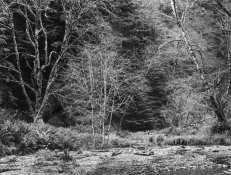
  • Prairie Creek, Nude.jpg
    Prairie Creek, Nude.jpg
    757.6 KB · Views: 77
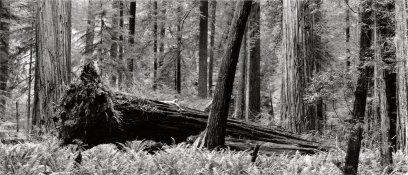
  • Fallen Redwood, Nude_7"x19".jpg
    Fallen Redwood, Nude_7"x19".jpg
    440.6 KB · Views: 81

AgX

Member
Allowing Ads
Joined
Apr 5, 2007
Messages
29,972
Location
Germany
Format
Multi Format
The use of a yellow came up with orthochromatic films, where a blue sky had more impact on exposure than with panchromatic film.
 
Photrio.com contains affiliate links to products. We may receive a commission for purchases made through these links.
To read our full affiliate disclosure statement please click Here.

PHOTRIO PARTNERS EQUALLY FUNDING OUR COMMUNITY:


Ilford ADOX Freestyle Photographic Stearman Press Weldon Color Lab Blue Moon Camera & Machine
Top Bottom