
• Welcome to Photrio!
    Registration is fast and free. Join today to unlock search, see fewer ads, and access all forum features.
    Click here to sign up

Glycol, TEA and Glycerine

Recent Classifieds

Forum statistics

Threads
202,816
Messages
2,845,846
Members
101,544
Latest member
johnsaigon0
Recent bookmarks
1
It's there to control the pH and form a buffer with borax. As the products of development happen, this will prevent the pH of the solution from drifting. So however it's formed, you want to have a pH about the right number, and enough boric acid and borax to buffer it around that pH so it stays there.

The pH will have the biggest effect on grain and development time. It shouldn't affect too much in the narrow range we're talking about here.

If you are within 0.25 of where it's supposed to be, it will probably be fine. I don't know what pH it's *supposed* to be, but I plugged the numbers into a buffer calculator and get around 9 for those. That seems to be in line with the Microphen number as well.

Oh, that's great! I will add borax at the end gram by gram until I reach the desired pH 9. Thanks for this information!
One more question, maybe you have the answer :smile: I found the ID-68R replenisher formula on web but I couldn't find an ""official" replenisher amount needed after each roll . Some people say that 9ml after each roll is the Ilford value from the '80s for Microphen, but I kind of doubt about those 9ml, because other phenidone developers like Xtol requires 70ml of replenisher.
 
Oh, that's great! I will add borax at the end gram by gram until I reach the desired pH 9. Thanks for this information!

Borax on its own in water has pH slightly above 9.2. If something acidic pulls pH down below 9, then very high amounts of Borax will be needed to bring it back above 9. You may need something more alkaline than Borax, e.g. Sodium Metaborate.
 
Borax on its own in water has pH slightly above 9.2. If something acidic pulls pH down below 9, then very high amounts of Borax will be needed to bring it back above 9. You may need something more alkaline than Borax, e.g. Sodium Metaborate.

I am afraid that I don't have any sodium metaborate in my photo chemicals closet. I could order some, but I think it would more easier to keep phenidone mixed in propylene glycol which maybe doesn't react with borax.
 
I am afraid that I don't have any sodium metaborate in my photo chemicals closet. I could order some, but I think it would more easier to keep phenidone mixed in propylene glycol which maybe doesn't react with borax.

If you have the ability to do that easily it would make things simpler for sure.
 
Oh, that's great! I will add borax at the end gram by gram until I reach the desired pH 9. Thanks for this information!
One more question, maybe you have the answer :smile: I found the ID-68R replenisher formula on web but I couldn't find an ""official" replenisher amount needed after each roll . Some people say that 9ml after each roll is the Ilford value from the '80s for Microphen, but I kind of doubt about those 9ml, because other phenidone developers like Xtol requires 70ml of replenisher.

The large amount of Xtol needed for replenishment is (at least partly) due to its replenisher being the plain developer itself. Most replenishable developers have a different formula for the replenisher which is more alkaline and has more developing agent than the plain developer.

Kodak could have formulated a specific replenisher for Xtol, in which case less than 70mL would probably have been required.
 
The large amount of Xtol needed for replenishment is (at least partly) due to its replenisher being the plain developer itself. Most replenishable developers have a different formula for the replenisher which is more alkaline and has more developing agent than the plain developer.

Kodak could have formulated a specific replenisher for Xtol, in which case less than 70mL would probably have been required.

On the other hand, having a relatively large volume of replenisher means that a relatively large volume of development byproducts are removed each time the working solution is replenished.
Removing some of those byproducts is equally as important as adding new developing agent.
That larger volume is probably the reason that X-Tol can be replenished indefinitely. For most replenishers that used smaller amounts, the build-up of byproducts meant that the working solutions had more finite lives.
 
Any specific temperature recommended for dissolving in propylene glycol? Or room temperature is just going to be enough?

Heating it really helps. I use 60-80C. You don't want to go much over that to keep it from off-gassing. The phenidone should dissolve readily at that temp. I microwave it in a glass shot glass and do 10 secs at a time.
 
On the other hand, having a relatively large volume of replenisher means that a relatively large volume of development byproducts are removed each time the working solution is replenished.
Removing some of those byproducts is equally as important as adding new developing agent.
That larger volume is probably the reason that X-Tol can be replenished indefinitely. For most replenishers that used smaller amounts, the build-up of byproducts meant that the working solutions had more finite lives.

Yes, I was thinking the same. Replacing 9 or 10ml of developer with a replenisher which, for Microphen, it has a double amount of phenidone and hydroquinone, it's just going to restore only the activity of both developing agents, without taking care of the bromides build-up. And probably, after a certain amount of rolls, the density of the negatives is going to decrease because of the bromides. But I am a little confused.. in literature I found that phenidone activity is not affected by bromides..
 
Heating it really helps. I use 60-80C. You don't want to go much over that to keep it from off-gassing. The phenidone should dissolve readily at that temp. I microwave it in a glass shot glass and do 10 secs at a time.

Thanks, I will try 60C for first use 🙂
 
Heating it really helps. I use 60-80C. You don't want to go much over that to keep it from off-gassing. The phenidone should dissolve readily at that temp. I microwave it in a glass shot glass and do 10 secs at a time.

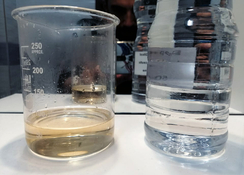
I just mixed 1 gr. of Phenidone in 60ml of propylene glycol heated to 65 Celsius. I am attaching a photo of the mixed solution sitting next to the untouched propylene glycol bottle. I can see a pale-brown tint of the phenidone solution while the original propylene glycol is crystal-clear. Is it ok? The phenidone powder seems to be a bit colored itself, but I am thinking that maybe the solution is tinted because it quickly oxidised. I really don't know how it should look like so that's why I am asking 🙂
 

Attachments

  • phenidone_propylene_glycol.jpg
    phenidone_propylene_glycol.jpg
    128.3 KB · Views: 99
Looks probably OK to me. It can be quite clear to slightly pink/yellow depending on concentration. It has probably oxidizied a little, but when you add it to solution with the rest of the developer I would expect the color to go away.

So the propylene glycol wasn't pure enough, you think? Actually it was yellow/pink tinted, but my bathroom mirror-light it's a 3200K led spot, so I guess that a proper white-balance is hard to get. with a smartphone. This oxidation is reducing the developing strength? Maybe some potasium/sodium metabisulphite added in propylene glycol before phenidone would prevent any oxidation?
 
So the propylene glycol wasn't pure enough, you think? Actually it was yellow/pink tinted, but my bathroom mirror-light it's a 3200K led spot, so I guess that a proper white-balance is hard to get. with a smartphone. This oxidation is reducing the developing strength? Maybe some potasium/sodium metabisulphite added in propylene glycol before phenidone would prevent any oxidation?

No, sorry I think it's fine. You don't need to to anything.
 
........Maybe some potasium/sodium metabisulphite added in propylene glycol before phenidone would prevent any oxidation?

Phenidone often looks a bit pink until other components are added.

Would a bit of metabisulphite dissolve and be helpful?
 
Phenidone often looks a bit pink until other components are added.

Would a bit of metabisulphite dissolve and be helpful?

I was thinking at metabisulfite but I am not suree how much should be used before phenidone mixing
 
Phenidone often looks a bit pink until other components are added.
Phenidone and its derivatives, if left to their devices, go through at least two oxidation steps during development. The first stage creates this colored compound, which is surprisingly stable, and more important: it is fully reversible e.g. with a secondary developer. The stability of this first oxidation stage allows for these high ratios of P vs. Q or C in practical developers.

Therefore I would not worry too much about moderate discoloration. Often I used discolored Dimezone-S in PG to mix E-6 FD, and as soon as I added the HQMS-K the color all but disappeared.
 
Phenidone and its derivatives, if left to their devices, go through at least two oxidation steps during development. The first stage creates this colored compound, which is surprisingly stable, and more important: it is fully reversible e.g. with a secondary developer. The stability of this first oxidation stage allows for these high ratios of P vs. Q or C in practical developers.

Therefore I would not worry too much about moderate discoloration. Often I used discolored Dimezone-S in PG to mix E-6 FD, and as soon as I added the HQMS-K the color all but disappeared.

That's a very good thing to know! I was thinking that the coloration means that some oxidation happen and that will increase over time. Thanks for.explanation!
 
Photrio.com contains affiliate links to products. We may receive a commission for purchases made through these links.
To read our full affiliate disclosure statement please click Here.

PHOTRIO PARTNERS EQUALLY FUNDING OUR COMMUNITY:


Ilford ADOX Freestyle Photographic Stearman Press Weldon Color Lab Blue Moon Camera & Machine
Top Bottom