
• Welcome to Photrio!
    Registration is fast and free. Join today to unlock search, see fewer ads, and access all forum features.
    Click here to sign up

Glycin stand development

Came home

H
Came home

  • 2
  • 0
  • 38
The Bee Keeper

A
The Bee Keeper

  • 2
  • 0
  • 54

Recent Classifieds

Forum statistics

Threads
202,200
Messages
2,837,142
Members
101,196
Latest member
brycemasmile
Recent bookmarks
3

Alan Johnson

Subscriber
Allowing Ads
Joined
Nov 16, 2004
Messages
3,390
The two solution glycin film developer has been around since 1910, including a version with added metol:
A formula with no metol emerged around 1950, Ilford ID-60.
In BJP 1961 Jan 8 p10 Crawley noted that the old method of producing sharp negatives for lantern slides was glycin stand development.
He formulated FX-2 which does have added metol but noted that glycin supplemented by metol would not give marked adjacency [edge] effects.

Since I am looking to get sharpness with some edge effects it seems ,without testing, that it is better to leave out the metol.
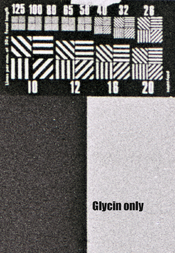
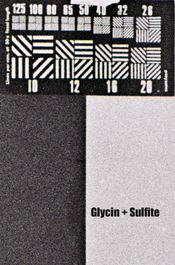
I tested an example formula with and without sulfite since read in the book by LFA Mason that, unlike metol, glycin will develop in absence of sulfite.
Photographs were taken of a dark grey card on top of a light grey card, including for reference a resolution chart taken from the correct distance.
Old style Efke 100 film was used to better show up any edge effects.
Development was in glycin-carbonate, 1g glycin, 5g sodium carbonate anh, water to 1L and
glycin -carbonate-sulfite, 1g glycin, 5g sodium carbonate anh, 5g sodium sulfite, water to 1L.
Both were developed for 1hr at 22C with agitation at 30 min only.
All dissolved in a few minutes at 35C. Results are shown in the attachments, processed identically. The width of the full 35mm frame is about 14 times the width of the test chart.

Conclusions to date:
Added sulfite makes no visible difference on the attachments but it does prevent the slight fogging/tanning seen with glycin alone.
There is a dark line at the border of the dark grey card with the light grey card. Hopefully in field tests using FP4 this may provide the sharpness from edge effect wanted.
I think it is called a Mackie line.
 

Attachments
  • Glycin + Sulfite.jpg
    Glycin + Sulfite.jpg
    712.5 KB · Views: 47
  • Glycin only.jpg
    Glycin only.jpg
    979.8 KB · Views: 44
Last edited:

chuckroast

Subscriber
Joined
Jun 2, 2023
Messages
3,232
Location
All Over The Place
Format
Multi Format
I have done all manner of (semi)stand and EMA testing with a variety of developers and films and have concluded that adjacency effects are really only found with older emulsions like TX320 and Efke PL200M. FP4+ and HP5+ are still an open question but APX 100, Arista 100, 400TX, 100TMAX, Fomapan 100 and 200, Double X, et all seem to not show this effect even with standing techniques. (Note that there are other possible reasons to use standing for those films, notably the compensating and midtone expansion effects of semistand and EMA.)

This was true across a variety of developers include Pyrocat-HD[C], DK-50, and HC-110, though I did not test every possible film/dev combo. There is some hope with highly dilute (1+9) juiced with 0.5 g/l sodium hydroxide, at least with FP4+.

I thus (non scientifically) opine that the older emulsions were far more inclined for edge effects irrespective of developer. I would love to be very wrong about this and your work gives me hope :wink:

Boy do I miss Efke ...
 

chuckroast

Subscriber
Joined
Jun 2, 2023
Messages
3,232
Location
All Over The Place
Format
Multi Format
Have you seen what John Finch got out of Rodinal 1:200?


Interesting, but to my eye, at least, I do not find that acutance or "look" compelling.

My own best FP4+ results are with D-23 1+9 + 0.5g/l sodium hydroxide. Shooting 35mm at box speed I get almost no grain, excellent acutance, and some edge effects:

1770840366772.png
 

Vetus

Member
Allowing Ads
Joined
Mar 29, 2023
Messages
72
Location
UK
Format
4x5 Format
Interesting, but to my eye, at least, I do not find that acutance or "look" compelling.

My own best FP4+ results are with D-23 1+9 + 0.5g/l sodium hydroxide. Shooting 35mm at box speed I get almost no grain, excellent acutance, and some edge effects:

View attachment 417826

Looks lovely, what was you're development time and agitation routine.
 

Lachlan Young

Member
Allowing Ads
Joined
Dec 2, 2005
Messages
5,116
Location
Glasgow
Format
Multi Format
have concluded that adjacency effects are really only found with older emulsions

This is massively inaccurate at a visual, never mind quantitative level. What you are seeing is probably more defined by whatever developers you are using not being capable of sufficiently accessing modern emulsion structures to release their relevant components and/ or that your imaging chain is inadequate to the point of being unable to actually see the effects in question (either via lack of sufficient MTF transfer, or confusing heightened visual granularity with heightened 'sharpness').

Modern (i.e. post mid-50s) emulsions can produce very strong (and potentially even visible enough to see the edge effect clearly if your imaging chain is adequate) adjacency effects when used in the mainstream developers and normal agitation patterns they were designed for. They were not designed for use in amateurish formulations dredged from primitive and ancient formularies and muddled around with in people's garden sheds until they worked within the designed-in margin for gross user error.

Any level of agitation sufficient to produce adequately even development will generally not produce any difference any visually significant difference in edge effects over and above those designed in. Absolute standstill (i.e. zero or very near zero) can potentially deliver heightened effects, but at the cost of significant uneveness - one initial solution for specialist purposes was thickened developers (to the level of the Polaroid paste) applied with a coating blade, but it's very obvious from the literature and the MTF results that emulsion building techniques could do the same job both better and more universally.
 

chuckroast

Subscriber
Joined
Jun 2, 2023
Messages
3,232
Location
All Over The Place
Format
Multi Format
This is massively inaccurate at a visual, never mind quantitative level. What you are seeing is probably more defined by whatever developers you are using not being capable of sufficiently accessing modern emulsion structures to release their relevant components and/ or that your imaging chain is inadequate to the point of being unable to actually see the effects in question (either via lack of sufficient MTF transfer, or confusing heightened visual granularity with heightened 'sharpness').

Modern (i.e. post mid-50s) emulsions can produce very strong (and potentially even visible enough to see the edge effect clearly if your imaging chain is adequate) adjacency effects when used in the mainstream developers and normal agitation patterns they were designed for. They were not designed for use in amateurish formulations dredged from primitive and ancient formularies and muddled around with in people's garden sheds until they worked within the designed-in margin for gross user error.

Any level of agitation sufficient to produce adequately even development will generally not produce any difference any visually significant difference in edge effects over and above those designed in. Absolute standstill (i.e. zero or very near zero) can potentially deliver heightened effects, but at the cost of significant uneveness - one initial solution for specialist purposes was thickened developers (to the level of the Polaroid paste) applied with a coating blade, but it's very obvious from the literature and the MTF results that emulsion building techniques could do the same job both better and more universally.

Your views are noted.
 

Raghu Kuvempunagar

Member
Allowing Ads
Joined
Jul 28, 2016
Messages
3,155
Location
India
Format
Multi Format
Conclusions to date:
Added sulfite makes no visible difference on the attachments but it does prevent the slight fogging/tanning seen with glycin alone.
There is a dark line at the border of the dark grey card with the light grey card. Hopefully in field tests using FP4 this may provide the sharpness from edge effect wanted.

Very interesting! Looking forward to see what results your FP4 tests will produce.
 
OP
OP

Alan Johnson

Subscriber
Allowing Ads
Joined
Nov 16, 2004
Messages
3,390
In reply to Lachlan, this quote from The Film Developing Cookbook 2020 p78:
"Crawley appears to be one of the few published researchers to have recognized as early as the 1950s that high acutance developers cannot be properly evaluated unless intermittent agitation is used.
Unfortunately, little else has been published on the subject, aside from a few vague references in the literature"
It quotes this reference p956:
Since this is not generally available to borrow and the book is over $100 there is nothing else published to refute Lachlan's view except mainly the observations on Photrio in relation to Pyrocat HD.
 
Photrio.com contains affiliate links to products. We may receive a commission for purchases made through these links.
To read our full affiliate disclosure statement please click Here.

PHOTRIO PARTNERS EQUALLY FUNDING OUR COMMUNITY:


Ilford ADOX Freestyle Photographic Stearman Press Weldon Color Lab Blue Moon Camera & Machine
Top Bottom