• Welcome to Photrio!
    Registration is fast and free. Join today to unlock search, see fewer ads, and access all forum features.
    Click here to sign up

Getting Fiber Based Paper Flat

Puddle

Puddle

  • 2
  • 2
  • 63

Recent Classifieds

Forum statistics

Threads
202,726
Messages
2,844,693
Members
101,487
Latest member
Bmattei
Recent bookmarks
1
A dry-mount.......
I suppose it is one of those things you have to weigh, and maybe keep an eye out. Ebay has them, of course, but they ARE heavy to ship.
But if FB is going to be part of your life, it might be one of the best purchases you make, in the long run.

Absolutely !

Lars
 
Drymount press:

For USA people, Keep an eye out on craigslist. They may turn up in a few categories other than photo equipment. I see them every now and then in the Denver Colorado area.
 
Maybe this will go by the wayside, but I have found that the easiest way to get fiber-base paper flat is to do this:

After the wash, blot so that there are no water drops. Then lay the paper emulsion side up on a clean blotter (or towel). Use a hair dryer to completely dry the emulsion side. The back is still slightly damp. Now, simply put the print between clean blotters and under heavy books for a few hours. Clean, flat, no hassle. - David Lyga
 
Last edited:
This might've already been said here, but what I do with my watercolour paper is hang them like normal when they're very wet, but once they dry a bit and are just damp, I pin it up on either side so that the paper is held tight and flat.
 
Ok,
I haven't done any printing on fiber based paper since high school but I want take it up again out of dissatisfaction with the tonal range of the RC papers.

So, two questions:

How do you get the darn things to dry flat? I have had, in the distant past, many bad experiences with dryers.

Does anyone still use ferrotype plates? If so, how does one use them? I long ago inherited 4 or 5 but I don't quite get how you use them.
a minute in the dry-mount press followed by a few minutes under a heavy piece of glass and they are flat for good.
 
I haven't re-read the whole thread, but cutting an Ilford FB matt 16 x 20 inch sheet into 10 x 8's dry as flat as an RC print for me in a Paterson drying rack; so I presume the issue is more to do with the size of a print?

Terry S
 
I flatten all my fiber prints, no matter the size, in a Seal dry mount press at 180F for a few minutes. Trick is to slightly moisten the back of the print before placing it in the press. I use distilled water as the tap water here is very hard and leaves a very slight mineral coating.
 
This is seasonal for me in the Northeastern US. In summer with high humidity the prints feel slightly damp even when they are dry and they are absolutely flat. But in the winter they curl and if left alone would have their edges touch. So in winter months I weight them down for days at a time which improves things greatly. They are still not completely flat and so I have to flatten them in a dry mount press if I am going to mount them.
 
I use old single weight papers which (at least the ones i´m using) curl like hell. So I use gummed paper tape to tack it into glass sheet. Next day I gently cut around the gummed paper tape off using X-acto blade and prints come off straight as as an arrow. Of course you need to make & trim the borders around the print as the tape is stuck on there forever, but if you are mounting it on the board, there´s no need of white borders in print itsef anyway.
Of course this method is laborious if printing multiple prints at a time.

-Vesa
 
I use old single weight papers which (at least the ones i´m using) curl like hell. So I use gummed paper tape to tack it into glass sheet. Next day I gently cut around the gummed paper tape off using X-acto blade and prints come off straight as as an arrow. Of course you need to make & trim the borders around the print as the tape is stuck on there forever, but if you are mounting it on the board, there´s no need of white borders in print itsef anyway.
Of course this method is laborious if printing multiple prints at a time.

-Vesa

Interesting technique! Are you tacking it while still wet or after drying? Gelatin against the glass or away from?
 
I tack with gum paper as well, which yields nicely flattened prints. I squeegee the prints (both sides) as they come out of the water and then place them on a sheet of glass while still wet but no longer dripping. A margin of only 3mm is sufficient for 8x10" papers so you don't lose all that much of the border.

I also tried the approach David Lyga explained: place the semi-dry print between clean paper and weigh down. Also works perfectly.

The third approach I use is just air dry the paper, allowing them to curl to their heart's content. When dry, flatten with a clothes iron on a low heat setting ("silk" works well). Place the pint between sheets of clean and dry paper, place on top of a perfectly flat surface and iron them for a minute or so. This yields fairly flat prints, but some waviness can remain with heavier papers. This approach is inferior to the ones above, but can be used in a pinch.
 
I use a Pako drum dryer. Prints come out pretty flat. In the good old days Pakosol or another print flattening solution was commonly used for commercial prints. Koraks steam iron approach simulates the old Kodak Print Straightening machine.

To keep a print from curling the paper base needs to retain some moisture.

The old solutions contained glycols or glycerin to retain moisture. Kodak claimed that this wasn't harmful to the print. .......?
 
I use some old Kodak dryer/blotter rolls (I have 5 rolls in very good condition). These are corrugated cardboard on the outer layer, then a layer of matte board coated with cloth, then another matte board. You lay the print face down onto the cloth/muslin side and roll the whole thing up tight and tie it off with the attached ribbon. Outer diameter is about 10 inches to give you an idea. Prints dry perfectly straight and have a unidirectional curve that you can easily roll back out. You get a non-polished finish on the print, obviously.
 
Buy a paper pad for acrylic painting. Once the emulsions surface is dry (not sticky), and the print is about to begin to curl, place it/ then between the sheets and weigh it all down with books. After two to three days the prints will be flat and dry. Just trim the edges by a few millimeters with a rotary cutter. Flat fibre prints are the one thing that has always worked for me.
 
Freestyle sells blotter sheets and books, 19x24 and smaller. Works for me.
 
I recently had to flatten a whole bunch of curly prints, 4x5 and 4x10. back to. back and face to face under something heavy didn't help much until I put the prints between a notebook and something else flat and took a shower with them on the bathroom counter. they are still flat..
 
Back in the day Pakosol, Kodak Print Flattening solution was used on all frerrotyped drum dryer prints. It definitely works, not sure how it effects the 200 year life span. Propylene glycol. I dry everything on a Pako, smaller, drum dryer, emulsion away from the drum against the belt, as long as you don't over dry. I've never used print flattening solution. The reverse curl of drying emulsion out definitely helps. To keep the prints from sticking to the canvas you need to harden the print. I use hardening fix.
Kodak made a print straightener, I have seen one, it steamed the print and ran it over a set of rollers in reverse curl. I suspect that this was a industrial tool. When you needed to shoot copy and the original would crack without the steam bath. Mostly single weight I suspect.
 
I use following method:

- Hang dry the papers, let dry for over night
- Wet the non-picture side with moist tissue to get some moisture to the paper
- Place in between two MDFs ja put weight on
- 1-2 hours and the prints are flat and dry

For me this is the lowest effort way. No need for have screens to dry on, no taping, cutting etc.
 
OR use a drum print dryer and leave the prints flat while they cool.
 
I find it harder to get film flat than FB prints. Especially 35mm that's been in the can for decades just won't co-operate, there are also fewer options to flatten it (vs. the dozens described in this thread).
 
I find it harder to get film flat than FB prints. Especially 35mm that's been in the can for decades just won't co-operate, there are also fewer options to flatten it (vs. the dozens described in this thread).
Agreed. My Father, back in the day, processed his own BW and stored the film rolled up in the cans 35mm came in. Thus two problems: How to remove the film without excessive scratching, and how to flatten the extricated film. Suggestions welcomed!
 
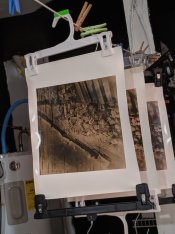
Still needs to be pressed, but prints are much flatter than any other method I have available to me.
 

Attachments

  • PXL_20201120_030134102.PORTRAIT-02.ORIGINAL.jpg
    PXL_20201120_030134102.PORTRAIT-02.ORIGINAL.jpg
    126.7 KB · Views: 241
Agreed. My Father, back in the day, processed his own BW and stored the film rolled up in the cans 35mm came in. Thus two problems: How to remove the film without excessive scratching, and how to flatten the extricated film. Suggestions welcomed!

I assumed you mean the aluminum Kodak cans? Can you tighten the roll while inside the can by grabbing the film in the center and turning, and then lift out?

I've had success flattening old 35mm by getting it into PrintFile sleeves and then sitting it under a heavy stack of books for a couple of weeks. I shot some film from the 60s and flattened it this way, so it _should_ be possible. It was still a little curly, but only in the long dimension, which is OK to deal with.
 
Photrio.com contains affiliate links to products. We may receive a commission for purchases made through these links.
To read our full affiliate disclosure statement please click Here.

PHOTRIO PARTNERS EQUALLY FUNDING OUR COMMUNITY:


Ilford ADOX Freestyle Photographic Stearman Press Weldon Color Lab Blue Moon Camera & Machine
Top Bottom