• Welcome to Photrio!
    Registration is fast and free. Join today to unlock search, see fewer ads, and access all forum features.
    Click here to sign up

Fuji Acros II or Adox HR-50

pared_amarilla.jpg

H
pared_amarilla.jpg

  • 0
  • 0
  • 22
December Path

H
December Path

  • 3
  • 0
  • 39

Recent Classifieds

Forum statistics

Threads
201,676
Messages
2,828,392
Members
100,882
Latest member
Photriо
Recent bookmarks
0

pkr1979

Member
Joined
Jun 25, 2019
Messages
567
Location
Oslo
Format
Multi Format
Hi all,

For black and white I use mainly Ortho Plus and T-max 400. And FilmFerrania Orto 50 when I do reversal.

However, for landscapes I'd like something different - and for landscapes and cityscapes with distant objects I assume HR-50 is suitable (I've shot it as Scala 50). But as it doesn't exist in 120 I need something else. I'll probably try it either way, but I am wondering about peoples experiences with Acros ii. I am not sure if I have misunderstood this or not - but this is a film that despite being less sensitive to red it is also less sensitive to blue/uv-light - making it ideal for 'horizon'-photography as it should cut through haze? It might not be as efficient in this as HR-50 but still pretty good at it?

If this is the case - how would you compare this film and its look to other films? And any particular developer(s) that it should be developed in?

Cheers
Peter
 

Chuck1

Member
Allowing Ads
Joined
Jul 4, 2022
Messages
795
Location
Arlington ma
Format
Multi Format
I've been wondering about fuji microfine developer, any info would be appreciated
 

blee1996

Subscriber
Joined
Jul 25, 2008
Messages
1,466
Location
SF Bay Area, California
Format
Multi Format
When using same developers (Adox FX-39 II), I feel the HR-50 has higher contrast than Acros II. Thus Acros II might be better fit for high dynamic range scenes (e.g. sunrise, sunset).

In addition, Acros II has really good reciprocity characteristics for long exposures that are sometimes required for landscape.

I do like HR-50, but Acros II is a bit more flexible for my landscape use.
 
OP
OP

pkr1979

Member
Joined
Jun 25, 2019
Messages
567
Location
Oslo
Format
Multi Format
When using same developers (Adox FX-39 II), I feel the HR-50 has higher contrast than Acros II. Thus Acros II might be better fit for high dynamic range scenes (e.g. sunrise, sunset).

In addition, Acros II has really good reciprocity characteristics for long exposures that are sometimes required for landscape.

I do like HR-50, but Acros II is a bit more flexible for my landscape use.

@blee1996 - did you ever notice if the spectral sensitivity of Acros II cuts through haze like, or similar to, HR-50?
 
Joined
Nov 3, 2024
Messages
369
Location
Éire; Vic & QLD Aus rota
Format
Medium Format
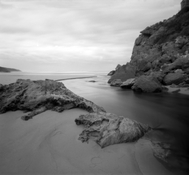
My freezer has just 4 (precious) rolls of long-ago expired ACROS II. I use it for 6x6 pinhole photography for simple landscape subjects that suit it. The defining feature of ACROS II is an almost creamy, dream-like appearance of the tonal range — far removed from the blunt edge of e.g. Delta 100 and others. No filters used with the pinhole camera.
 

Attachments

  • Gellibrand River at Lion Headland_GONP.jpg
    Gellibrand River at Lion Headland_GONP.jpg
    240 KB · Views: 72

DREW WILEY

Member
Allowing Ads
Joined
Jul 14, 2011
Messages
14,852
Format
8x10 Format
Acros (both the original and II versions) are classified as Orthopan films - not fully panchromatic, but not Orthochromatic in the restricted sense either. The effect is less red sensitivity, and conversely, more green sensitivity. You can use nearly all regular black and white contrast filters with it, provided your choice of red filter is no deeper than a 25 red. It is extremely fine grained. I rate it at 50 and develop it in PMK pyro, but any number of developers should work decently. It has its own look.

The current II version has slightly less blue sensitivity than the original Acros, and a slightly longer straight line down into the toe. But these differences are subtle. Sadly, Acros isn't available in sheet sizes anymore; but 120 roll film is easy to get.
 

Augustus Caesar

Member
Allowing Ads
Joined
Oct 30, 2023
Messages
488
Location
Cleveland
Format
35mm
Hi all,

For black and white I use mainly Ortho Plus and T-max 400. And FilmFerrania Orto 50 when I do reversal.

However, for landscapes I'd like something different - and for landscapes and cityscapes with distant objects I assume HR-50 is suitable (I've shot it as Scala 50). But as it doesn't exist in 120 I need something else. I'll probably try it either way, but I am wondering about peoples experiences with Acros ii. I am not sure if I have misunderstood this or not - but this is a film that despite being less sensitive to red it is also less sensitive to blue/uv-light - making it ideal for 'horizon'-photography as it should cut through haze? It might not be as efficient in this as HR-50 but still pretty good at it?

If this is the case - how would you compare this film and its look to other films? And any particular developer(s) that it should be developed in?

Cheers
Peter
Acros II in FX-39 is as good as it gets.
 

albireo

Subscriber
Joined
Nov 15, 2017
Messages
1,619
Location
Europe
Format
Multi Format
However, for landscapes I'd like something different - and for landscapes and cityscapes with distant objects I assume HR-50 is suitable (I've shot it as Scala 50). But as it doesn't exist in 120 I need something else. I'll probably try it either way, but I am wondering about peoples experiences with Acros ii. I am not sure if I have misunderstood this or not - but this is a film that despite being less sensitive to red it is also less sensitive to blue/uv-light - making it ideal for 'horizon'-photography as it should cut through haze?

For this particular purpose, in 120, I'd like to suggest a second option: Rollei Retro 400S. Expose it at 100-125. No filters! It's already extremely red sensitive, for obvious reasons (rumored to be, or be derived from, Agfa Aviphot 200 aerial stock). Develop it in something very diluted, for a longish time. Adox should have something suitable.

I think it will be close to what you're looking for.
 

cirwin2010

Member
Allowing Ads
Joined
Jan 3, 2021
Messages
239
Location
Massachussetts
Format
Analog
Across II is my favorite film in 120 format. I find it works exceptionally well in low light and long exposure scenarios. My current preferred way to develop it is as follows:

Rodinal 1+100
18 Minutes @ 68F
Agitation: 15 secs per min for 3 mins, then 1 inversion every 3 mins.

The above combination gives me incredibly sharp and detailed results that hold up well to 8-10x enlargements (16x20") prints. Even enlarged that much, if I inspect the prints up close or even using a magnifier, there is still more detail there. With good technique when shooting, it is the highest resolving film I have tried. Acros II in 120 is comparable and sometimes beats my 4x5 in terms of detail at similar print sized. I am using Hp5+ on my 4x5 so it isn't an apples-to-apples comparison.

I briefly tried some other developers with Acros II. I tried hc-110 dilution B and FX-39 II. They both yielded practically invisible grain when compared to Rodinal 1+100. This made using my grain focuser a bit challenging and created less apparent sharpness. I just found Rodinal to look good to my eyes and stuck with it.

I find that the film has adequate red sensitivity and works with red filters as well as anything else. Looks at spectral sensitivity curves it is about the same as other conventional films.
 

DREW WILEY

Member
Allowing Ads
Joined
Jul 14, 2011
Messages
14,852
Format
8x10 Format
No, the cutoff point of Acros in the red is sooner than most typical pan films. You need to look at those spectral sensitivity charts more closely. It is officially classified as something else for a reason. Just try using a deep red 29 filter and see what happens. Even using a greater filter factor won't retrieve all the information. Another evidence is how green, the complement to red, reproduces so much lighter. For example, a light green 11 or X0 filter with Acros will have just as much effect as a rather dark green filter on regular pan film.
 

Augustus Caesar

Member
Allowing Ads
Joined
Oct 30, 2023
Messages
488
Location
Cleveland
Format
35mm
No, the cutoff point of Acros in the red is sooner than most typical pan films. You need to look at those spectral sensitivity charts more closely. It is officially classified as something else for a reason. Just try using a deep red 29 filter and see what happens. Even using a greater filter factor won't retrieve all the information. Another evidence is how green, the complement to red, reproduces so much lighter. For example, a light green 11 or X0 filter with Acros will have just as much effect as a rather dark green filter on regular pan film.
I have noticed that greens show lighter on Fuji B&W films than on Ilford films.
 

Augustus Caesar

Member
Allowing Ads
Joined
Oct 30, 2023
Messages
488
Location
Cleveland
Format
35mm
No, the cutoff point of Acros in the red is sooner than most typical pan films. You need to look at those spectral sensitivity charts more closely. It is officially classified as something else for a reason. Just try using a deep red 29 filter and see what happens. Even using a greater filter factor won't retrieve all the information. Another evidence is how green, the complement to red, reproduces so much lighter. For example, a light green 11 or X0 filter with Acros will have just as much effect as a rather dark green filter on regular pan film.
Tri-X was a "Type B" emulsion, with extra red sensitivity for indoor work, I believe.

See this:


1763778435796.jpeg
 

cirwin2010

Member
Allowing Ads
Joined
Jan 3, 2021
Messages
239
Location
Massachussetts
Format
Analog
No, the cutoff point of Acros in the red is sooner than most typical pan films. You need to look at those spectral sensitivity charts more closely. It is officially classified as something else for a reason. Just try using a deep red 29 filter and see what happens. Even using a greater filter factor won't retrieve all the information. Another evidence is how green, the complement to red, reproduces so much lighter. For example, a light green 11 or X0 filter with Acros will have just as much effect as a rather dark green filter on regular pan film.

I'm looking at the datasheet provided by Fuji for Across II. It shows sensitivity all the way out to 650nm. This is comparable to other films such as Tri-x and HP5+.

I've used this film with a red filter with success. I admit I haven't tried a deep red with it yet. My deep red filter works great with HP5+ as a reference point.

It appears that Acros had less red sensitivity than Acros II, but I never tried the original version first hand.
 

loccdor

Member
Joined
Jan 12, 2024
Messages
2,546
Location
USA
Format
Multi Format
When using same developers (Adox FX-39 II), I feel the HR-50 has higher contrast than Acros II. Thus Acros II might be better fit for high dynamic range scenes (e.g. sunrise, sunset).

You've described exactly the way I like to use them.

The two films are my go-to slow high resolution pair. I don't really need any other slow B&W films than those.

In harsh sunny 16, I prefer Acros and expose a bit towards the shadows. I develop it in HC-110 H dilution 10 minutes 20C.

In sunny 11, or overcast 8, Scala 50 as negative in Rodinal semi-stand 1+50 10 minutes 22C one gentle inversion halfway. Also for infrared at 6 ISO.

Acros in EV 15:

54751998507_03cb550a50_k.jpg


Scala 50 in EV14:

54233718417_58e466b5d8_k.jpg


Acros is more of a jack of all trades with the exception that it can't do infrared. Scala's contrast can be a bit much for portraits. Maybe with a green filter it could work better for that.
 

DREW WILEY

Member
Allowing Ads
Joined
Jul 14, 2011
Messages
14,852
Format
8x10 Format
Note that Acros has a dip in green sensitivity analogous to true pan films. Therefore its effective extra sensitivity to green is due to its lesser sensitivity to red. One reason for its orthopan tweak might have been for sake of achieving its extra fine grain.

I got into Acros when Fuji came out with it in 4x5 Quickload sleeves, convenient for backpacking. Kodak Readyload sleeves were still "double" and held two sheet of film each, and were far less reliable than when they finally switched to single-sheet themselves. I shot a lot of Acros in the mountains. The foliage came out more realistic than typical pan films like FP4; but with careful exposure, it could handle gleaming ice and shimmering glacial polish on granite well too.

The look of the recent II version is only slightly different. But I appreciate the slightly longer straight line down into the toe of the new product; it allows to me successfully shoot at 100 once in awhile, rather than at my typical 50 for sake of better shadow separation.
 

MCB18

Subscriber
Allowing Ads
Joined
Jan 16, 2023
Messages
1,352
Location
Colorado
Format
Medium Format
However, for landscapes I'd like something different - and for landscapes and cityscapes with distant objects I assume HR-50 is suitable (I've shot it as Scala 50). But as it doesn't exist in 120 I need something else.

If you are simply looking for HR-50/Scala 50 in 120, Rollei 80s is the film for you! They’re both Aviphot 80, although Adox is having you overexpose and pull it a bit to tame the contrast. I buy it as Astrum FN-64 and shoot at EI 64 and it is a wonderful film!

Hope that helps!
 

popdoc

Subscriber
Allowing Ads
Joined
Jul 14, 2015
Messages
28
Location
Virginia
Format
Large Format
Was in Big Bend national park for a week shooting day and late at night with Acros II 120, processed it all save for 3 rolls in FX39-II and the results were exceptional and both scanned and printed wet beautifully.
1764339538896.jpeg
 
Photrio.com contains affiliate links to products. We may receive a commission for purchases made through these links.
To read our full affiliate disclosure statement please click Here.

PHOTRIO PARTNERS EQUALLY FUNDING OUR COMMUNITY:


Ilford ADOX Freestyle Photographic Stearman Press Weldon Color Lab Blue Moon Camera & Machine
Top Bottom