Foma/Arista, ISO and developers
I've been mucking around with the Foma/Arista films for a few years, as much as anything because of the price. It makes for excellent film to shoot with cost impunity and run film through antiques with questionable exposure control. It's also great stuff for my students to learn with when trying their hand and smelly analog ways.
There's always been a lot of debate about the "real" ISO of these films with the general consensus that they are about a stop below box speed. But ISO is frankly a matter of intention.
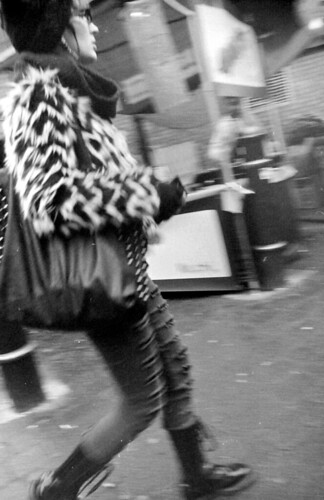
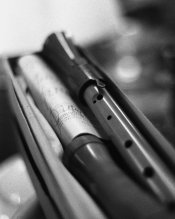
When exposed at box speed and souped in common developers like D-76, Xtol, HC-110 etc., you will get nicely separated highlights and midtones with a fair loss of shadow detail. Lab workers who have densitometers will generally and correctly argue that ISO is determined by the shadow detail, therefore the Foma films are overrated on their box ISO. But that's also a matter of taste. I find the Foma films are perfect for achieving a very popular look (often reproduced in digital) where you hold that highlight and midtone detail and let the shadows go almost black. It can be a very beautiful look, hence the digital imitation. I rush for these films when I am visualizing this way, both the 100 and 400 (I haven't personally used much of the 200). If I am trying to hold shadow detail I'll use a different film or rate the Foma lower (or just meter for the shadows -- same thing).
Needless to say, this isn't low-light film. If you are looking for fast ISO or a good push, try a different film -- Tmax, Tri-X, Delta...
I've also found that the 100 and 400 tolerate highlight overexposure extremely well in the developers I use, so I can simply expose for the shadows when needed. Here I find the 100 great at ISO 50, and the 400 at ISO 100. Great shadows, held highlights.
That works particularly well with Rodinal(s) at 1:100, stand developing with minor agitation at 30 minutes. Very sharp, good grain and an individual tonality. But one of my favorite developers for them is Crawley's FX-15 (née Acutol S). It's a speed-increasing developer that injects a bit more shadow detail than D-76 etc., and also does a fine job with highlights. It's a solvent developer so the grain is a little softer than Rodinal, but still adequately acute for a sizable enlargement, particularly in large format. Does well in rotary too. Formula easily found online. Easily mixed. Good keeping.
Fomapan 100 @ 100 in FX-15 1:1 -- 11min @ 20C/68F (rate at 50 for shadows.)
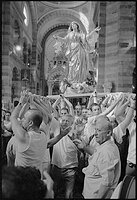
Fomapan 400 @ 200 in FX-15 1:1 -- 13min @ 20C/68F (rate at 100 for shadows. Rate at 400 for highs and mids but dropped shadows photojournalism style.)
I'm getting ready to try some in Crawley's even-more-speed-increasing FX-11, just out of curiosity. If it looks interesting I'll update here.
Another developer I've found that it loves is
Harald Leban's Beutler-Pyro. Here you get about as much compensation as the FX-15, with slightly more acutance, though with longer times on the 400 (try 14 min.). The image-specific stain does very well with the highlights.
Go out and play! Love your film for its unique characteristics -- it doesn't all have to fit in particular tone curves. That's why film is more interesting than digital!
The Perfesser





 )
)