

I've been wondering about the comparison of the two. I have a Canon FD macro bellows setup with a film copying attachment, but lack the macro lens, and am uncertain if I want to invest in another lens; Money could be used elsewhere on needed photographic stuff. My scanner on the other hand is a cheap Epson 4490 and it would certainly cost quite a bit more then buying a lens to upgrade. Still, I do want the best output on a beer belly budget. With the digital camera I do have options thru the menu system to save as a raw file and change color recording parameters but it can't compete with a scanners ability in dust removal. Anyone ever try digitally re-photographing with their DSLR?
-
Welcome to Photrio!Registration is fast and free. Join today to unlock search, see fewer ads, and access all forum features.Click here to sign up
You are using an out of date browser. It may not display this or other websites correctly.
You should upgrade or use an alternative browser.
You should upgrade or use an alternative browser.
Flatbed Scanning vs DSLR re-photographing?
-
H
- Thread starter waynecrider
- Start date
Recent Classifieds
-
For Sale Bogen Salon Special, 6x6 enlarger w/ lens
- Started by wiltw
-
Sold SOLD!
- Started by B.S.Kumar
-
For Sale FS: Verito Diffused Focus 8 3/4 in f/4 Lens
- Started by B.S.Kumar
-
For Sale FS: Toyo 810G Monorail Camera
- Started by B.S.Kumar
-
For Sale Contax Hologon 16mm f8 Leica-M Converted
- Started by eftones
Forum statistics

Digitizing film with a DSLR has been tried and reported over and over again. Short summary from what I've read: it works but it's a lot of hassle and the results are not better than what even an old flat bed scanner can deliver. Needless to say there will be people who claim their Canon D30 used as a scanning device outperformed a drum scanner and others who claim an office scanner beat their Nikon D3x.
And i asked question on some of those forums and never answered me, how will be the comparison between flatbed scanner or even Nikon film scanner against digital medium format with Macro sharpest lens and tilt/shift ability, will this still not beating any scanner?

And i asked question on some of those forums and never answered me,
not exactly ...
your post here is exactly under mine where I had said I would offer to do a comparison ... but no takers
and later on the next page there were quite a few answers perhaps not addressed directly to "dear TareqPhoto"
also on this thread, there are some answers.
Its to take the time to provide answers and not be thanked or recognized. I no longer expect anything more than a silent absence to the questioner after going to much trouble to answer a question (which one assumes they've bothered to check and read the answers {but can't be certain of that})
Wow, this one got contentious but quick...and out of nowhere.
It's a good question, and one that ought not be sidetracked so early.
This is how I copy my prints and digitize most negs (which is not often). It works fine, and it is more versatile and faster than a scanner. You can shoot an object of any size. Additionally, you can use HDR techniques for tough negatives, and do many other "artistic" things. It is very useful for screen printing, for instance. (I usually use medium format film for screen prints, but small format digital could be used just as well.)
With this option for digitization, I have decided that a flatbed scanner would not be a good investment for me. For some, it might be.
It doesn't compete with a drum scanner upon the most critical of observations, but how critical does the copy need to be, and how much money do you have to pay for drum scans?
FD macro lenses are not that expensive, and need not be used for macro pix alone.
FWIW, you do not need a bellows unit for doing this. It is overkill, and will make things more cumbersome and slow. I use the Canon compact macro on a 10D, with extension tubes for the rare occasion in which I want to copy a 35mm neg. Do you ever use the bellows? You could sell that to fund the macro lens.
It's a good question, and one that ought not be sidetracked so early.
This is how I copy my prints and digitize most negs (which is not often). It works fine, and it is more versatile and faster than a scanner. You can shoot an object of any size. Additionally, you can use HDR techniques for tough negatives, and do many other "artistic" things. It is very useful for screen printing, for instance. (I usually use medium format film for screen prints, but small format digital could be used just as well.)
With this option for digitization, I have decided that a flatbed scanner would not be a good investment for me. For some, it might be.
It doesn't compete with a drum scanner upon the most critical of observations, but how critical does the copy need to be, and how much money do you have to pay for drum scans?
FD macro lenses are not that expensive, and need not be used for macro pix alone.
FWIW, you do not need a bellows unit for doing this. It is overkill, and will make things more cumbersome and slow. I use the Canon compact macro on a 10D, with extension tubes for the rare occasion in which I want to copy a 35mm neg. Do you ever use the bellows? You could sell that to fund the macro lens.
Last edited by a moderator:
Wow, this one got contentious but quick...and out of nowhere.
sorry if my reply sounded contentious. Its just that it has been done over and over and the results are easily found by searching.
I have made a number of posts where I feel that with anything short of a 5DMkII you'll get inferior results to even an Epson 4990, you won't have the control you won't have dust removal, they lack the range needed for recording negative and you won't have any automation.
I use a DSLR for copying text in books and magazines (as do commercial machines) but for copying film you have different criteria
naturally people will long to do this and if that's their choice then its really up to them. I do recall one post where someone posted some benefits ...
if you develop a workflow then please by all means publish it, I'd be happy to work with the results and even make a comparison scan on my gear here ... all for the love of it.

sorry if my reply sounded contentious. Its just that it has been done over and over and the results are easily found by searching.
I have made a number of posts where I feel that with anything short of a 5DMkII you'll get inferior results to even an Epson 4990, you won't have the control you won't have dust removal, they lack the range needed for recording negative and you won't have any automation.
I use a DSLR for copying text in books and magazines (as do commercial machines) but for copying film you have different criteria
naturally people will long to do this and if that's their choice then its really up to them. I do recall one post where someone posted some benefits ...
if you develop a workflow then please by all means publish it, I'd be happy to work with the results and even make a comparison scan on my gear here ... all for the love of it.
Wow Sir you really must know allot of using a digital camera to make a picture of a picture made on film. So should my workflow should include a 5dMII or a scanner to get from film to digital. I have many LF film files from 6x17 to 8x10. Also want to convert 8x10 glass plates as well as do reversal. I was thinking iof buying a professional drum scanner Optronics ColorGetter Eagle Drum Scanner
So the mII is the way to go. Please can you provide access to your personal testing. I have see drum scanner but glass plates aren't going to be an option.
In case this is serious
personally I don't find a DSLR the "way to go" and my testing on this has not been remotely successful enough to bother with publishing it Certainly with glass plates in 8x10 size there may be some advantages, however I'd suggest that you get a flatbed scanner such as an Epson 4870 / 4990 and
- remove the glass; make or have made an acrylic holder to replace the glass and allow you to sit the plates on a holder
or
- use some small soft plastic stoppers to hold the glass plate above the scanner glass by 1~2 mm to 1) prevent any newton rings 2) put the emulsion at the ideal focusing distance 3) make it faster to scan
even 1200dpi scans (and noone seems to dispute that 1200 is outside the scope of resolution on the above Epsons) of 8x10 glass plates will yeild huge files and likely obtain all the detail that was present from the original optics.
If you factor in the buggerising around with a DSLR (making mounts, setting lighting, reducing reflections ... I'm sure you'll be quite some way towards being done ... unless you're doing thousands for a museum.
I'll be interested to see you get 12,000 x 9600 pixels out of the 8x10 plate using your 5DMkII
So should my workflow should include a 5dMII or a scanner to get from film to digital. I have many LF film files from 6x17 to 8x10. Also want to convert 8x10 glass plates as well as do reversal. I was thinking iof buying a professional drum scanner
personally I don't find a DSLR the "way to go" and my testing on this has not been remotely successful enough to bother with publishing it Certainly with glass plates in 8x10 size there may be some advantages, however I'd suggest that you get a flatbed scanner such as an Epson 4870 / 4990 and
- remove the glass; make or have made an acrylic holder to replace the glass and allow you to sit the plates on a holder
or
- use some small soft plastic stoppers to hold the glass plate above the scanner glass by 1~2 mm to 1) prevent any newton rings 2) put the emulsion at the ideal focusing distance 3) make it faster to scan
even 1200dpi scans (and noone seems to dispute that 1200 is outside the scope of resolution on the above Epsons) of 8x10 glass plates will yeild huge files and likely obtain all the detail that was present from the original optics.
If you factor in the buggerising around with a DSLR (making mounts, setting lighting, reducing reflections ... I'm sure you'll be quite some way towards being done ... unless you're doing thousands for a museum.
I'll be interested to see you get 12,000 x 9600 pixels out of the 8x10 plate using your 5DMkII
I'll be interested to see you get 12,000 x 9600 pixels out of the 8x10 plate using your 5DMkII
While not practical for high-volume work, there's no reason one couldn't shoot the 8x10 in 4 or 6 or even 9 sections. 9 sections is still between 1:2 and 1:3 reproduction ratios. Pretty easy to achieve with just extension tubes (or a dedicated macro, of course). Since it's flat art (and no parallax), re-assembling would be fairly trivial. DPP provides lens distortion corrections, or they can be computed by the stitching program.
Now, mind you, I've never done this. But if I had a single (or few) 8x10's that needed digitizing and I didn't have a scanner, this is what I'd do. With enough dilligence, there's no reason you couldn't approach 35000 pixels in the long dimension using a DSLR and re-photographing.
--Greg

I've photographed negs of various formats in sections and stitched, and indeed, this is one of the attractions of this method--you can get as much resolution as you need and as your technique and equipment allow. The practical limit, I've found, is on the order of 5000 ppi.
In practice, this doesn't always mean scanning the full neg or slide at high res, but it may involve deciding that a certain crop works for some specific purpose, then going back and reshooting that crop full frame, rather than reshooting the whole neg in nine panels, stitching and cropping.
In practice, this doesn't always mean scanning the full neg or slide at high res, but it may involve deciding that a certain crop works for some specific purpose, then going back and reshooting that crop full frame, rather than reshooting the whole neg in nine panels, stitching and cropping.
While not practical for high-volume work, there's no reason one couldn't shoot the 8x10 in 4 or 6 or even 9 sections. 9 sections is still between 1:2 and 1:3 reproduction ratios. Pretty easy to achieve with just extension tubes (or a dedicated macro, of course).
undoubtedly ... but if I was faced with a project like this, I'd still go the flatbed. One can do anything one likes and impose any restrictions or criteria upon how to do it one wants to. I'm familiar with equipment which uses DSLR's to digitise books for instance:
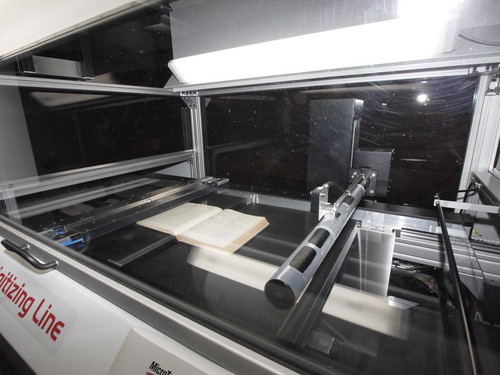
, but that design may be driven as much by constraints as by "what works best"

I realize this thread has gone a bit stale now, but I felt I should comment, since I have direct experience with the question the OP had.
I have thousands of slides and negatives that I've wanted to digitize for a while now. I began to digitize them with the first scanner I owned that had enough resolution to consider doing so. It was an Epson 3170, with a max optical res of 3200 ppi, and it did a decent job, but I could tell when examining my slides under a loupe that I wasn't getting all the detail. So eventually I upgraded to an Epson 4990, which has a claimed max optical res of 4800 ppi, but which in fact doesn't have a much better resolution than the 3170 does. I determined to my satisfaction that my 4990 scans at about 2000 ppi. On a good day. Which it turns out is about typical for a flatbed scanner. Even the vaunted Epson V7xx series don't put out much more resolution than the 4990 does. And of course, when examining my slides with a loupe after scanning with the 4990 I could see that I was still not getting all the detail that was there.
And then I found out about "digital slide duplicators". At the time, they were all over eBay. Probably still are. I found some info on them and the results looked really good, so I bought one. Problem with using a "digital slide dupicator" with your DSLR is the resolution is dependent upon the zoom lens you're using. And chances are you'll need to use a zoom unless you own a full frame DSLR because the focal length you'll need --- or the one I needed anyway -- is about 70mm, maybe just a shade less. So, I was using an EF 28-80 zoom, which was just okay, and to make things annoying, every time I inserted a new slide in the holder, the camera would refocus, so I'd have to manually straighten the slide because the front element rotates, donchaknow. Well, I persevered, though, and shot a bunch of dupes using my 28-80 lens and they were definitely, without question, sharper than the scans I was getting from my Epson 4990. But using that 28-80 zoom was bothering me. I had a growing suspicion that it was the Achilles heel in my setup.
So I got industrious. I removed the slide holder from my duplicator because it wasn't adjustable. Nowadays the ones I've seen are, which is good. And I modified the duplicator tube so it would accept a stage. I had previously bought an 80's vintage zoom slide duplicator with both slide and roll film stages, and I used these. Next, I removed the inner corrective lens from the duplicator. The tube has 52mm threads, so I just threaded it directly onto my Micro-Nikkor 55mm f/3.5 lens. To get things to focus where the slide or negative was the right size, I had to use extension tubes with the Nikkor 55mm. In my case, I needed 30mm. So that was the totality of my outfit: an adapter for my EOS camera to the Nikon F T-mount, 30mm of tubes, the Micro-Nikkor 55mm lens, the optical tube from the "digital slide duplicator" and the slide (or negative) stage.
This setup has worked great. For one thing, the lens's front element doesn't turn. For another, it's a flat-field macro and it's extremely sharp. I use my camera's Live View function to nail focus, stop the lens down to f/8, set up a off-camera flash, and fire away. And yes, the images from this rig are noticeably sharper than they were when I was using the 28-80 zoom.
Now, my DSLR is just a cheezy, entry-level Canon with 10.2 mp of resolution. This translates into about 2600 ppi of true image resolution, which is better than any flatbed that I know of. But just think what this rig would be like with a T3i or a 7D, eh? And if you have a full frame camera, then you don't need to mess with all this cobbling together of stuff. Just get a good macro bellows with slide copier stage and a macro lens, and use that instead. Or a 1:1 macro lens would probably work, too, but you'd have to figure out a way to mount the slide or negative.
In an earlier thread, where I mentioned that I used this rig, pellicle commented that this setup couldn't compare to a scanner that you can load up with a bunch of slides or negs, set things up, click on scan and then walk away from the scanner for however long. Well . . . that's true. But the scans from a flatbed are inferior, for one thing, and for another, I can usually scan about three or four slides per minute using my rig. It takes longer with negs because repositioning them accurately takes longer. So, even though I can't walk away from my rig, I can make the dupes a lot faster, and they're better to boot.
So now that I've determined to my satisfaction that duping 35mm slides and negatives in some cases (b&w are easy, color can be a problem) works better than scanning them, I'm faced with this dilemma: do I go to all the trouble of archiving all my slides and negs with my cheezy 10.2 mp camera, or do I wait until I get one with better resolution? This question has become so troubling to me that I have decided to halt the process of archiving my images and wait until I buy a DSLR with higher resolution. With some of the images I have, my camera with this rig will resolve the individual particles of grain, but with others, especially Velvia, it doesn't resolve the grain at all. Hence my concern more than ever that I should get a DSLR with more resolution. Especially since, for what the high-end Nikon scanners go for these days, I can buy a much better camera than what I have now.
Sorry for the length of this post, but I figured I'd give you the complete rundown from beginning to end.
I have thousands of slides and negatives that I've wanted to digitize for a while now. I began to digitize them with the first scanner I owned that had enough resolution to consider doing so. It was an Epson 3170, with a max optical res of 3200 ppi, and it did a decent job, but I could tell when examining my slides under a loupe that I wasn't getting all the detail. So eventually I upgraded to an Epson 4990, which has a claimed max optical res of 4800 ppi, but which in fact doesn't have a much better resolution than the 3170 does. I determined to my satisfaction that my 4990 scans at about 2000 ppi. On a good day. Which it turns out is about typical for a flatbed scanner. Even the vaunted Epson V7xx series don't put out much more resolution than the 4990 does. And of course, when examining my slides with a loupe after scanning with the 4990 I could see that I was still not getting all the detail that was there.
And then I found out about "digital slide duplicators". At the time, they were all over eBay. Probably still are. I found some info on them and the results looked really good, so I bought one. Problem with using a "digital slide dupicator" with your DSLR is the resolution is dependent upon the zoom lens you're using. And chances are you'll need to use a zoom unless you own a full frame DSLR because the focal length you'll need --- or the one I needed anyway -- is about 70mm, maybe just a shade less. So, I was using an EF 28-80 zoom, which was just okay, and to make things annoying, every time I inserted a new slide in the holder, the camera would refocus, so I'd have to manually straighten the slide because the front element rotates, donchaknow. Well, I persevered, though, and shot a bunch of dupes using my 28-80 lens and they were definitely, without question, sharper than the scans I was getting from my Epson 4990. But using that 28-80 zoom was bothering me. I had a growing suspicion that it was the Achilles heel in my setup.
So I got industrious. I removed the slide holder from my duplicator because it wasn't adjustable. Nowadays the ones I've seen are, which is good. And I modified the duplicator tube so it would accept a stage. I had previously bought an 80's vintage zoom slide duplicator with both slide and roll film stages, and I used these. Next, I removed the inner corrective lens from the duplicator. The tube has 52mm threads, so I just threaded it directly onto my Micro-Nikkor 55mm f/3.5 lens. To get things to focus where the slide or negative was the right size, I had to use extension tubes with the Nikkor 55mm. In my case, I needed 30mm. So that was the totality of my outfit: an adapter for my EOS camera to the Nikon F T-mount, 30mm of tubes, the Micro-Nikkor 55mm lens, the optical tube from the "digital slide duplicator" and the slide (or negative) stage.
This setup has worked great. For one thing, the lens's front element doesn't turn. For another, it's a flat-field macro and it's extremely sharp. I use my camera's Live View function to nail focus, stop the lens down to f/8, set up a off-camera flash, and fire away. And yes, the images from this rig are noticeably sharper than they were when I was using the 28-80 zoom.
Now, my DSLR is just a cheezy, entry-level Canon with 10.2 mp of resolution. This translates into about 2600 ppi of true image resolution, which is better than any flatbed that I know of. But just think what this rig would be like with a T3i or a 7D, eh? And if you have a full frame camera, then you don't need to mess with all this cobbling together of stuff. Just get a good macro bellows with slide copier stage and a macro lens, and use that instead. Or a 1:1 macro lens would probably work, too, but you'd have to figure out a way to mount the slide or negative.
In an earlier thread, where I mentioned that I used this rig, pellicle commented that this setup couldn't compare to a scanner that you can load up with a bunch of slides or negs, set things up, click on scan and then walk away from the scanner for however long. Well . . . that's true. But the scans from a flatbed are inferior, for one thing, and for another, I can usually scan about three or four slides per minute using my rig. It takes longer with negs because repositioning them accurately takes longer. So, even though I can't walk away from my rig, I can make the dupes a lot faster, and they're better to boot.
So now that I've determined to my satisfaction that duping 35mm slides and negatives in some cases (b&w are easy, color can be a problem) works better than scanning them, I'm faced with this dilemma: do I go to all the trouble of archiving all my slides and negs with my cheezy 10.2 mp camera, or do I wait until I get one with better resolution? This question has become so troubling to me that I have decided to halt the process of archiving my images and wait until I buy a DSLR with higher resolution. With some of the images I have, my camera with this rig will resolve the individual particles of grain, but with others, especially Velvia, it doesn't resolve the grain at all. Hence my concern more than ever that I should get a DSLR with more resolution. Especially since, for what the high-end Nikon scanners go for these days, I can buy a much better camera than what I have now.
Sorry for the length of this post, but I figured I'd give you the complete rundown from beginning to end.
- Joined
- Jul 4, 2009
- Messages
- 146
- Format
- 35mm
Your findings match my suspicions given the surprisingly good results I was able to get from my D80 and a lightbox and a foam tube to block light. I would expect a macro lens and bellows to give excellent quality. However, the Nikon Coolscan would give you ICE. To me, a scanner without good ICE is like an shoe that perpetually has a stone in the heel. I just can't tell you how much I hated spotting dust out of my scans when I had an ICE-less scanner. Some people don't seem to mind but I would walk a hundred miles for the excellent ICE on the latest Nikon scanners.
No need to go overboard with a clumsy bellows unless it is needed. It should not be necessary, even for copying 35mm film frames. A 50mm macro lens with a 50mm extension is the most you would ever need, and that is on an FX or equivalent format digital camera, copying tiny 35mm film frames. Even less magnification is needed with APS-H or APS-C cameras. When I used to copy film and prints for a museum exhibit prep company, we used a 1Ds with a 50mm compact macro on a backlit copy stand, and no extensions of any kind. Most of the work was 4x5 or larger, though.
Having a backlit copy stand would definitely make the process easier. I don't have one, but I've thought about buying one of the "industrial strength" slide duplicators I see on eBay from time to time like the old Honeywell Repronars or Bowens Illumitrans. They must have been really expensive in their day, and now they usually go for pretty cheap. That would take care of the problem and obviate the need for my cobbled together rig.
As for ICE, I've heard good things about Nikon's implementation of it. But can't say the same thing about Epson's. My 4990 has ICE and the first thing I noticed when I used it was that it really slowed down the scanning process and it also noticeably reduced the sharpness of the image. I could have lived with the slowness, but I found any image sharpness reduction to be unacceptable, so I never use ICE as a result. As for getting rid of the dust, I only do that on images that will be included in my portfolio. Yeah it can be annoying, but I've gotten pretty good at it and it usually doesn't take me all that long to clean an image these days. Those images that go into the archive will be cleaned if and when I will ever need to display them.
As for ICE, I've heard good things about Nikon's implementation of it. But can't say the same thing about Epson's. My 4990 has ICE and the first thing I noticed when I used it was that it really slowed down the scanning process and it also noticeably reduced the sharpness of the image. I could have lived with the slowness, but I found any image sharpness reduction to be unacceptable, so I never use ICE as a result. As for getting rid of the dust, I only do that on images that will be included in my portfolio. Yeah it can be annoying, but I've gotten pretty good at it and it usually doesn't take me all that long to clean an image these days. Those images that go into the archive will be cleaned if and when I will ever need to display them.
Hi
since my name was mentioned ...
firstly thanks for your post as its good to read at length what others have gone through. Much like my own experiences, but you have different trade offs.
that's about what I found .. however my 4990 does have slightly better ability to get into denser areas of the neg (maninly C-41) than did my 3200 (slightly different to your 3170).
Like you I don't depend on more than 2400dpi accuracy on my scans.
but of course not an advantage over other scanners such as a Nikon which I always recommend when wanting more critical scans ...
and that has automation ... but for sure its not a flatbed.
which as I recall was my main point in the favour of the flatbed ...
its a vexing question, there are advantages to a better full frame SLR for double up use as a camera (that's a joke) and the Nikon scanner is of course not cheap. A 5D MkII however is more expensive than the LS4000 ... and of course if you're not scanning anymore (meaning your film use is legacy) then there is no need to keep it and you can on sell it
However I think its significant to mention that other people use other films than 35mm, like me. So the scans of larger formats on the flatbed start to make significantly better sence than a DSLR when you move from 35mm to 645 to 6x7 and eventually 4x5. There the 2000dpi starts to walk away from the fixed pixels you can capture in a snap using a 35mm duping arrangement.
Things are quiet here so its good to have discussion (if you ask me). So please don't interpret this as any sort of attack on your way of doing things.
since my name was mentioned ...
firstly thanks for your post as its good to read at length what others have gone through. Much like my own experiences, but you have different trade offs.
...
I have thousands of slides and negatives that I've wanted to digitize for a while now. I began to digitize them with the first scanner I owned that had enough resolution to consider doing so. It was an Epson 3170, with a max optical res of 3200 ppi, and it did a decent job, but I could tell when examining my slides under a loupe that I wasn't getting all the detail. So eventually I upgraded to an Epson 4990, which has a claimed max optical res of 4800 ppi, but which in fact doesn't have a much better resolution than the 3170 does. I determined to my satisfaction that my 4990 scans at about 2000 ppi.
that's about what I found .. however my 4990 does have slightly better ability to get into denser areas of the neg (maninly C-41) than did my 3200 (slightly different to your 3170).
Like you I don't depend on more than 2400dpi accuracy on my scans.
don't forget to factor in barrel distortion which your lens will introduce to your "scan"Problem with using a "digital slide dupicator" with your DSLR is the resolution is dependent upon the zoom lens you're using. And chances are you'll need to use
Now, my DSLR is just a cheezy, entry-level Canon with 10.2 mp of resolution. This translates into about 2600 ppi of true image resolution, which is better than any flatbed that I know of.
but of course not an advantage over other scanners such as a Nikon which I always recommend when wanting more critical scans ...
well I don't know that I said that, I merely mentioned that it was one of the factors which you need to factor in ... if its not a problem for you then its not a problem.In an earlier thread, where I mentioned that I used this rig, pellicle commented that this setup couldn't compare to a scanner that you can load up with a bunch of slides or negs, set things up, click on scan and then walk away from the scanner for however long.
the speed advantage may tip the balance of the effort / benefit analysis, but the difference between 2000dpi (the lower limit you mention for a flatbed) and the 2600 you feel you get from the DSLR is not really a large factor IMHO ... naturally the number looks better, but again if you pop it onto a Nikon LS-4000 you'll get a decent 4000 dpi AND you'll do colour negs better tooWell . . . that's true. But the scans from a flatbed are inferior, for one thing, and for another, I can usually scan about three or four slides per minute using my rig. It takes longer with negs because repositioning them accurately takes longer. So, even though I can't walk away from my rig, I can make the dupes a lot faster, and they're better to boot.
and that has automation ... but for sure its not a flatbed.
So now that I've determined to my satisfaction that duping 35mm slides and negatives in some cases (b&w are easy, color can be a problem)
which as I recall was my main point in the favour of the flatbed ...
I'm faced with this dilemma: do I go to all the trouble of archiving all my slides and negs with my cheezy 10.2 mp camera, or do I wait until I get one with better resolution? ... . Hence my concern more than ever that I should get a DSLR with more resolution. Especially since, for what the high-end Nikon scanners go for these days, I can buy a much better camera than what I have now.
its a vexing question, there are advantages to a better full frame SLR for double up use as a camera (that's a joke) and the Nikon scanner is of course not cheap. A 5D MkII however is more expensive than the LS4000 ... and of course if you're not scanning anymore (meaning your film use is legacy) then there is no need to keep it and you can on sell it
However I think its significant to mention that other people use other films than 35mm, like me. So the scans of larger formats on the flatbed start to make significantly better sence than a DSLR when you move from 35mm to 645 to 6x7 and eventually 4x5. There the 2000dpi starts to walk away from the fixed pixels you can capture in a snap using a 35mm duping arrangement.
Things are quiet here so its good to have discussion (if you ask me). So please don't interpret this as any sort of attack on your way of doing things.
Like you I don't depend on more than 2400dpi accuracy on my scans.
Well, 2400 ppi is what I've been scanning at ever since I learned the "truth" about flatbed scanners here at this forum. However, more recently, I came across a thread over at photo.net in which a member, who was also aware of the limits of his scanner noticed that he was seeing more detail when he scanned his images at max resolution compared to 2400 ppi. Here's a link to the thread:
New limits of my Epson 4490 - Photo.net Film and Processing Forum
His claim is that his 4490 scans at a max of about 2400 ppi (doubtful), but that he had to scan at 4800 ppi to get it.
Well, this really piqued my curiousity, so I tried it out on a negative that I knew to be critically sharp, and what I found was that curved lines, which showed some evidence of the "jaggies", i.e., stairsteps, had none when scanned at 4800 ppi, and same as Carlos at photo.net, this detail remained even after reducing the image size.
And to wander on even a bit further, when I first discovered that my Epsons didn't put out nearly the resolution they claimed, I had noticed that some things didn't bear out this claim. I was even down to counting pixels in one slide of an object that clearly showed substantially more color detail than 2400 ppi would have allowed. So I've always known that saying that a scanner has a true scanning resolution of, say, 2000 ppi is not without its errors. There is definitely more going on, and the scans do benefit from scanning at max resolution, even if they are reduced to the same size as 2400 ppi scans or smaller. Now, I'll admit, the differences are small, but I'm all about capturing the most resolution possible -- especially with 35mm. With medium format, it's a different story. The negative is so large that there is probably little to gain from scanning at maximum resolution.
the speed advantage may tip the balance of the effort / benefit analysis, but the difference between 2000dpi (the lower limit you mention for a flatbed) and the 2600 you feel you get from the DSLR is not really a large factor IMHO ... naturally the number looks better, but again if you pop it onto a Nikon LS-4000 you'll get a decent 4000 dpi AND you'll do colour negs better too
No dispute here. If only the LS-4000 wasn't so dang expensive, I'd consider getting one. I may have come up with a cheap alternative, though. I mentioned in another thread here, I believe, that I picked up a Konica-Minolta Scan Dual IV at a thrift store for $10. All I got was the scanner and the A/C adapter, so I didn't know if it worked or not. I put out a request on the net for the film holders, scoured the net for the software. Found the software and eventually film holders. Then found out that the scanner wasn't working properly. Oh well, I was only out about $30 total. But anyway, I also found a place that claims it can fix my scanner for $105. So, neglecting shipping charges, I should be able to have a functioning 3200 ppi scanner for about $130. I've since learned that the SC IV can be rather finicky, but that it delivers sharp scans. And I've had the opportunity to view quite a few scans made by it. Even one guy who had replaced it with an expensive Nikon scanner -- like the 8000 or something. Well, the Nikon scans were clearer, but the SD IV scans looked pretty darn good, really.
its a vexing question, there are advantages to a better full frame SLR for double up use as a camera (that's a joke) and the Nikon scanner is of course not cheap. A 5D MkII however is more expensive than the LS4000 ... and of course if you're not scanning anymore (meaning your film use is legacy) then there is no need to keep it and you can on sell it
That's the thing, though. I'm still very much an active film user, both 35mm and medium format. Right now it's looking like I'm gonna have to sell a motorcycle to afford a 5DII, and I might have enough left over for an LS-4000, but I'd rather spend it on a lens or lenses. Problem with this is, when the 5DII is obsolete and ready for the junk pile, that bike will likely have increased in value (it's a classic), which is really why I've been dragging my feet about selling it.
However I think its significant to mention that other people use other films than 35mm, like me. So the scans of larger formats on the flatbed start to make significantly better sence than a DSLR when you move from 35mm to 645 to 6x7 and eventually 4x5. There the 2000dpi starts to walk away from the fixed pixels you can capture in a snap using a 35mm duping arrangement.
Again, no argument here. I have a pretty good collection of 6x6 slides and negs that continues to grow, have recently purchased a Bronica ETRS-i, so now I have a growing collection of 6x4.5 slides and negs as well. I look forward to the days when I can move up to 6x7 and 4x5 eventually. That's why I bought my 4990.
Things are quiet here so its good to have discussion (if you ask me). So please don't interpret this as any sort of attack on your way of doing things.
Hardly. I've learned a lot from your contributions here, and hope to continue to do so.
- Joined
- Jul 4, 2009
- Messages
- 146
- Format
- 35mm
I would be that guy. I got a Coolscan 9000. I found the Scan Dual IV to be vexing but mainly because I had used a 9000 previously. Without that point of reference I would doubtless be much happier with it. In many ways it is an excellent machine.
It is fast. It is truly sharp at 3200 dpi. I was able to get some really quite good scans of Velvia using it. The weak point of this unit is its sensor and DA converter. For negative scanning (where contrast is expanded greatly) I was never happy with the results. I shoot a lot of negative.
Still, my work is there for all to see. If it looks good to you then you will be happy. But you will still need a solution for your MF film.
Here are my sets dedicated to different scanners which include Scan Dual IV and Coolscan 9000:
Collection: By Scanner
Also, if you sold the bike for a Coolscan 9000 you would be purchasing another thing that will also go up in value. And you could scan your MF film too. But the 9000 is slow for 35mm.
It is fast. It is truly sharp at 3200 dpi. I was able to get some really quite good scans of Velvia using it. The weak point of this unit is its sensor and DA converter. For negative scanning (where contrast is expanded greatly) I was never happy with the results. I shoot a lot of negative.
Still, my work is there for all to see. If it looks good to you then you will be happy. But you will still need a solution for your MF film.
Here are my sets dedicated to different scanners which include Scan Dual IV and Coolscan 9000:
Collection: By Scanner
Also, if you sold the bike for a Coolscan 9000 you would be purchasing another thing that will also go up in value. And you could scan your MF film too. But the 9000 is slow for 35mm.
I loved my Nikon Coolscan V that was given to me by a friend who moved to a flatbed. However, I used it so little after a few projects with it. And when I found out how much they sell for on the used market, I sold it (after asking my friend's permission) on Craigslist for $700 cash with no haggling required. I put the money into some darkroom equipment that I would actually use regularly. I have since moved to a digital camera and a copy stand, and I am happy with the results. A purpose-made lens makes a big difference, though. I use a borrowed EF 100mm macro, and it is great. I think 10 Mpix makes a great file size, so I would just invest in a nice macro lens and keep doing what you are doing. And, I just prefer the way copied images look to scanned images, in general. The amount of volume you can quickly handle quickly is a great benefit, and you can control your copies in Camera Raw, which I find very convenient. I plan on sticking with this for 35mm, and moving to a flatbed for larger film some day.
I would be that guy. I got a Coolscan 9000. I found the Scan Dual IV to be vexing but mainly because I had used a 9000 previously. Without that point of reference I would doubtless be much happier with it. In many ways it is an excellent machine.
Hey, thanks for checking in! I really appreciated your comparisons. That 9000 does an awesome job, but is just way way out of my price range. And you're right, you managed some great scans with the SD IV. Me, I shoot mostly slides, and when I'm shooting color film, nowadays it's usually Ektar in 35mm.
Interesting point about a 9000 vis-a-vis my bike. Food for thought . . .
Last edited by a moderator:
I have since moved to a digital camera and a copy stand, and I am happy with the results. A purpose-made lens makes a big difference, though. I use a borrowed EF 100mm macro, and it is great. I think 10 Mpix makes a great file size, so I would just invest in a nice macro lens and keep doing what you are doing. And, I just prefer the way copied images look to scanned images, in general. The amount of volume you can quickly handle quickly is a great benefit, and you can control your copies in Camera Raw, which I find very convenient. I plan on sticking with this for 35mm, and moving to a flatbed for larger film some day.
I agree about being able to manipulate the images as RAW. It is quite a bit more effective and convenient that using Epson Scan on the preview images.
I have a copy stand and actually a pretty decent selection of macro lenses: the aforementioned Micro-Nikkor 55mm f/3.5, a Vivitar 105mm f/2.5 (goes to 1:1), and a Tamron 90mm f/2.5 (1:2 w/o tubes, same as the Nikkor). This idea of back-lighting images is growing on me, but it would be more for convenience than anything else, since I've already put together a slide copy rig. And that old Nikkor, which I use in the rig, is plenty sharp.
Yeah, you'll find that a good flatbed will work great for larger film formats. My 4990 does a bang up job with medium format, and I have a friend who's a large format nut and he uses a 4990 for his 4x5 scans. He outputs his prints to a printer with high quality paper (think it's an Epson, but I'm not sure), and his prints are quite stunning, really. In fact, it was after seeing his prints that I decided to buy my lightly-used 4990.
- Joined
- Jul 4, 2009
- Messages
- 146
- Format
- 35mm
If by "RAW" you mean Lightroom then I don't see a lot of difference in flexibility between 16bit TIFFs and DSLR "RAW" files. Both seem to give me similar levels of control. I use Lightroom almost exclusively for my few DSLR sourced images as well as all my scanned images.
For me, it is the increased preparation capabilities of the program with raw files, and the speedy "work flow" for organization, editing, and preparation. Camera Raw and other similar programs can do a lot specifically with the raw files they are designed to "interpret," and do it fast, while they are more limited with tiffs or jpegs, especially in terms of contrast control (i.e. "recovery" and "fill"). I wouldn't even bother using a raw converter to prepare .tif or .jpg files for printing, other than for purposes of organization and editing. I'd go straight to Photoshop, which I find slower when working on large batches of pix.
To each his/her own, of course. I just find it incredibly convenient to work on my copies as if they were any other images from my digital camera. No extra equipment or software, and no need to change "modes" in my head when going from one to the other.
To each his/her own, of course. I just find it incredibly convenient to work on my copies as if they were any other images from my digital camera. No extra equipment or software, and no need to change "modes" in my head when going from one to the other.
Glad this thread is continuing. I'll admit, I don't use PS much for image editing, but I got curious when reading about Camera Raw. So I booted PS and loaded a raw image. Geez luiz, I've been used to Canon's DPP, which I've always thought was plenty good enough, but with Camera RAW, it appears that almost all necessary corrections can be done at the raw level before saving the file to a given file format. Wow. DPP is handy for translating quantities of files over to other formats, though. I guess CR can do this too?
| Photrio.com contains affiliate links to products. We may receive a commission for purchases made through these links. To read our full affiliate disclosure statement please click Here. |
PHOTRIO PARTNERS EQUALLY FUNDING OUR COMMUNITY:  |