


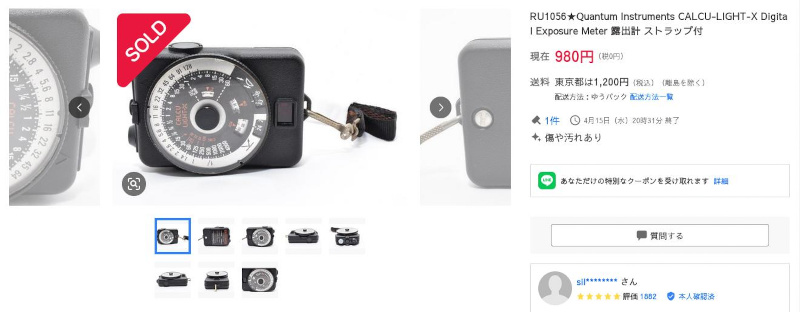
I was browsing Yahoo Auctions without any plan, just looking around, and saw a Calcu-Light-X sold for ... 980¥ (!). This is 5 to 6 €/$/£. Bought it. Description says it is untested because corrosion in the batteries housing. Big probabilities it can be fixed, anyway I have fixed several cameras and light meters corroded contacts and circuitry before.
This one:
This just in order to tell that over the years I found often valuable devices for nothing on Yahoo. Some of them, are Sekonic light meters. I have two L-428, one working, the other dysfunctional, was just in a lot with other stuff. I have otherwise all the addons: dome, lumidisc, 10°viewfinder, enlargement probe, fiber optic spot measurement.
The working one has stopped working for the H-values scale.
I have not found docs about tinkering with the L-428, so started unscrewing in order to see what. Maybe people who have also tinkered with it can contribute more details. Anyway I can share this little fix.
This L-428 uses a sliding scale in order to cover its measurement spectrum. The H-values measurements use a filter that slides between the silicone sensor and the blue filter. What happened is that it did fall out of place. The other meter has it, but it lacks the blue filter so it is good in order to better see what happens when H and L scales are switched:
after, some unscrewing, we see the pin that is pushed up by the sliding scale, through the body into the pivoting head, where it moves a spring mounted lever:
unscrewing from the front cover of the body is of no use, but it tells that in case the pivoting head needs to be remove for some other reason, there is quite some disassembly. Otherwise for such an old device it is very well done and no corrosion did sneak its way inside:
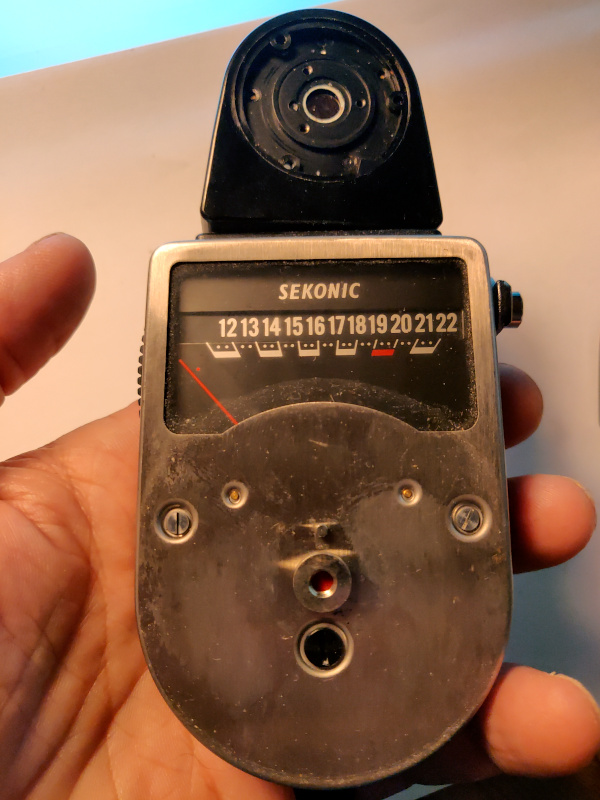
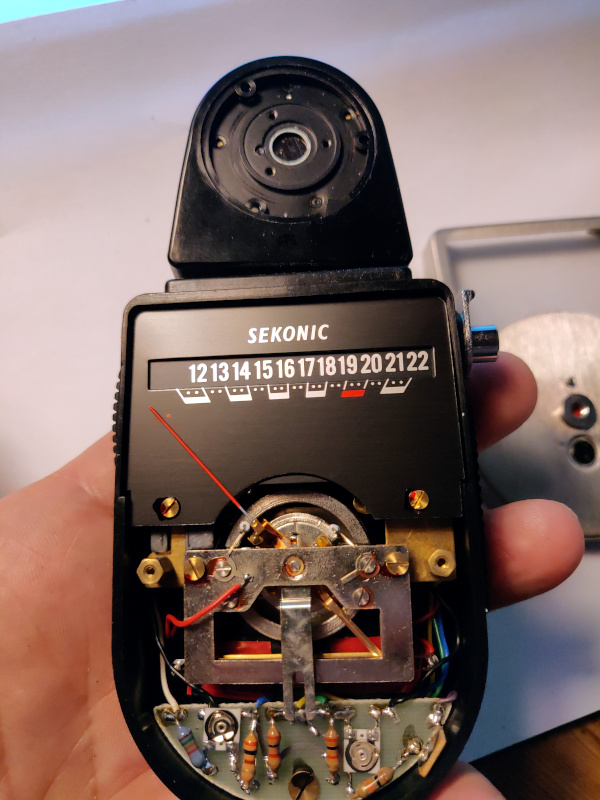
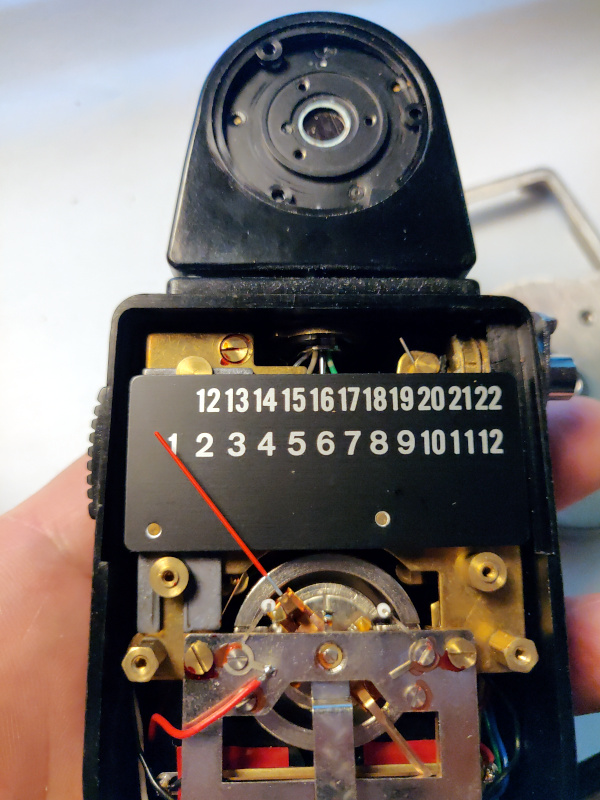
but then unscrewing from there was not needed. The fix is done by accessing inside the head.
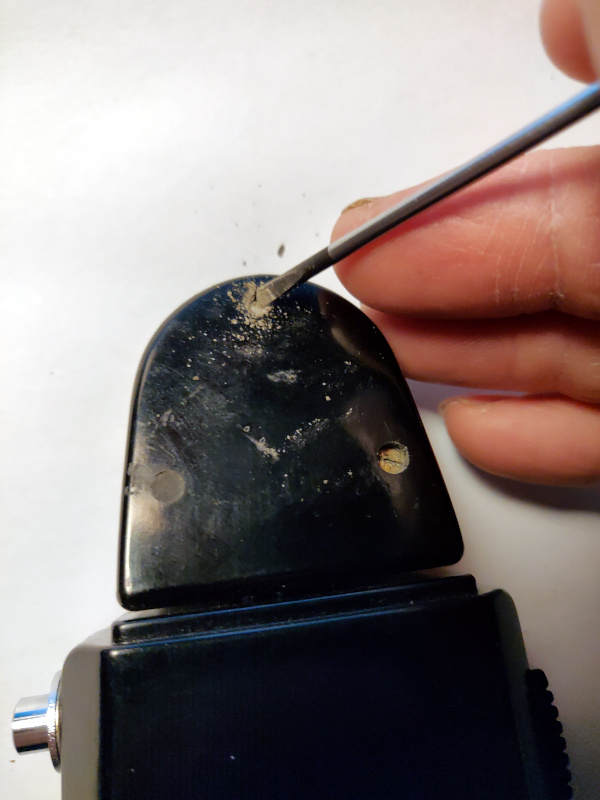
there are hard seals protecting three brass screws. Scrap away and unscrew the back cover of the head:
the board with the silicone sensor:
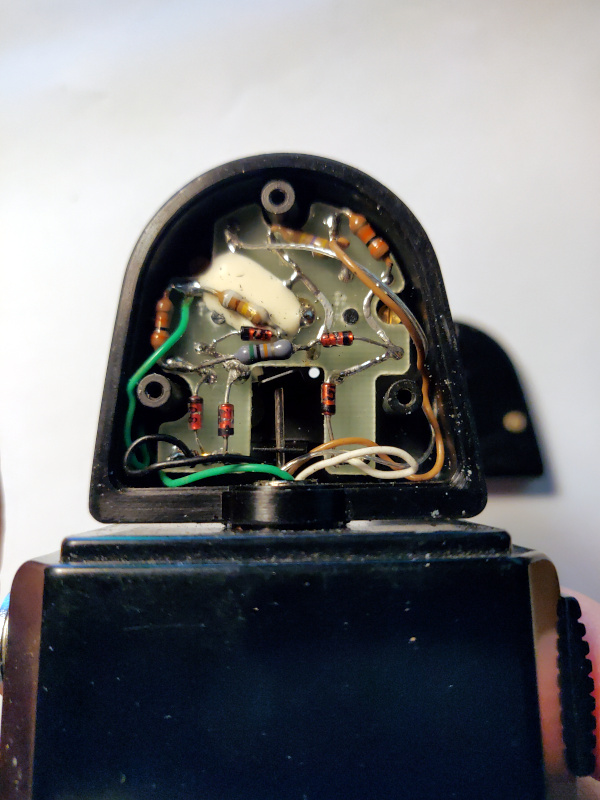
two brass screws to remove (the one on the right is visible , the other is in the shadow on the left.
Also unscrew the socket for the accessories (dome, lumidisc, viewfinder, etc) on the front:
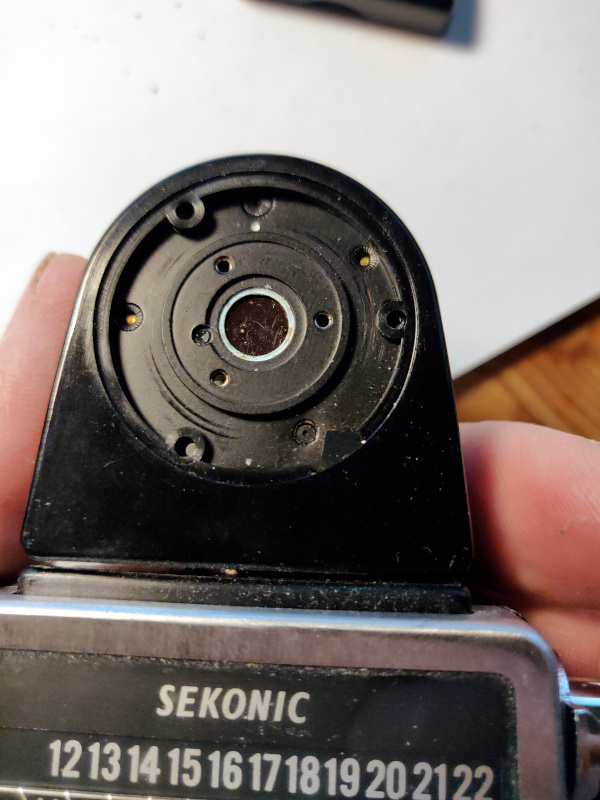
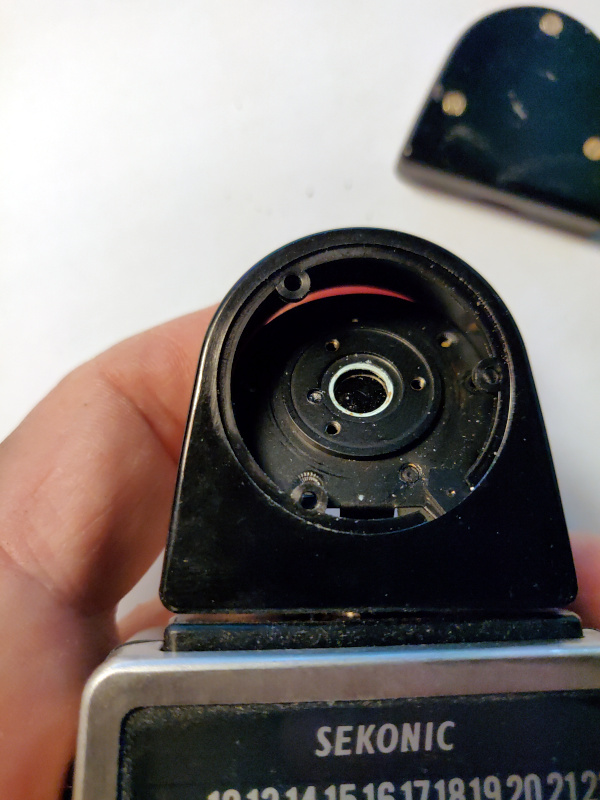
the inner ring holds the blue filter, the outer ring is the socket for accessories as well as retainer for the sensor holder:
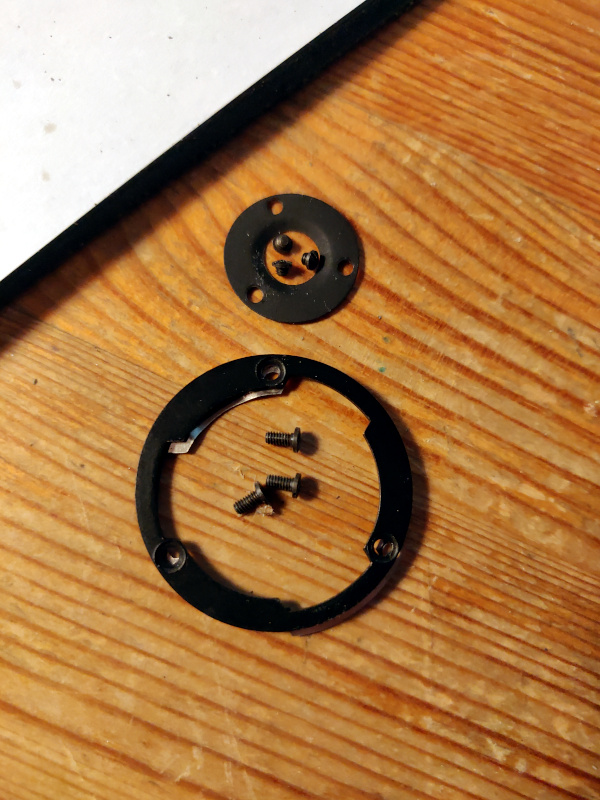
when this ring removed the sensor holder with its board is loosened:
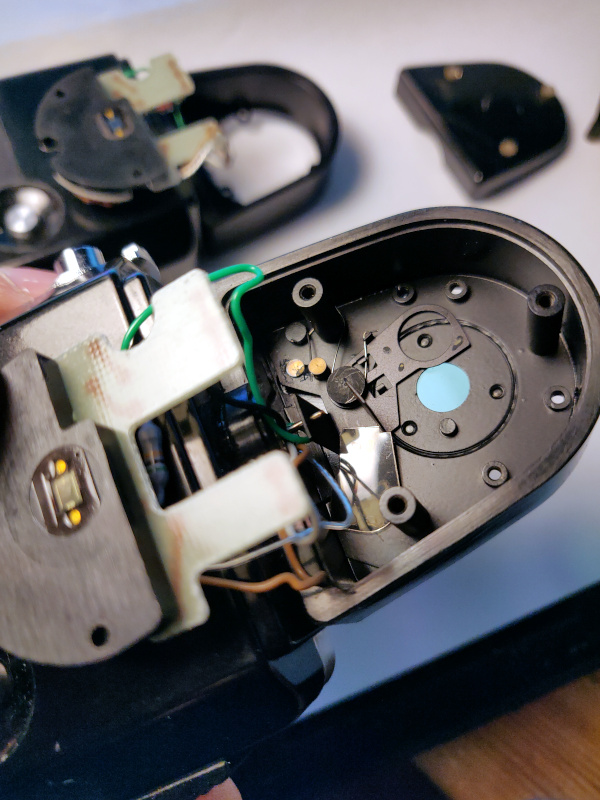
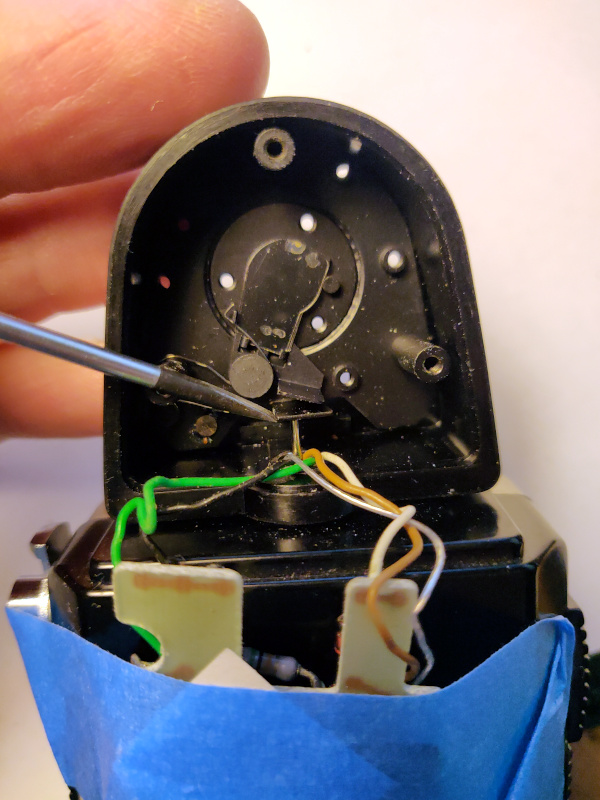
on the back, when the board with silicone sensor is moved out of the way, without need to remove wires (they are long enough), the H-values mask mechanism is accessible.
It did fall out of place. Probably the weakness of this meter, as the glue points holding this mask are very tiny:
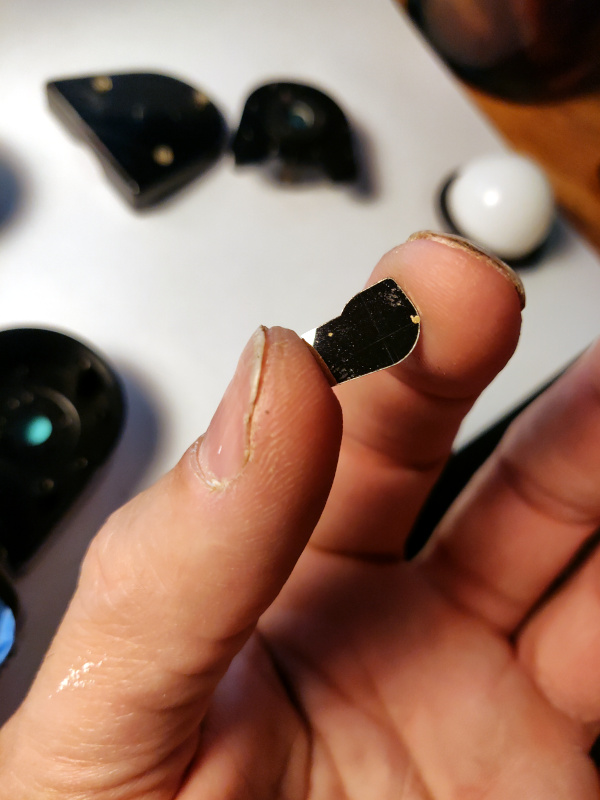
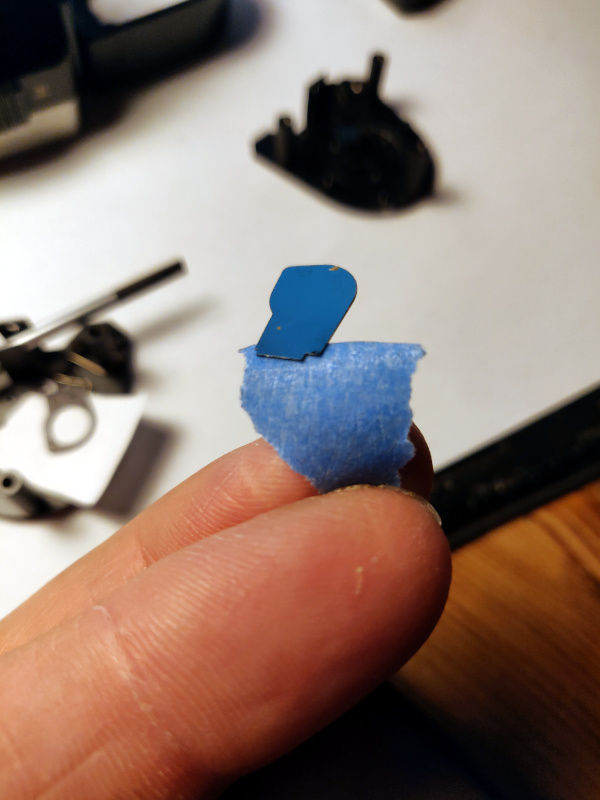
the mask is reflective but not opaque, it filters well the light, checked with the small torch of a mobile phone:
So the fix: as I have a spare L-428, I could just swap the whole part:
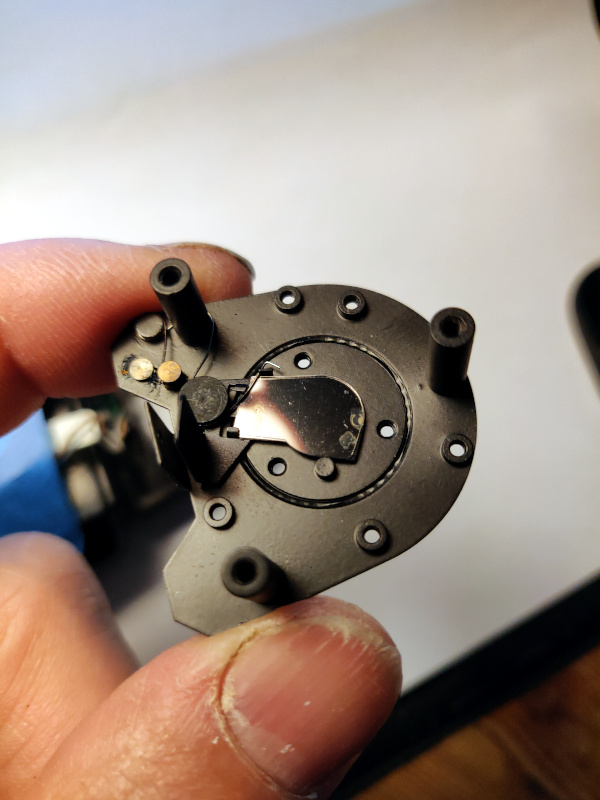
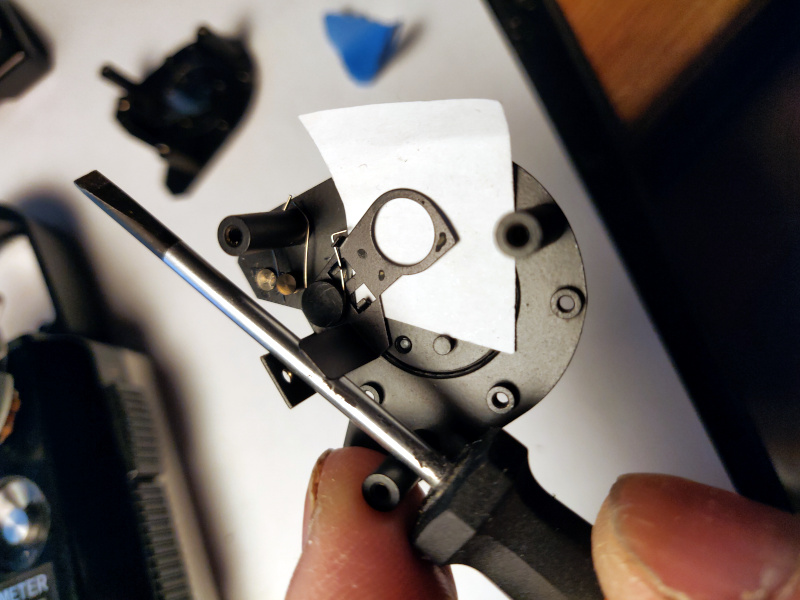
it comes out after you bend a bit the retainer and guide of the pin :
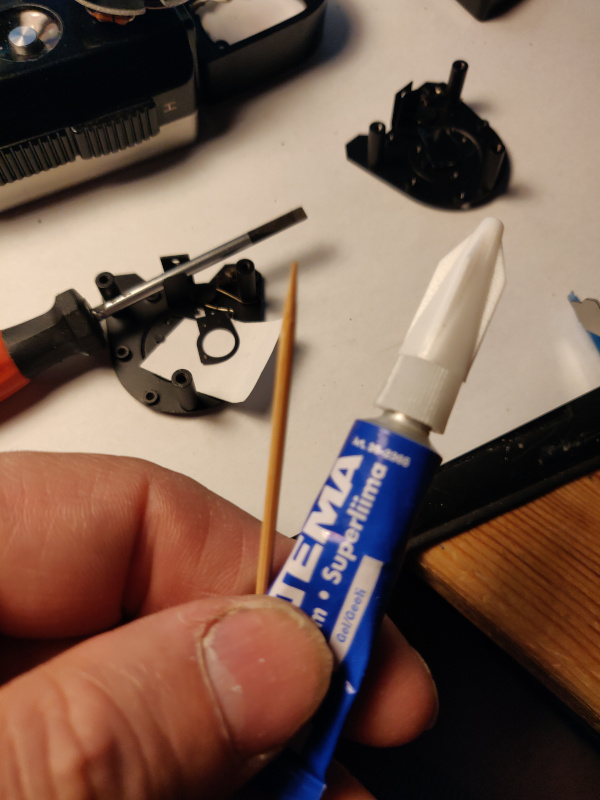
I decided instead to glue the mask back on its sliding holder. This is a bit tricky. I used cyanoakrylate glue with a toothpick. Hold the part away from the "eye" where the blue filter sits, and inserted a piece of paper under, just as safety against excess glue. I used a piece of low adhesive blue tape for holding and positioning the mask on its support, after few points of glue are applied:
after reassembly I tested the meter against a correctly working one and it is fine. A very nice meter
This one:
This just in order to tell that over the years I found often valuable devices for nothing on Yahoo. Some of them, are Sekonic light meters. I have two L-428, one working, the other dysfunctional, was just in a lot with other stuff. I have otherwise all the addons: dome, lumidisc, 10°viewfinder, enlargement probe, fiber optic spot measurement.
The working one has stopped working for the H-values scale.
I have not found docs about tinkering with the L-428, so started unscrewing in order to see what. Maybe people who have also tinkered with it can contribute more details. Anyway I can share this little fix.
This L-428 uses a sliding scale in order to cover its measurement spectrum. The H-values measurements use a filter that slides between the silicone sensor and the blue filter. What happened is that it did fall out of place. The other meter has it, but it lacks the blue filter so it is good in order to better see what happens when H and L scales are switched:
after, some unscrewing, we see the pin that is pushed up by the sliding scale, through the body into the pivoting head, where it moves a spring mounted lever:
unscrewing from the front cover of the body is of no use, but it tells that in case the pivoting head needs to be remove for some other reason, there is quite some disassembly. Otherwise for such an old device it is very well done and no corrosion did sneak its way inside:
but then unscrewing from there was not needed. The fix is done by accessing inside the head.
there are hard seals protecting three brass screws. Scrap away and unscrew the back cover of the head:
the board with the silicone sensor:
two brass screws to remove (the one on the right is visible , the other is in the shadow on the left.
Also unscrew the socket for the accessories (dome, lumidisc, viewfinder, etc) on the front:
the inner ring holds the blue filter, the outer ring is the socket for accessories as well as retainer for the sensor holder:
when this ring removed the sensor holder with its board is loosened:
on the back, when the board with silicone sensor is moved out of the way, without need to remove wires (they are long enough), the H-values mask mechanism is accessible.
It did fall out of place. Probably the weakness of this meter, as the glue points holding this mask are very tiny:
the mask is reflective but not opaque, it filters well the light, checked with the small torch of a mobile phone:
So the fix: as I have a spare L-428, I could just swap the whole part:
it comes out after you bend a bit the retainer and guide of the pin :
I decided instead to glue the mask back on its sliding holder. This is a bit tricky. I used cyanoakrylate glue with a toothpick. Hold the part away from the "eye" where the blue filter sits, and inserted a piece of paper under, just as safety against excess glue. I used a piece of low adhesive blue tape for holding and positioning the mask on its support, after few points of glue are applied:
after reassembly I tested the meter against a correctly working one and it is fine. A very nice meter