
But isnt that exactly the point I was making? A fast lens for 35mm film usually has a shallow DOF.
-
Welcome to Photrio!Registration is fast and free. Join today to unlock search, see fewer ads, and access all forum features.Click here to sign up
- Home
- Forums
- Analog Workflow Forums (100% Analog/Traditional)
- Analog Equipment
- Medium Format Cameras and Accessories
You are using an out of date browser. It may not display this or other websites correctly.
You should upgrade or use an alternative browser.
You should upgrade or use an alternative browser.
First Medium Format Folder
-
A
- Thread starter Sam21
- Start date
Recent Classifieds
-
Sold Kodak Ektar 203mm F 7.7 on flash supermatic shutter, mounted on 98x96 board
- Started by Gaston 012
-
For Sale 150mm f/8 Nikkor-SW - covers 8x10 and more
- Started by Steve Goldstein
-
Sold SUMMICRON 35mm F2 With Googles (8 elements) + M3 Double Stroke (For parts or repair)
- Started by Guillaume Zuili
-
Sold Hasselblad V Adapter To Linhof
- Started by Jessxi
Forum statistics

If you do any darkroom printing, and are like me, you are likely to find that working with medium format film is really nice!
How? What is "nice" about it, when compared to 35mm?
How? What is "nice" about it, when compared to 35mm?
Do you have experience printing in the darkroom?
There is a whole slew of differences - some quite subtle, some quite clear. Tonal gradation, reduction of issues with grain, reduction of issues with dust, ease of negative handling, ease of cataloguing through visual reference and contact proofs, qualities of a lot of medium format suitable darkroom equipment.
I have lots of 35mm negatives I like printing from. But I enjoy the larger negatives more.
FWIW, I much prefer working from medium format film when I'm scanning and sharing digitally too, but that is a more recent experience. I've been preferring the medium format negatives in the darkroom since at least the 1980s.
No, I think I have mentioned that a couple of times here in the forum. I am using a specialist lab, I am focussing on the picture and the storyline.
But I understand that from a lab technicians perspective, the bigger the negative, the better.
If the process itself is the hobby, the bigger negative is part of the craft. My focus is the photograph, so I see it differently.
But I understand that from a lab technicians perspective, the bigger the negative, the better.
If the process itself is the hobby, the bigger negative is part of the craft. My focus is the photograph, so I see it differently.
Just a fact based comparison of three different cameras; one being a M4:
- Mamiya Six is by far the largest in volume among the three. Even when “folded,” its camera body is quite big compared to the Leica, though it’s obviously built around a medium-format mechanism.
- Super Ikonta is a good compromise: a 6×6 folder, but when folded it is only about twice the volume of the Leica M4 — not tiny, but more pocketable than the Mamiya Six.
- Leica M4 is clearly the most compact and lightweight — less than half the volume of the Mamiya Six, and considerably lighter — which is a huge advantage if your concern is “how pocketable / carryable” a camera is.

We are talking about MF cameras, so the M4 has zero relevance here. I can tell you for a fact that my Mamiya-Six sits nicely in my vest pocket.
- RezaLoghme
- Deleted

Pioneer
Member
If I am reading your post correctly, you first make a case that a bigger negative (4x5) does not make a difference, but then in the 2nd paragraph it does.
What about a 35mm hi res film with a modern lens? Shouldnt that produce better results than an Agfa Isolette (The "J" is an "I" in sans-serif fonts).
Thanks for the response. Sorry if I confused the issue. My primary point was that a larger negative does make a difference. The reference to the 4x5 cameras shooting a 6x9 medium format negative wasn't really necessary. Matt really made my point with far less confusion and a lot less words. Problems in the front standard being possibly a bit less parallel usually show up in lower resolution in the borders, and even then not usually noticeable until much larger print sizes, at least with my camera.
My other point is that sharpness isn't the most important thing to me. Medium format negatives have much better tonality in my humble opinion, even in the smaller 645 formats.
My experience with 35mm negatives is that they begin to run out of resolution when printed above 11x14 unless one is very careful. Of course my printing skills certainly don't equal some on this forum so there may be others who will disagree with that.
And thanks for the reminder that back when my early Isolette was manufactured, Agfa was using a font where the letter "I" resembles a "J" to these old eyes so I still refer to it as my Jsolette.

MF folders are usually bigger than 35mm cameras.
Not in my experience.
Most of my 6X6 folders are more compact (as in, pocketable) than most of my 35mm SLRs with a standard lens.
My 6x9 Voigtländer Bessa II is incredibly compact and slim. It's smaller than a small paperback when folded and it gives me negatives I would dream of having with my 35mm cameras (and resolution is only one thing, the rendering of the old Colour Heliar is breathtaking).
Try handling a Voigtländer Perkeo 6x6 folder side by side your favourite 35mm SLR.
Last edited:
xya
Member
No, no problem ever. Grab one if you get one. You will never regret it, it's just a perfect little camera.Curious if you ever experienced issues with frame spacing on the Pearl III. Those auto spacing systems are curious in older cameras, though I suppose similar systems continued to be used well past the 50s. Such a tiny little camera that I would definitely look to if wanting 4.5x6.
So many contributions within 2 days. I would not agree with most of them. I had more than a 100 of these folders, I see the concerns, but a lot of it is just academic rethoric, not coming from practical use. Folders have their advantages and their weaknesses. A folder can always sit in you pocket in case of. There is nothing worse than missing a photo. A non-optimal one is still better than none. Have a look at my folders website if you are intersted...
- RezaLoghme
- Deleted
Do you have experience printing in the darkroom?
There is a whole slew of differences - some quite subtle, some quite clear. Tonal gradation, reduction of issues with grain, reduction of issues with dust, ease of negative handling, ease of cataloguing through visual reference and contact proofs,
All great points, all valid even in my scanning routine.
Here's another one: I sometimes have only 10 minutes for a walk in the local forest during my lunch break. A 6x9 folder is an ideal companion here, as it allows me to take, and finish, a whole roll of quick 'notes' about what I see, a small project if you will, that fully fits within the small interval available. 8 pictures and a self-contained 'project'.
In those 10 minutes walking around, it's likely that the light didn't change a lot, and I might have taken my shots using pretty similar exposure settings. This means I can think of the roll I've shot as an organic 'whole', a bit like LF photographers would do with each of their sheets, and I can control my desired result via a combination of exposure+development decisions, which is something I like doing. E.g. pull processing. Only 8 coherent images on which to act in development as a whole.
In a situation like the above, I will always prefer a medium format camera to a 35mm camera with 36 images to shoot - with the latter I will 100% not finish the roll, I will forget what I had on that roll, I will finish it in a completely different setting and I will then have to resort to developing by the leaflet or following my notes for a generic processing, and this will lead to uneven results.
Last edited:
- RezaLoghme
- Deleted
- RezaLoghme
- Deleted
It seems my earlier reply disappeared, so let me put the point in a calmer and more neutral way:
Folded MF folders are indeed very flat.
In that state they feel smaller than a 35mm SLR with a lens attached — I completely agree.
But once the camera is actually in use, the size equation changes.
A 6×6 folder with the lens extended is noticeably larger than any of my 35mm rangefinders, and the lenses are typically slower.
None of this is criticism — just trying to understand the practical trade-offs people value.
If the appeal is the shooting experience rather than the physical dimensions, that makes sense. I’m simply comparing the actual operating size to a 35mm RF or SLR and trying to learn how others think about it.
Folded MF folders are indeed very flat.
In that state they feel smaller than a 35mm SLR with a lens attached — I completely agree.
But once the camera is actually in use, the size equation changes.
A 6×6 folder with the lens extended is noticeably larger than any of my 35mm rangefinders, and the lenses are typically slower.
None of this is criticism — just trying to understand the practical trade-offs people value.
If the appeal is the shooting experience rather than the physical dimensions, that makes sense. I’m simply comparing the actual operating size to a 35mm RF or SLR and trying to learn how others think about it.
But once the camera is actually in use, the size equation changes.
A 6×6 folder with the lens extended is noticeably larger than any of my 35mm rangefinders, and the lenses are typically slower.
Just to understand your use case a little better: are you perhaps a street photographer? People in the street, capturing the moment, HCB, fast action, etc?
Last edited:
The only thing a 35mm negative has over most medium format negatives is that the 35mm negative was probably taken with a higher resolution/sharper lens. A Pentax or many other high quality 50mm lens on a 35mm SLR will almost always have a better MTF rating or higher resolving power than even a high class Zeiss 80mm on a Hasselblad. On a small print size the 35mm might look sharper/snappier, but when you get to the 11X14/16X20 size print the 35mm just can't hold its own in several areas. One is film grain if the same film is used. The other is, and some folks might argue here, but not me, the range of tone values. The third might be that any, even tiny defect, say emulsion speck will show up like a sore thumb in a 11X14 or larger print from a 35mm negative. So, while a 35mm camera might be easier to handle and carry and have a slightly higher resolution lens it falls behind even a front cell focusing camera like a Zeiss Super Ikonta with Tessar lens or even my old clunky Kodak Monitor 620 with the "Special" lens. Oh, and the other thing I like about medium format and large format is working with those bigger negatives, not to mention the astoundingly beautiful transparency.
No, I think I have mentioned that a couple of times here in the forum. I am using a specialist lab,
In that case, the compromises you are accepting by giving up so much control over the technical aspects probably negate any subtle quality differences that may arise because of the differences between the formats.
Just use the camera that you are most comfortable with. That will make far more difference than a different camera might.
And of course, if your preference is something in 35mm, there really isn't much point in contributing to this thread, which is specifically about something you don't prefer.
Extremely well said Matt.In that case, the compromises you are accepting by giving up so much control over the technical aspects probably negate any subtle quality differences that may arise because of the differences between the formats.
Just use the camera that you are most comfortable with. That will make far more difference than a different camera might.
And of course, if your preference is something in 35mm, there really isn't much point in contributing to this thread, which is specifically about something you don't prefer.

Pioneer
Member
Just a quick followup, I ended up picking up an Agfa Isolette with a Solinar from the seller Certo6 on eBay. Everything seems to be in great condition and the bellows are brand new. I shot my first roll and the shots themselves look well exposed and focused, but I've got these strange blue dots across most of the frames. They're not in the same locations from shot to shot--honestly have no clue what they could be. I've cropped in and screenshotted one of the frames to show you what I'm referring to.
Any idea what these could be? I did develop another roll along with the same chemistry in this session and it came out perfectly fine, but when I went to develop this roll the tank was leaking after the initial pre-rinse so I had to go back into a light tight bag and fix the seal on the tank. It meant that the film sat wet in the tank for a bit while I fixed that. Not sure if that could play a role.
BTW. I hope you are enjoying your camera. Folding cameras are nice and portable and great fun.
- RezaLoghme
- Deleted

darinwc
Subscriber
*The OP has already purchased a camera, so the rest of this discussion is moot.It seems my earlier reply disappeared, so let me put the point in a calmer and more neutral way:
Folded MF folders are indeed very flat.
In that state they feel smaller than a 35mm SLR with a lens attached — I completely agree.
But once the camera is actually in use, the size equation changes.
A 6×6 folder with the lens extended is noticeably larger than any of my 35mm rangefinders, and the lenses are typically slower.
None of this is criticism — just trying to understand the practical trade-offs people value.
If the appeal is the shooting experience rather than the physical dimensions, that makes sense. I’m simply comparing the actual operating size to a 35mm RF or SLR and trying to learn how others think about it.
But To explain the appeal, first consider a folding rangefinder like the Super Ikonta or Mamiya Six and compare to a non-folding medium format camera like a hasselblad, pentax 67, or Fuji. These are heavyweight beasts especially with a prism attached.
The folders are compact and lightweight, give you eye level view, and use a quiet leaf shutter. The lenses can be top notch if aligned properly. Are they the perfect cameras? Of course not. Do they have limitations? Yes. Are they just plain fun to use? Absolutely!
Now compare these to a 35mm camera. Less difference in weight or portability. But you are now using a much larger negative. And you can use fast film at 400 or even 800 speed and still have almost no grain. Fast film also means you don't need as fast of a lens.
So ultimately a medium format folder fits a niche. The portability and usability similar to a 35mm, but the large negative of medium format. With the full realization that most of us shooting film these days do so for fun and personal projects.

- Joined
- Aug 18, 2005
- Messages
- 592
- Format
- Multi Format
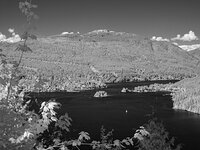
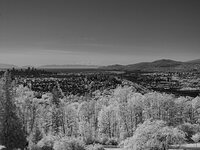
Some years ago, we planned a trip to Yucatan. I had always wanted to see Chichen Itza and I had a copy of southwest photographer Laura Gilpin's Temples in Yucatan about her 1940s visit. I knew I would have to take a film camera as an homage to Laura. It would have to be small enough to fit in a pocket. I selected the oldest of my 6x4.5 Zeiss Ikonta 520s as an appropriate choice. It has an uncoated 70mm f/3.5 Tessar in a Compur-Rapid shutter and is 3 1/4 x 4 1/2 x 1 1/2 easily fitting in a pocket. In spite of its age it is as solid as a rock and has its original bellows. Of course, the film would be Verichrome Pan. It worked out well for me and here is a low res scan of an 8 3x4 x 11 1/2 print very downsized to add here which does no justice to the print. I have carried its younger coated brother on many trips since. I find f/8 and f/11 excellent apertures for the Tessar.


moggi1964
Subscriber
I am looking out for an MPP Microflex but as part of an auction lot just got a Franka Solida III which has an F/2.9 75mm lens (not the 80mm version).
Definitely going to run a film through it and see what I get.
Definitely going to run a film through it and see what I get.

blee1996
Subscriber
I am looking out for an MPP Microflex but as part of an auction lot just got a Franka Solida III which has an F/2.9 75mm lens (not the 80mm version).
Definitely going to run a film through it and see what I get.
Frank Solida III is a solid camera.
 I guess you got the 75mm f2.9 Radionar lens. Wide open it is a bit dreamy, while stopped down to f/8 or f/11 is tacking sharp. Hopefully your uncoupled rangefinder still works well and matches the lens.
moggi1964
Subscriber
It must be an early V3 or I am being mislead in my search online as it doesn't have a rangefinder. Do let me know if it is an earlier version camera.


Yes, front cell focusing was always considered less desirable than unit focusing. What I have found is that at certain distances the front cell focus Tessar lens is every bit as sharp as the unit focusing Tessar. I've said above in a post that I really like the robust Super Ikonta B, B mod. II or BX cameras since they are built like a tank. I was just looking on the big auction site and found a fully working Super Ikonta B with the uncoated Tessar much like the first one I owned. $90.00 with free shipping was just to hard to resist and it's now on its way. Now I have an uncoated Tessar and an Opton "T" coated Tessar. It doesn't get much better than that!Also, theoretically, unit focus like the Perl III/IV cameras are "better" than front cell focus cameras like the Zeiss folders. However, practically this is rarely a problem for most actual usage of the cameras. Folders were designed to be (relatively) small, light, easy to carry cameras that produced excellent negatives when handled correctly. I don't find the limitations burdensome but I also don't use a folder for rapid street photography or macro close ups, or other types of photography that may be better handled with my Hasselblad or Mamiya SLRs or (god forfend) digital. Horses for courses, as they say.
My experience has been that front cell focusing tends to fall short at close distances (10 feet), but the difference isn't huge. For those shots my TLR works better.
| Photrio.com contains affiliate links to products. We may receive a commission for purchases made through these links. To read our full affiliate disclosure statement please click Here. |
PHOTRIO PARTNERS EQUALLY FUNDING OUR COMMUNITY:  |