• Welcome to Photrio!
    Registration is fast and free. Join today to unlock search, see fewer ads, and access all forum features.
    Click here to sign up

First attempts at F stop printing

Cigar again

H
Cigar again

  • 1
  • 0
  • 23
Rainy Day Trees

A
Rainy Day Trees

  • 8
  • 1
  • 116

Recent Classifieds

Forum statistics

Threads
203,166
Messages
2,850,766
Members
101,705
Latest member
kyuut
Recent bookmarks
0

Tom Kershaw

Subscriber
Allowing Ads
Joined
Jun 5, 2004
Messages
4,975
Location
Norfolk, United Kingdom
Format
Multi Format
I tried this technique for the first time last Sunday, seems to work very well, and the explanation in 'Way Beyond Monochrome' makes sense.

I wrote out the following table, I presume I got it correct?

Dead Link Removed

1/2 stop intervals aren't really sufficient, so I'll need to go down to 1/4 stop intervals; for that, building the test strip printer detailed in "WBM" might be worthwhile.
 
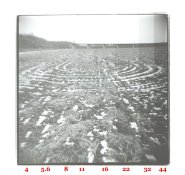
Tom: I presume your table describes times to give for a test strip? Rather than use cumulative strips, I made a mask with a 1" wide opening that I move across the paper in 1/2 stop increments, as follows: 5, 8, 11, 16, 22, and 32 seconds. To be perfectly accurate the first step should be 5.6 seconds but that's not really an issue for me. 1/2 stops work for me; if one strip is too light and the next too dark I simply choose a time between the 2. After becoming comfortable with f/stop printing I cannot imagine doing it the linear way.
 
For successive times just multiply the previous time as follows:

1/2 stop x 1.414 (square root of 2)
1/3 stop x 1.26
1/4 stop x 1.19

Steve.
 
Dan,

Yes, the table describes times for a test strip. With your device, how do you keep the mask in the correct position?

'After becoming comfortable with f/stop printing I cannot imagine doing it the linear way'. - I agree.

Tom.
 
I use an easel I built with a 1" opening...behind which I move the paper, per a guide I have marked. I do a sequence of exposures as follows:

64
44
32
22
16
11
8
5.6
4
2.8

If I need a 1/4 stop that falls between these, I consult my chart. This test strip is for my base, grade 00 exposure, soft. When I've chosen the soft exposure, I replace the test strip easel with the regular easel and expose a sheet for the soft exposure and then switch to the #5 hard filter and give the full sheet a 4 second exposure, then using a card I expose sheet next for 1.6 seconds...move the card...expose for 2.4 seconds, etc...so the soft base plus hard test has a sequence of hard filter exposures of:

4
5.6
8
11
16
22
32
44
64

I pick the strip I like, put in a new sheet of paper and do a soft plus hard exposure and evaluate it.

Man, I can't wait for my StopClock Pro!
 
why would you want to give the hard exposure test a four second exposure before starting your f/stop sequences? I guess it would work but seems like you would not need it if you just made the strip without it. here is a chart from a book called Way Beyond Monochrome by Ralph Lambrecht and Chris Woodhouse.

Ralph's website is www.darkroomagic.com

lee\c
 
Dan,

Yes, the table describes times for a test strip. With your device, how do you keep the mask in the correct position?

'After becoming comfortable with f/stop printing I cannot imagine doing it the linear way'. - I agree.

Tom.

Tom: the paper stays in the easel. I have some tape on the blades marked off in 1" increments. I simply slide the mask from one mark to the next. The post about moving the paper instead of the mask appeals to me but I haven't come up with a convenient and reliable way to move the paper.
 
why would you want to give the hard exposure test a four second exposure before starting your f/stop sequences? I guess it would work but seems like you would not need it if you just made the strip without it. here is a chart from a book called Way Beyond Monochrome by Ralph Lambrecht and Chris Woodhouse.

Ralph's website is www.darkroomagic.com

lee\c

Ummm...because the first strip is a 4 second exposure? That exposure *IS* the start of the f-stop sequence. I just fon't bother with the 2.8 second exposure and skip it.
 
Tom: the paper stays in the easel. I have some tape on the blades marked off in 1" increments. I simply slide the mask from one mark to the next. The post about moving the paper instead of the mask appeals to me but I haven't come up with a convenient and reliable way to move the paper.

I move the paper instead of the mask because it allows me to have the masked area remain the same for the whole sequence. I position the mask so that it contains the highlight area of greatest consequence to me.
 
Perhaps you could explain the gist of this method, the idea behind it, for those of us not familiar with the text you mentioned?
 
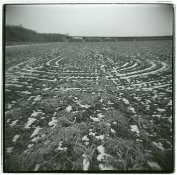
Here's a sequence...the initial 00, soft test strip, the hard test strip (5 on top of base 00 exposure) and the print. The scans aren't great but you can see what the process is about.
 

Attachments

  • 00x.jpg
    00x.jpg
    75.1 KB · Views: 205
  • 5x.jpg
    5x.jpg
    56.4 KB · Views: 208
  • crop_circlesxx.jpg
    crop_circlesxx.jpg
    92.6 KB · Views: 193
There's a pretty simple formula for figuring out how much time to add/subtract for a given number of stops. The formula is new_time = base_time x (2^#_of_stops). Works for whole and fractional stops above and below the base exposure. For exposures below the baseline, simply use a negative number. Plug that into your calculator or spreadsheet and you're done. The forum won't allow me to upload an Excel spreadsheet, else I'd have included one.
 
Last edited by a moderator:
Photrio.com contains affiliate links to products. We may receive a commission for purchases made through these links.
To read our full affiliate disclosure statement please click Here.

PHOTRIO PARTNERS EQUALLY FUNDING OUR COMMUNITY:


Ilford ADOX Freestyle Photographic Stearman Press Weldon Color Lab Blue Moon Camera & Machine
Top Bottom