
• Welcome to Photrio!
    Registration is fast and free. Join today to unlock search, see fewer ads, and access all forum features.
    Click here to sign up

Film testing

Recent Classifieds

Forum statistics

Threads
201,903
Messages
2,831,924
Members
101,014
Latest member
photomaximo
Recent bookmarks
0
OP
OP

JRoosa

Member
Allowing Ads
Joined
Jul 31, 2014
Messages
112
Location
Colorado, US
Format
35mm
I'm surprised it worked so well myself. I also can't believe the meter on my FA handles 1/3 stops so repeatably. I just cranked the ISO knob and left it set on P with matrix metering for the whole test.

The photoresistor is linear over the range of the stops on my enlarger lens. As the light gets dimmer the slope of the curve changes, but is still linear locally. I think the higher densities are reading a little denser than they should.

I think I can work my way up to those densities by using intermediate standards to re-zero on.

Next step is to shoot a roll with a full range of densities from 0 to X and see how they contact print on my paper.

Not bad for seventy cents.

J.
 

Rudeofus

Member
Joined
Aug 13, 2009
Messages
5,119
Location
EU
Format
Medium Format
IIRC, photo resistors are not exactly small, and for your measurements you would like to determine density in rather confined areas on your film. You should therefore think about switching to photo diodes. If a photo diode is still too big, you can drill a small hole through its plastic housing and insert a fiber optic. With this trick you can vastly reduce the area you look at and thereby create a micro densitometer. With the same procedure you can also create a tiny but very intense light source on the other side and thereby greatly reduce stray light.
 
OP
OP

JRoosa

Member
Allowing Ads
Joined
Jul 31, 2014
Messages
112
Location
Colorado, US
Format
35mm
I'm putting the negative in the enlarger set up to make an 8x10 enlargement from 35mm, so the area measured is quite small.

I looked at my data again, and I should be getting linear measurements from an absolute density of 0 (no neg, f/2.8) up to 1.50 (no neg, f/16). My zone VIII negative measures between 1.33 and 1.54 (including FB+fog) depending on the test, so the numbers may be real even though they look odd. There may be some other artifact that changes the curve for higher densities in my setup (Callier effect?).

I need to graph the full range of densities to see what that looks like.

This is a great project for right now since it's tough to get out and shoot this week.

-J.
 

Bill Burk

Subscriber
Allowing Ads
Joined
Feb 9, 2010
Messages
9,473
Format
4x5 Format
You are getting good densities... My lower-right dot at 0.60 x-axis should be at 0.20 x-axis... It's a good curve.
 

ic-racer

Member
Joined
Feb 25, 2007
Messages
16,735
Location
USA
Format
Multi Format
Now that you have a simple densitometer you can also use your enlarger as a makeshift sensitometer. So the in-camera film exposures you are doing will be required to get a workable exposure index. However, once you have your exposure index, you can keep tabs on your development with 'control strips' you make with the sensitometer. It will save you from having to go to the trouble of making the exposure series in your camera over and over. With the equipment you already have all you need is an inexpensive uncalibrated step wedge (you can calibrate it yourself by reading the densities with the densitometer you already made). Just sandwich that with a piece of film under your enlarger. Since you already have the light sensor, you can standardize your sensitometer exposures by ensuring your ohm reading from the light sensor is always the same prior to making the sensitometer exposure.

You will have to play around with enlarger light output and your exposure time to get an exposure that shows a good film curve. You won't get the whole curve because modern films have a range greater than the 'standard' 21 step wedge.
 
Last edited by a moderator:

Rudeofus

Member
Joined
Aug 13, 2009
Messages
5,119
Location
EU
Format
Medium Format
All these people suggesting the use of an enlarger as a makeshift densitometer: please do yourself a favor and look at the flare your enlarger lens creates! You may get reasonable results in the lower density regions, but above D=1.5 you will likely get very inaccurate numbers. A very simple test to verify this is putting a small piece of sheet metal (or some other flat but fully opaque object) into the negative holder(make sure it covers only part of the frame) and measuring its density. BTW it is not the absolute density that matters here, but the difference between min and max density.
 
OP
OP

JRoosa

Member
Allowing Ads
Joined
Jul 31, 2014
Messages
112
Location
Colorado, US
Format
35mm
I don't know if flare matters in my setup. The negative is in a holder and the whole frame is filled with the same density.

I am measuring relative density, I zero it to Fb+fog or to an empty carrier and everything is relative to that measurement.

I have four more photoresistors left and I'm tempted to make a new gadget that has either an led or laser light source so I'm not burning my enlarger lamp all the time. That would take the lens out of the equation.

I would need a step wedge to calibrate that though. Since my aperture is used to determine the slope of my curve.

J.
 

albada

Member
Allowing Ads
Joined
Apr 10, 2008
Messages
2,177
Location
Escondido, C
Format
35mm RF
I have four more photoresistors left and I'm tempted to make a new gadget that has either an led or laser light source so I'm not burning my enlarger lamp all the time. That would take the lens out of the equation.

I would need a step wedge to calibrate that though. Since my aperture is used to determine the slope of my curve.
J.

A related idea is to use a 555 and blink the LED with a duty-cycle of 50%, 25%, 12.5%, etc. The blink-rate must be high enough so the DMM will average the resistance; a rate of 30 Hz or higher should be fine. This will accurately reduce light-level and eliminate a light-calibration.

Mark Overton
 

Bill Burk

Subscriber
Allowing Ads
Joined
Feb 9, 2010
Messages
9,473
Format
4x5 Format
I don't know if flare matters in my setup. The negative is in a holder and the whole frame is filled with the same density.

I am measuring relative density, I zero it to Fb+fog or to an empty carrier and everything is relative to that measurement.

I have four more photoresistors left and I'm tempted to make a new gadget that has either an led or laser light source so I'm not burning my enlarger lamp all the time. That would take the lens out of the equation.

I would need a step wedge to calibrate that though. Since my aperture is used to determine the slope of my curve.

J.

You could just as easily eliminate flare by taking the negative from the carrier and put the negative right on top of the photocell...
 
OP
OP

JRoosa

Member
Allowing Ads
Joined
Jul 31, 2014
Messages
112
Location
Colorado, US
Format
35mm
The negative on photocell idea is good. Everything needs to sit still, so I'm going to make a different setup for that with a clip for the film.

I need more banana clips.

-J.
 
OP
OP

JRoosa

Member
Allowing Ads
Joined
Jul 31, 2014
Messages
112
Location
Colorado, US
Format
35mm
I built another one. This one cost more ($10) and took longer to make (30 min).

image.jpg

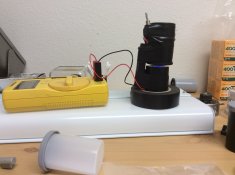
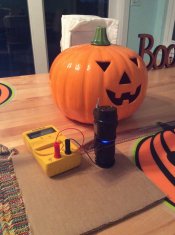
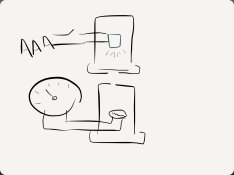
The top is a blue led in a film can with a hole and parchment paper diffuser on the bottom. The bottom has a hole and a photoresistor at the bottom. Led runs off two AAA batteries.

The battery holder acts as a spacer between the two. With the power off, the potoresistor sees no light (open circuit).

I need to add a little clip to hold the film flat and still. When it pushes on the top unit the numbers change.

I gotta calibrate it.

J.
 
OP
OP

JRoosa

Member
Allowing Ads
Joined
Jul 31, 2014
Messages
112
Location
Colorado, US
Format
35mm
Screen Shot 2014-10-18 at 18.02.20 PM.png

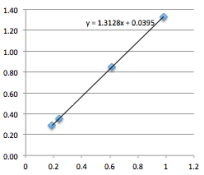
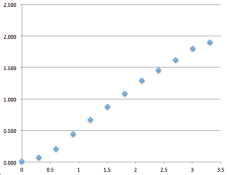
Here's a calibration curve. The density on the Y axis is what I measured for FB+Fog, I, V, and VIII from my last test. The X axis is the relative log of the resistance zeroed to no film in the device.

It boggles my mind that these things work so well. I probably shouldn't put one in my carry on bag next time I travel, though.

This one is nice, because I can sit upstairs and be social/watch the kids while I play with it. I also glued it to a piece of cardboard for a base.

This seems to work as well as the one on the enlarger from the standpoint of being able to hold a line over a reasonable range of densities.

-J.
 
OP
OP

JRoosa

Member
Allowing Ads
Joined
Jul 31, 2014
Messages
112
Location
Colorado, US
Format
35mm
Screen Shot 2014-10-18 at 18.27.34 PM.png

[TABLE="width: 260"]

[TD="width: 65"][/TD]
[TD="width: 65"]Old[/TD]
[TD="width: 65"]New[/TD]
[TD="width: 65"][/TD]


FB+Fog
[TD="class: xl63, align: right"]0.000[/TD]
[TD="class: xl63, align: right"]0.000[/TD]
[TD="class: xl64"][/TD]


I
[TD="class: xl63, align: right"]0.061[/TD]
[TD="class: xl63, align: right"]0.069[/TD]
[TD="class: xl64, align: right"]12%[/TD]


I-1/3
[TD="class: xl63, align: right"]0.051[/TD]
[TD="class: xl63, align: right"]0.056[/TD]
[TD="class: xl64, align: right"]8%[/TD]


I-2/3
[TD="class: xl63, align: right"]0.045[/TD]
[TD="class: xl63, align: right"]0.045[/TD]
[TD="class: xl64, align: right"]1%[/TD]


I-1
[TD="class: xl63, align: right"]0.017[/TD]
[TD="class: xl63, align: right"]0.029[/TD]
[TD="class: xl64, align: right"]41%[/TD]


I+1/3
[TD="class: xl63, align: right"]0.093[/TD]
[TD="class: xl63, align: right"]0.105[/TD]
[TD="class: xl64, align: right"]11%[/TD]


I+2/3
[TD="class: xl63, align: right"]0.122[/TD]
[TD="class: xl63, align: right"]0.134[/TD]
[TD="class: xl64, align: right"]9%[/TD]


I+1
[TD="class: xl63, align: right"]0.164[/TD]
[TD="class: xl63, align: right"]0.168[/TD]
[TD="class: xl64, align: right"]2%[/TD]


V
[TD="class: xl63, align: right"]0.558[/TD]
[TD="class: xl63, align: right"]0.550[/TD]
[TD="class: xl64, align: right"]1%[/TD]


VIII
[TD="class: xl63, align: right"]1.042[/TD]
[TD="class: xl63, align: right"]1.060[/TD]
[TD="class: xl64, align: right"]2%[/TD]

[/TABLE]


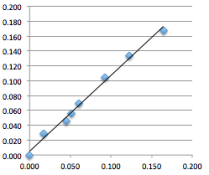
This compares my previous data to new measurements with the new gadget. The percentages are how far off the numbers are from each other. One caveat is that I'm measuring from the same strip I derived my density/log(resistance) slope from. The numbers don't match up perfectly, but they are so close that I would make the same deductions about development/exposure. They are certainly well within a third of a stop.

Pretty awesome.

Oh, and I took some actual pictures today too. Not a bad day.

-J.
 
OP
OP

JRoosa

Member
Allowing Ads
Joined
Jul 31, 2014
Messages
112
Location
Colorado, US
Format
35mm
image.jpg

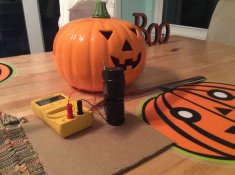
This photo gives you a better idea of the setup.

J.
 

Attachments

  • image.jpg
    image.jpg
    582.2 KB · Views: 96
OP
OP

JRoosa

Member
Allowing Ads
Joined
Jul 31, 2014
Messages
112
Location
Colorado, US
Format
35mm
I almost started a fire.

I forgot leds have no resistance. I hooked it right up to two aaa batteries in series. The internal resistance keeps the current to 15mA.

I almost used a lithium battery that would have not have liked being short circuited.

I need to rewire it with a resistor.

Be careful!

J.
 

albada

Member
Allowing Ads
Joined
Apr 10, 2008
Messages
2,177
Location
Escondido, C
Format
35mm RF
I almost started a fire.
I almost used a lithium battery that would have not have liked being short circuited.

The LED will dim as the batteries run down. You need constant voltage, so I suggest powering the LED with a power-supply. A charger for an old broken cell-phone or any other gadget should work.

Mark Overton
 
OP
OP

JRoosa

Member
Allowing Ads
Joined
Jul 31, 2014
Messages
112
Location
Colorado, US
Format
35mm
Sounds like that might be part of version 3. When the batteries die, I need to cut it apart anyway.

Now that I have one that works well, I'm going to focus on seeing how the changes affect my printing.

I also need to spend some time shooting and printing. Darkroom tinkering is only fun for a little while. When the weather gets crappy, I'll test some other films and developers.

-J.
 

Rudeofus

Member
Joined
Aug 13, 2009
Messages
5,119
Location
EU
Format
Medium Format
A related idea is to use a 555 and blink the LED with a duty-cycle of 50%, 25%, 12.5%, etc. The blink-rate must be high enough so the DMM will average the resistance; a rate of 30 Hz or higher should be fine. This will accurately reduce light-level and eliminate a light-calibration.
All multimeters are constructed in such a way that they eliminate noise at 50 and 60 Hz. These two frequencies, and multiples thereof, are what you should set your oscillator to, and the closer you get, the more accurate your measurements will be. Also note that the 555 will be quite poor when you try to reach duty cycles below 5%. You will likely get much much better results with a small circuit board that contains an ATmega micro controller, which is trivial to get and nicely supported by GCC/linux, and can reach accurate duty cycles at much higher frequencies.
 
OP
OP

JRoosa

Member
Allowing Ads
Joined
Jul 31, 2014
Messages
112
Location
Colorado, US
Format
35mm
I actually picked blue because of the slight purple hue of my film...for some reason I can't get all of the purple dye out despite good fix, extra washing, longer fix, warmer washing, etc. That's a problem for another day. The blue should be least absorbed by the purple compared to red and green.

My test failed. I must have miscalculated by a stop on my 0-to-XII series, and now I'm lost trying to sort it out. At the very least, I'm still getting linear measurements up to a density of 1.7, and there is no sign of a shoulder up there.

-J.
 
OP
OP

JRoosa

Member
Allowing Ads
Joined
Jul 31, 2014
Messages
112
Location
Colorado, US
Format
35mm
This may be interesting to me alone at this point. I moved back to the enlarger setup, the LED is running down the batteries and changes value through the run. It also changes value a little just because it is not very rigidly built.

When I get motivated, I'll make one that is more rigid and runs off an old cell phone charger. I'll probably make it look like a real densitometer with an armature and a flat working surface. I think that if the gadget is rigid, then I can just add in a rheostat to allow me to zero it at the start of a run, and I won't need to make a calibration curve every time.

I got my 0 to XI roll to work, although development is a little long.

You can see the toe and the shoulder here without difficulty.

Screen Shot 2014-10-20 at 20.42.10 PM.png

This is Tri-X with an EI of 160. D76 1:1 68deg for 8:30. Zone I is good, but V is at 0.88 and VIII is at 1.46. It is about N+1 if you believe Adams's numbers. Even if it is, I have linear values all the way up to zone X, so it would be printable on a lower grade.

I'm going to print this as a contact sheet now and see where the values fall on the paper.

I also need to print some real pictures. The nerd inside me is happy now.

-J.
 
OP
OP

JRoosa

Member
Allowing Ads
Joined
Jul 31, 2014
Messages
112
Location
Colorado, US
Format
35mm
So, it all seems to have worked as old man said it would in his book.

When I contact print the roll with maximum black for the film base, I can just start to see the suggestion of a frame at zone I (0.072 density above FB+Fog on this neg). Zone 0 (0.010) is maximum black. Zone IX, X, and XI are almost indistinguishable (1.6-1.9). Zone VIII is barely below that (1.46). It seems that shooting for a zone VIII at 1.2ish, which is where my zone VI fell, is ideal, at least on the contact sheet.

Lessons learned:

-I could have overexposed by 1 stop and cut development by 20% and got to almost exactly the same spot. What fun would there have been in that?

-Cheap photoresistors are very reliable (my electrical engineer wife replies, "Duh. Of course they are.")

-I can now make proper contact sheets. Before, I had to leave some gray to the film base and bump up the contrast to see anything. The images on my contact sheet look perfect!

-Ilford 8.5x11 paper is really nice for contact sheets. Everything fits!

-I can throw two frames into the end of the roll at zone I and VIII to verify good development/exposure...I only shoot 35/roll anyway.

-Once the system is set up (device, spreadsheet, calibration technique), testing a strip is doable in about 5 minutes.

Not bad. Now I have to test some of my other films. I'm very curious to see if I can make some old film work better.

Thanks for the help and encouragement, everybody!

-J.
 
Last edited by a moderator:
Photrio.com contains affiliate links to products. We may receive a commission for purchases made through these links.
To read our full affiliate disclosure statement please click Here.

PHOTRIO PARTNERS EQUALLY FUNDING OUR COMMUNITY:


Ilford ADOX Freestyle Photographic Stearman Press Weldon Color Lab Blue Moon Camera & Machine
Top Bottom