• Welcome to Photrio!
    Registration is fast and free. Join today to unlock search, see fewer ads, and access all forum features.
    Click here to sign up

Film Testing (WBM) Curves 320TXP in XTol 1:1 Too Contrasty—How Did I Mess Up?

Recent Classifieds

Forum statistics

Threads
202,033
Messages
2,834,118
Members
101,081
Latest member
bugsandflowers
Recent bookmarks
0
Joined
Jan 7, 2005
Messages
2,742
Location
Los Angeles
Format
4x5 Format
Stephen, when you write that Zone System speed point falls 2/3 stops below the ISO speedpoint, do you mean it is below 0.1 fb+f?

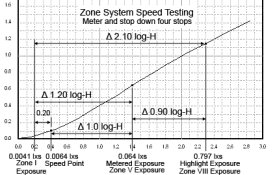
No, it's about the misinterpretation of the ratio between the speed point and the metered exposure point caused by combining a flare interpretation with effectively a no flare testing situation. While the shadow exposure for an average scene does fall around 4 stops down from the metered exposure point (4 1/3 to be exact), the speed point doesn't. If you stop down four stops below the metered exposure point, the exposure will fall 2/3 of a stop below 0.10. In order to bring it up to 0.10, the exposure needs to be increased by 2/3 of a stop which accounts for the lower EIs encountered in Zone System testing. I did a thread on the ratio sometime ago.

Speed Point - Metered Exposure Ratio - Zone System.jpg

On another note, I am finding all the contributions on this thread very informative, thank you everyone. I am not sure, however, as to the best way to interpret my results to find the development times. I realise that one can take great pictures without any of this, but I would love to know my personal timings for N-1, N, and N+1. Perhaps I need to contact the tablet for the curves, and to perform a separate EI test in natural light using a non-uniform target and my camera.

I believe it's very important to understand the theory. The solution to your problem is retesting, and you shouldn't be so concerned about the film speed. As to exactly what N, N+1, etc should be in terms of aim CIs and why is another interesting point of theory.
 
Last edited by a moderator:
Joined
Jan 7, 2005
Messages
2,742
Location
Los Angeles
Format
4x5 Format
Stephen, I'm trying to come up with a decent illustrative test example to show flare vs no flare. For the flare test I was going to photograph a reflection tablet. Here's a question a I have (actually this would apply to transmission wedges too).

Most tablets have a progressive set of densities. Therefore the difference in density between any two adjacent steps is relatively small. We know that flare affects the highest reflection densities on the reflection tablet most. Consider the step with the highest reflection density. Suppose we placed the step with the lowest reflection density right next to it, rather than further away. Does that change the amount of flare impacting the step with the high reflection density?

Asked another way, if one fills the frame with a front lit reflection tablet or backlit transmission wedge of a given total density range, does the arrangement of the steps on the tablet/wedge have an effect on the way flare affects the resulting curve? Or is it only the total range that matters?

As an aside, why are most reflection tablets glossy? It would be easier to work with them if they were not.

Distribution does play a factor. We've all seen the bleed from a really light area next to a really dark area. I guess this could be consider a localized flare effect in addition to the veiling flare.

The reason why reflection tablets are glossy is that glossy produces a greater reflection density range. Think about the difference between the D-Max of matte paper at around 1.60 with glossy paper at around 2.00 to 2.20. I know what you're saying about the difficulty in handling. It's kind of ironic that reflectance is based on a Lambertain surface.
 
Last edited by a moderator:
Joined
Jan 7, 2005
Messages
2,742
Location
Los Angeles
Format
4x5 Format
Michael, I think if you do a test where half the frame has a black card and half has a white card you'll find that the density of the black card will fall off slightly as you move away from the white card.
 
Joined
Jan 7, 2005
Messages
2,742
Location
Los Angeles
Format
4x5 Format
I wonder if you used 0.1 as the speedpoint, or WBM recommended 0.17 in arriving at the CIs. I am trying to understand the difference in the calculations.

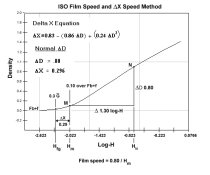
An interesting point about the speed point is that it's not necessarily where you want a specific exposure to fall - the shadows for B&W negative material and the metered exposure point for color reversal film for example. The purpose is to have a point that has meaningful information about the material. One of the functions of in the determination of the speed point is that it defines the limits of the material being tested. When the B&W ISO parameters are met, the minimum useful exposure that will produce a high quality print falls approximately one stop to the left of the speed point density of 0.10. If the processing is different, greater or less, then the relationship of the minimum useful exposure point and the 0.10 density point changes. In contrast conditions outside the ISO parameters, a different method should be applied such as the Delta-X Criterion.

ISO Speed Graph with Delta X equatioin.jpg

Film speed is then determined using the speed point, but as I said, exposure doesn't necessarily fall at that point. The ISO film speed is just a different approach to determining the fractional gradient speed point. It is basically the Delta-X Criterion. As we know, the fractional gradient speed point falls around a stop lower than the 0.10 density point, yet when this was the standard, film speeds were one stop slower than film speeds produced using the current standard. This sounds contradictory to our understanding on how speed works. Shouldn't film speeds increase the further left the speed point falls? One of the points missed in almost all general purpose photography books is that the speed point is only part of the determination of film speed. There is also the speed constant.

Film speed is part of the exposure equation used in exposure meters. This is why the ratio between the speed point and metered exposure point is so important. For black and white the speed the constant is 0.80 and for color reversal it's 10. This means that there is 1/3 stop difference between the color reversal speed point and the metered exposure point for a given film speed. With black and white film it's a 3 1/3 stop difference. The speed constant for color reversal films used to be 8. Without changing the speed point, the change in the speed constant caused a 1/3 stop increase in the film speed. Changing the constant instead of the speed point preserves all the important information about the material that the speed point is associate with.

This can be done with the black and white speed constant too. WBM uses a density of 0.17 as the speed point. With normal development, this produces approximately a 2/3 of a stop decrease in film speed compared to the 0.10 speed point, depending on the shape of the film curve. There's nothing wrong with wanting a little extra exposure as a safety factor or perhaps to achieve better results with your personal metering techniques. The problem with the 0.17 speed point is that it isn't in good agreement with the limits of the material. If you want the extra film speed, it's better to simply use the 0.10 with a speed constant of 0.50 instead of 0.80, or for those using relative film speed, adjust the EI by 1/2, 2/3, or whatever amount works best for you.
 
Last edited by a moderator:
Joined
Jan 7, 2005
Messages
2,742
Location
Los Angeles
Format
4x5 Format
I am also not sure what CI to consider normal, as this is the first time I applied a densitometer to the job. I was planning to follow WBM 0.57 or nearby, or to do a paper test.

WBM has the best set of gradient values for diffusion printing that I've seen. I probably think this because they closely agree with mine. The difference is in how they were determined. Mine incorporates flare into the equation, WBM doesn't.

The equation to determine the CI for any luminance range is:

CI = NDR / (log subject luminance range - flare)

The luminance range of a scene is reduced at the film plane by flare. The range you are developing for is the one that actually strikes the film. With a one stop flare factor, a scene will a 7 stop luminance range effectively becomes a 6 stop range at the film plane. If you develop for a 7 stop range, you would be under developing. One of the ways the various methods that don't factor in flare use to still produce good CI values or accurate processing is to use higher negative density range values. The average log exposure range (which equates to the aim negative density range) for a grade two paper printed with a diffusion enlarger is 1.05. WBM uses a 1.20 and the Zone System uses a 1.25 range. This effectively compensates for the lack of a flare adjustment to the luminance range. And while this approach will produce a good negative, it doesn't correctly reflect the process.

One consideration to maintain when factoring in flare into the equation is that the degree of flare isn't a constant. Flare varies with different luminance ranges. It's virtually impossible to determine the exact flare value for any given scene but flare tends to change by 1/3 stop per stop change in the luminance range. If the value of flare is kept constant, the CI values for shorter luminances will be too high producing contrasty negative and with longer luminance ranges, a fixed flare value will produce CI values that are too low. The developmental model that best reflects the shooting conditions would use a variable flare model.

Another factor that needs to be considered is that there isn't a perfect relationship between the negative density range and the paper LER. Loyd Jones found that “for the soft papers, the density scales of the negative (NDR) should in most cases exceed the sensitometric exposure scale of the paper (LER), whereas, for the hard papers, the density scales of the negatives should in most cases be less than the sensitometric exposure scale of the paper (LER).” In other words, it’s not only acceptable, but preferable to have a slightly contrastier negative for contrasty scenes and a slightly flatter negative for flatter scenes.

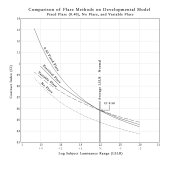
This is why my developmental model averages the fixed flare method and the variable flare method. In the following graph, all the models are based on a 1.05 NDR. An increase in the aim NDR with the no flare curve will shift it upward to be even with the others. The similar shape of the no flare and practical flare model curves is why the WBM with its higher NDR and no flare approach and my practical flare model agree so closely.

Fix, no, variable flare graph copy.jpg

In practice with the use of variable contrast papers, personal taste, the uncertainty of the flare, etc, how critical are these distinctions? In most situations, not very. There's always been a large range of acceptability in photography. Afterall, it's an art form that uses science. I just think it's important to understand how it really works.
 
Last edited by a moderator:
OP
OP
Rafal Lukawiecki

Rafal Lukawiecki

Member
Allowing Ads
Joined
Feb 23, 2006
Messages
789
Location
Wicklow, Ireland
Format
Multi Format
Michael, no need to apologise, your questions about flare testing conditions are very relevant to my question.

Stephen, thank you for our extensive explanations and the time you put into them. I feel like I would like to back up my understanding of practical sensitometry with some additonal studying. You mentioned threads on which you explained aspects of it, would you be so kind to recommend also any other relevant reading?

I am looking forward to retesting when I am back in Ireland from my current trip to Wyoming. My overall goal of being able to find a working set of development times and EI, based on a set of sensibly chosen CIs, still remains. I like the completeness of the WBM approach, but I would also like to hear your suggestions as to the alternatives. I suppose I also ought to do a paper response test to validate my chosen CIs at some stage, but I am not sure how much of a personal variable those would happen to be.
 

Bill Burk

Subscriber
Allowing Ads
Joined
Feb 9, 2010
Messages
9,479
Format
4x5 Format
Hi Rafal,

Hope you are having fun shooting Wyoming!

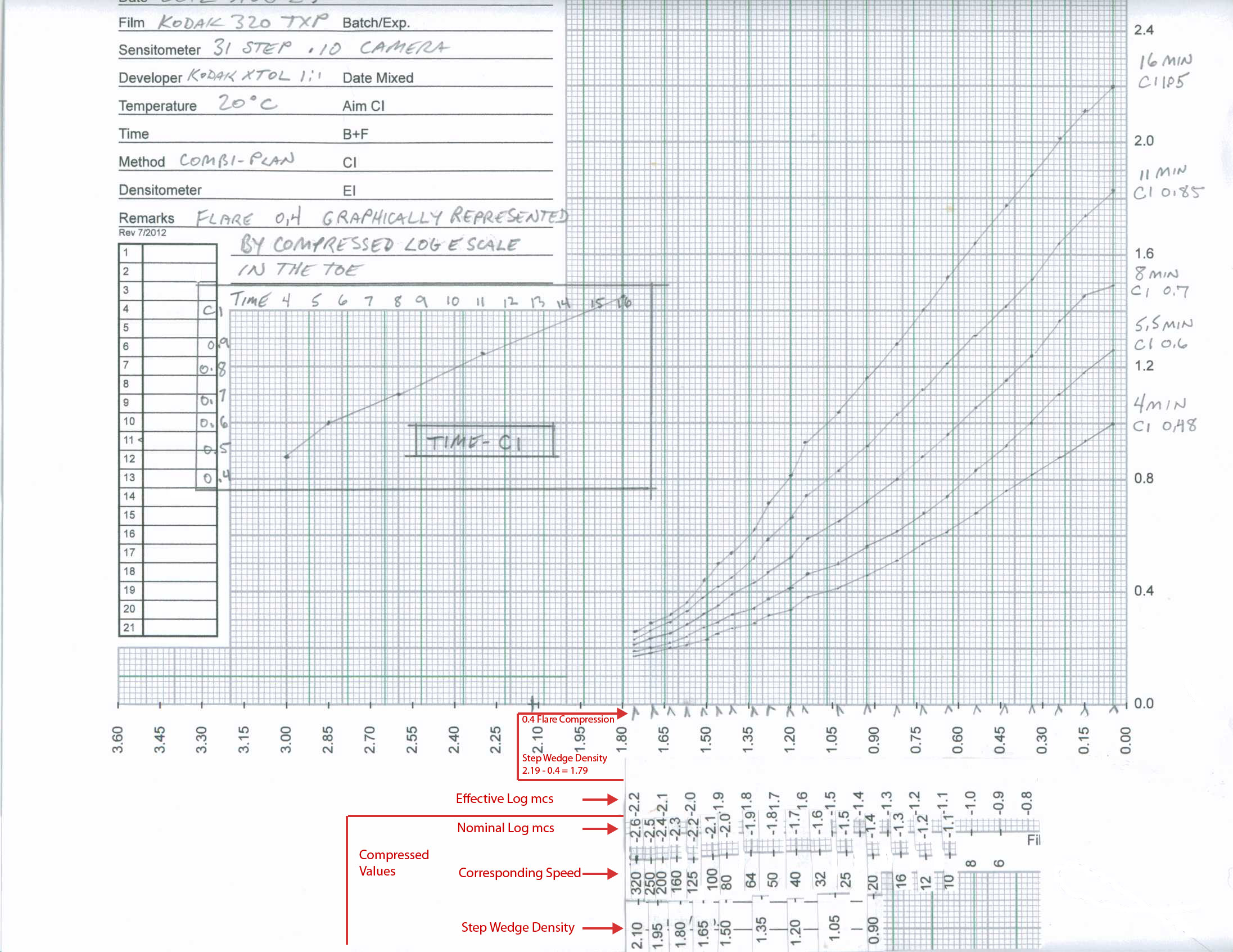
I am working on a revised graph of your data with a compressed LogE scale in the toe to counteract the effect of flare.

I think it's the necessary approach to graph a test that was shot with flare.

One interesting thing my new graph will do. I will end it abruptly at the speed point for 320. That's because effectively flare guaranteed there isn't any step wedge sample that received "less" light than that.
 
OP
OP
Rafal Lukawiecki

Rafal Lukawiecki

Member
Allowing Ads
Joined
Feb 23, 2006
Messages
789
Location
Wicklow, Ireland
Format
Multi Format
Thanks, Bill. I am amazed by the amount of care, insight, and sheer time you, and others, have been putting into helping me understand, and control, film testing. I have never realised how complex the subject was, until I have tried the procedure. The funny thing is, that with the material being so forgiving, I realise the exactitude of such testing is probably not necessary. I just happen to be obsessive enough to want to know the answers. I am very grateful to all of you for your assistance. Thank you!

PS. Wyoming is amazing. Leaving the high, people-free, mountain wilderness areas tomorrow, for a week in the Tetons and Yellowstone.
 
Last edited by a moderator:

Bill Burk

Subscriber
Allowing Ads
Joined
Feb 9, 2010
Messages
9,479
Format
4x5 Format
Rafal,

Here is my impression of what your film curves would look like if they did not include flare.

RafalCompressed.jpg


I compressed the Log E scale in the toe by taking what I thought was a reasonable speed point.

Using that as if it was equal to EI 320 which is by definition -2.6 Log mcs.

Add 0.4 Log E flare to that = -2.2 Log mcs.

The difference (arithmetic) is 0.0038 mcs.

I then built a compressed scale by adding 0.0038 mcs to each 0.1 log increment going from the speed point to the right until it stopped being significant.

Some example values:

-2.6 Log mcs + 0.0038 mcs => -2.2 Log mcs
-2.5 Log mcs + 0.0038 mcs => -2.15 Log mcs
-2.0 Log mcs + 0.0038 mcs => -1.86 Log mcs
-1.5 Log mcs + 0.0038 mcs => -1.45 Log mcs
-1.0 Log mcs + 0.0038 mcs => -0.98 Log mcs

By -1.0 Log mcs the difference caused by flare is 0.02 Log mcs which is insignificant to me.
 
Joined
Jan 7, 2005
Messages
2,742
Location
Los Angeles
Format
4x5 Format
Stephen, thank you for our extensive explanations and the time you put into them. I feel like I would like to back up my understanding of practical sensitometry with some additonal studying. You mentioned threads on which you explained aspects of it, would you be so kind to recommend also any other relevant reading?

There are a couple of threads:

What is the Relationship between Film Speed and Camera Exposure?
(there was a url link here which no longer exists)

Is the K factor relevant to me or should I cancel it out?
(there was a url link here which no longer exists)

Hiding in Plain Sight
(there was a url link here which no longer exists)

These papers are a good start:

View attachment Calibration Levels of Films and Exposure Devices, Connelly.pdf
View attachment Contrast Index a.pdf
View attachment Exposure-Speed Relations and Tone Reproduction.pdf
View attachment safety factors in Camera Exposure.pdf

Some Books:

Beyond the Zone System
Photographic Materials and Processes
Exposure Manual
Theory of the Photographic Process
 
OP
OP
Rafal Lukawiecki

Rafal Lukawiecki

Member
Allowing Ads
Joined
Feb 23, 2006
Messages
789
Location
Wicklow, Ireland
Format
Multi Format
Which CI & Calculating Flash Power for Transmission Tablet Contact Exposure

I am back from Wyoming, it was a wonderful treat for my eyes and for my soul. I am nursing 72 exposed sheets of 320TXP, a mixture of N-1, N, and N+1. Based on my earlier, flawed and flare-affected testing, described in this thread, and based on various recommendations here, I have treated N-1 as EI 160, N as EI 200, and N+1 as EI 320 (or 250 on a couple of sheets by mistake). Now, all I need to do is to figure out the corresponding development times, for XTol 1+1, to be able to print them on my diffuser (Ilford 500H) enlarger, with my usual papers, MGWT/MGIV FB.

As far as I can see from reading your detailed suggestions, bar Bill's post 41 which I have not yet fully followed, it would be good if I retested for the development times by contacting my 31-step Stouffer and so eliminating flare and other issues. I have just finished a marathon of reading other related (there was a url link here which no longer exists), also on sensitometers, exposures when contacting and so on, and I am not sure if I would get reliably repeatable exposures by using my enlarger (equiped with Ilford 500H) due to lamp warm-up and start-up times with short exposures. Also, this light is a green/blue mix, not a white light, though this might not matter for this test.

My feeling is that I could use a Speedlight SB-800 in manual mode, checked with a flash meter (Sekonic L-508). I followed Stephen's 8 Feb 2009 calculations for the required contact exposures, on (there was a url link here which no longer exists), and elsewhere, but I don't know how to adapt those calculations to a flash exposure. My meter tells me a needed f/stop, and I do not know how this converts to the fcs or other measures of exposure at the surface of the contact printer. I don't mind doing some pre-testing to fine tune the exposure, but it would be nice to start in the right ballpark, and it would be a bonus to understand the math. I can vary the flash output and distance, and I know its various GNs.

My second quest is to figure out which CIs are the ones I should be striving for my N-1, N, and N+1. WBM clearly suggests some, but since they are based on the WBM technique for calculating them, I am confused if I should follow those. In fact, I am not even sure how to find out CIs from my new tests—other than by begging Bill again—since I have previously relied on Ralph's spreadsheet.

I suspect I will have to figure this over the course of trial and error, but I would love to give my new 72 sheets the best I can with the knowledge I have so far. Bear in mind, that until now, my previous few decades of photography, including 4x5 since 2000, were never based on testing but on manufacturer's recommendations, +/- about 30% for N+/-1, add-and-subtract some experience-based-factor for HP5+. However, I lack that experience with 320TXP. Overall, I like the idea of being more in control of the process, so if this stage succeeds, I will also test, for the first time, HP5+, to find out how it compares to my past experience.
 
OP
OP
Rafal Lukawiecki

Rafal Lukawiecki

Member
Allowing Ads
Joined
Feb 23, 2006
Messages
789
Location
Wicklow, Ireland
Format
Multi Format
I have to also say I'm generally not a fan of metrics such as CI, Gamma etc. I look at them as "nice to know" results after plotting the curves, but it's really the full H&D curve that tells me what I need to know, not contrast index - particularly when it comes to N minus territory.

Thanks for confirming my other suspicion, Michael, that CI alone might be an oversimplification. I started to fear that when I noticed that a single set of my (flawed) test numbers could be interpreted to produce quite a few different CIs by using different methods: WBM spreadsheet gave one set of CIs, Bill very kindly provided two others, with and without flare compensation. Unfortunately, I do not have the experience of correlating the shape of the curve to my printing experience, as I have never cared for the curves in the past 30 years. I can see, however, this would be useful: for example, I have found it harder to get the local contrasts in skin tones right. Now, I suppose this would be visible from a middle section of a curve, but it will take me a while to make that connection. I look forward to being able to relate my existing printing practice to the curves and tests, hoping for more predictibility and fewer difficult negatives in the future. In the meantime, I would like to figure out the development times through new, better, tests. Thank you for helping me, any additional suggestions are much appreciated.
 
OP
OP
Rafal Lukawiecki

Rafal Lukawiecki

Member
Allowing Ads
Joined
Feb 23, 2006
Messages
789
Location
Wicklow, Ireland
Format
Multi Format
PS. I have started a (there was a url link here which no longer exists) to ask for advice on using a flash unit as a sensitometer. Hopefully this means it will be easier to carry the discussion about CI and so on on this thread, without confusing the issue. I hope I am not going to cause any upset by doing that, and thanks for your help.
 

Bill Burk

Subscriber
Allowing Ads
Joined
Feb 9, 2010
Messages
9,479
Format
4x5 Format
I guess what I don't understand about things like CI is, why "summarize" the curve with a straight line of best fit when you already have the full curve??

No matter what you do... you have to pick an amount of time in the developer, and that is a single number.
 

Bill Burk

Subscriber
Allowing Ads
Joined
Feb 9, 2010
Messages
9,479
Format
4x5 Format
(there was a url link here which no longer exists)

(there was a url link here which no longer exists)

Using the highlighted row in this chart and working off the assumption that N = 7 stops, N+1 = 6 stops and N-1 = 8 stops of subject that has to fit on the No. 2 paper.

AND, assuming I'm correct with my flare-chart adjustment...

N time should fall around 6 minutes.
N+1 around 9 1/2 minutes and
N-1 around 4 1/2 minutes.

I would not recommend development times of 4 1/2 minutes because it could lead to uneven processing.

In the case of N-1 I would suggest a change to your developer. I think Michael R 1974 can give you some good ideas there, as it's one of his specialties...
 
Joined
Jan 7, 2005
Messages
2,742
Location
Los Angeles
Format
4x5 Format
My second quest is to figure out which CIs are the ones I should be striving for my N-1, N, and N+1. WBM clearly suggests some, but since they are based on the WBM technique for calculating them, I am confused if I should follow those. In fact, I am not even sure how to find out CIs from my new tests—other than by begging Bill again—since I have previously relied on Ralph's spreadsheet.

You can go back and read post #36. There's also a paper I wrote that spells it out in more detail.

View attachment What is Normal.pdf
 

Bill Burk

Subscriber
Allowing Ads
Joined
Feb 9, 2010
Messages
9,479
Format
4x5 Format
Obviously, but what is to be gained by basing that time on a CI versus a plotted curve?

Contrast Index (CI) was designed to pick points that will be useful on paper. So it "kind of" picks Zone I to Zone VIII.

Using the chart from Stephen and choosing 6, 7 and 8 stops, is similar to finding where Zone VII, VIII and IX hits the paper. (Giving CI for N+1, N and N-1).

I double-checked by looking at the graph (which includes a Time/CI curve), and it looks like it might be right.
 
OP
OP
Rafal Lukawiecki

Rafal Lukawiecki

Member
Allowing Ads
Joined
Feb 23, 2006
Messages
789
Location
Wicklow, Ireland
Format
Multi Format
You can go back and read post #36. There's also a paper I wrote that spells it out in more detail.

View attachment 57307

Thank you for sharing, Stephen. I have been re-reading this entire thread, including your detailed posts, and attachments, and the linked articles, over the past few days.

I think I am trying to solve too many things at the same time: figuring out N,+/-1 Dev times for the negs in hand, learning about the relationship of CIs to curves and how hard finding the numbers may be, figuring out flare as a very real but debatable factor, reconciling WBM and AA ZS testing approaches with their criticism that I found here, fashioning a make-shift sensitometer, making it repeatable enough for now and good enough for a future EI test, and trying to follow it all in my mind with general equations of exposure. I'm sure, with time, I will get there, as that is how I think and process information, and, in my non-photographic professional life, I have managed to comprehend, and pass on to others, fairly complex abstractions. I like dealing with complexity in a systematic and a logical way. In the meantime, thank you for your patience, and I apologise if I have asked about something that you have already explained—I would hate to make you feel that I was wasting your time, as on the contrary, I am very grateful for it. How I wish these discussions could be more face-to-face and interactive.
 

Bill Burk

Subscriber
Allowing Ads
Joined
Feb 9, 2010
Messages
9,479
Format
4x5 Format
I think we're kind of saying the same thing. CI works fine within a "normal" exposure range. For high contrast scenes it doesn't tell me enough about the shape of the shoulder for example, particularly when applying minus development. This is where targetting the paper range can be dangerous.

Fortunately in Rafal's case, we are sticking to N-1 at most. His current curve crosses the "paper" right at the end of the data and there isn't a shoulder on the graph. The danger in this case is going to be uneven development...

But if that is the danger, your advice is still good, to look at the "greater picture". It may be better to give normal development to N-1 and expect to print on a No. 1 paper than to risk uneven development. Or repeat a test using a compensating developer to see the possibilities. Depending on the developer and technique chosen, the shape of the curve may change.
 
OP
OP
Rafal Lukawiecki

Rafal Lukawiecki

Member
Allowing Ads
Joined
Feb 23, 2006
Messages
789
Location
Wicklow, Ireland
Format
Multi Format
Thank you, gentlemen, for continuing to explain the complexities of tone reproduction to me. Stephen, I have now reviewed your paper "What is Normal", and the other paper that you recommended, "Exposure-Speed Relations and Tone Reproductions", and I have, also, re-read parts of BTZS, and WBM. I plan on finishing reading BTZS, and the other suggested items, and I have ordered a copy of "Sensitometry for Photographers" by Eggleston.

I am puzzled by how the flare/non-flare computations arrive at almost identical aim CIs: Stephen's practical flare model, and the WBM gradients, mentioned on page 212, especially as there is one other major, I think, difference in approaches. Stephen uses the generally accepted LER of 1.05 for Grade 2 paper. This, by ISO definition, only uses a portion of the available scale of a paper, notably not exceeding 90% of the available DMax. WBM carefully points out that "log exposure range of grade-2 paper is limited to 1.05, but this ignores extreme low and high reflection densities." and it suggests "We have no problem fitting a negative density range of 1.20 onto grade-2 paper, if we allow the low end of Zone II and the high end of VIII to occupy these paper extremes." WBM uses the figure of 1.2 in the calculation of aim average gradients on page 213.

Perhaps I am wrong in thinking so, but my observations of my own, and of other peoples' prints, suggest that a full range of paper DMax is often used and aimed for, and even enhanced further with Se toning. If we took the longer LER, as suggested by WBM, into the calculation of a contrast gradient using Stephen's approach, surely we would come up with a different set of aim CIs. Should we follow WBM advice, or was flare somehow part of the explanation?

I am confused by the apparent lack of consistency between testing based on old school, pre-ISO-change-in-1960 ZS, later improvements to ZS tests, WBM, and even Stephen's carefully thought through explanations, and BTZS. And I have not even thought much yet about the impact of enlarger flare.

Noticing the apparent disagreement between experts, in a discipline as old as photography, helps me understand why many experienced photographers and printers recommend not to go too deep into the logic of this matter, and just to rely on the graceful forgiveness of the process. Still, there is a part of me that would like to get my mind around it. Perhaps, in time, I will, or perhaps I was born too late to have a chance.
 
Last edited by a moderator:

Bill Burk

Subscriber
Allowing Ads
Joined
Feb 9, 2010
Messages
9,479
Format
4x5 Format
Perhaps I am wrong in thinking so, but my observations of my own, and of other peoples' prints, suggest that a full range of paper DMax is often used and aimed for, and even enhanced further with Se toning. If we took the longer LER, as suggested by WBM.

From Minor White's Zone System Manual 1961/63edition...

"The high values of a scene must be distinguished from the "highlights" or White Keys...very tiny spots in the print... require no detail... The presence of highlights or white keys in a photograph with a long series of grays gives richness; or in a long series of textured whites the white keys give vitality."

So it's important to have Black Keys and White Keys on the print, they are out of the aim points.

Whether you take 1.05 or 1.20 is a matter between you and your "teacher." It may be an important part of the system in Way Beyond Monochrome, so I would hesitate to steer you away from it if you follow Ralph Lambrecht's teaching. I found my LER by serendipity. I had a negative hard to print on Grade 2 and another one that was hard to print on Grade 3. I decided my aim was going to be right between these two negatives' characteristics. I didn't want any negatives to be harder to print than these two.
 
OP
OP
Rafal Lukawiecki

Rafal Lukawiecki

Member
Allowing Ads
Joined
Feb 23, 2006
Messages
789
Location
Wicklow, Ireland
Format
Multi Format
Bill, you make a great point about serendipity helping you find your LER from a couple of negatives. Though I have been printing for a fairly long time, I have only owned a densitometer for just about a month. I bought it with the purpose of doing these tests, specifically to learn more about 320TXP, and longer term, to build a logical understanding of all of my materials, to have more control over them. I like your experience, and I think I will go back to some of the negatives I know well, and I will analyse them with the densitometer, to learn more about what I like, and what I do not like printing.

Whether you take 1.05 or 1.20 is a matter between you and your "teacher." It may be an important part of the system in Way Beyond Monochrome, so I would hesitate to steer you away from it if you follow Ralph Lambrecht's teaching.

Feel free to steer me! My only teachers of photography taught me when I was 7 years old. It was very enjoyable, but since I got my darkroom when I was 9, I had no other teachers, except for one amazing master workshop recently, and great many books, trial and error. Almost 40 years later, WBM finally pushed me to do the testing, and I am very grateful for that. It must have been the line "The final results are well worth the time commitment of about 8 hours" on page 217. I am, however, a little disconcerted on account of: reading more than 300 posts about the importance of flare, and the lack of account for it in the WBM method, the lack of precision in the recommendation for the making of the exposure, and my experiences of that, and also by the other points raised, such as the choice of a different speed-point (as opposed to a different constant), and its less common choice of LER. All of this makes discussing my—arguably less compatible—findings, with others, harder. I am sure this system works well for those who get to know it well, but I would rather follow a more trodden path, for which I am likely to get more support from those who have tried it successfully. WBM is a wonderful book, and I value it very highly, perhaps the "Customizing Film Speed and Development" part is just one I might have to rely a little less on, but I am glad to have tried it. Besides, I feel this is the best compendium of practical analogue monochrome, and the most up-to-date.

Nonetheless, at present, I am rereading BTZS, I am half-way through chapter 8. At least I will be able to plot my curves, I hope, without having to beg you, Bill, for your services, though I might use R for that purpose.

I don't think I will give up on the Zone System, as I like it very much, but I hope the BTZS lesson of practical sensitometry will help me use ZS in a more measured way, especially for materials that are new to me. Who knows, we might be faced with a need to work with constantly changing materials over the coming years, as the players change, or even exit the market. Any direction you can steer me in will be good learning to help me cope with the new world of analogue photography.

Also, as I read between Michael's various comments, I gather that a more holistic approach to all the components of the tone reproduction system, once assimilated, ought to help me achieve my goals.

 
OP
OP
Rafal Lukawiecki

Rafal Lukawiecki

Member
Allowing Ads
Joined
Feb 23, 2006
Messages
789
Location
Wicklow, Ireland
Format
Multi Format
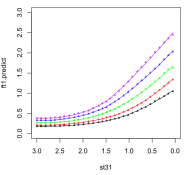
For what it's worth, as I am re-reading BTZS, I have just decided to plot my own curves (using R) from the flawed test data, which I enclosed in the first post on this thread. Thanks to your comments, especially Stephen's patient demystifying of the concepts, I feel more able to do it without having to ask Bill for his services. This is the resulting set of curves, I have smoothed them using LOESS before plotting, and I am glad to say this looks almost identical to Bill's hand-made plot:

Flawed Film Test Curves.png

Reading page 91 of BTZS, "Troubleshooting the Film Test" section, Figure 7-6d, shows a similar situation, where the curves' toes stack up on top of each other this way. Mr Davis helpfully comments: "You'll get curves like this if you test films in the camera (by photographing the step tablet on a light box, for example). These curves are not usable.". I suppose I know from you, gentlemen, that the key reason for the curve stacking is the flare. I wish I read BTZS before the test, but at least I have learned something useful my usual way: try and err.

I am looking forward to retesting, most likely using the flash exposure technique. I hope I get a repeatable exposures, but just in case, I will shoot 25, or so sheets, so I can average the readings from each of the five development batches. I need to do that, as I usually develop 5 at a time in my HP CombiPlan. I wonder, however, if I should agitate a little less than usual, perhaps down to 3–4 inversions only every 30s.
 
Photrio.com contains affiliate links to products. We may receive a commission for purchases made through these links.
To read our full affiliate disclosure statement please click Here.

PHOTRIO PARTNERS EQUALLY FUNDING OUR COMMUNITY:


Ilford ADOX Freestyle Photographic Stearman Press Weldon Color Lab Blue Moon Camera & Machine
Top Bottom