

JWMster
Member
So I'm working on my Caffenol CHrs and my personal development time, and notice that when I camera scan with my DSLR and Negative Supply's handy hardware for this purpose, if the camera's set on AP (Nikon 750D), that the shutter adapts and basically much of the process is negated as the camera interpolates and recovers much more than I intended. Yes, this is nice and demonstrates quite a bit of forgiving lattitude if I blow the shot, but I'm after setting the variables for "best".
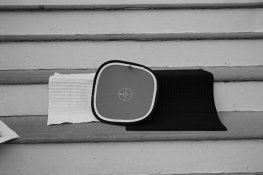
I'm thinking to rescan my test shot comprised of a scene with 3 objects: 1) gray card, 2) black, highly textured rag and 3) white, highly textured rag. This time I'm going to set the whole on manual on the basis of the gray card's neutral exposure and then repeat the "scans". Purpose is to see the under and over exposure WITHOUT adjustment to get a handle on personal effective ISO / Developing Time.
Caffenol doesn't have the commercially established parameters, so it seemed worthwhile to me to try to push into a bit of the zone-type of approach here, but frankly there's not a lot I've seen on hybrid work along this line (unless I've missed it). Does any of this make sense to folks, or am I simply spinning my wheels with "fun testing" that's really a waste of time? I would think the process applies generally to hybrid shooting even with commercial developers, but especially for home brew. But I don't have the formal training and decades of deep experience you folks have. Would appreciate any advice. Thanks!
I'm thinking to rescan my test shot comprised of a scene with 3 objects: 1) gray card, 2) black, highly textured rag and 3) white, highly textured rag. This time I'm going to set the whole on manual on the basis of the gray card's neutral exposure and then repeat the "scans". Purpose is to see the under and over exposure WITHOUT adjustment to get a handle on personal effective ISO / Developing Time.
Caffenol doesn't have the commercially established parameters, so it seemed worthwhile to me to try to push into a bit of the zone-type of approach here, but frankly there's not a lot I've seen on hybrid work along this line (unless I've missed it). Does any of this make sense to folks, or am I simply spinning my wheels with "fun testing" that's really a waste of time? I would think the process applies generally to hybrid shooting even with commercial developers, but especially for home brew. But I don't have the formal training and decades of deep experience you folks have. Would appreciate any advice. Thanks!


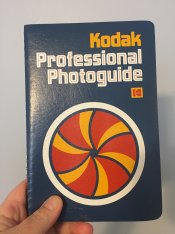
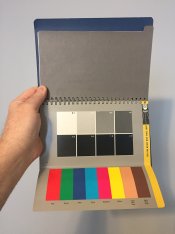


 ). Suppose you do get what you pay for. Note that I'm not mixing my own chems for the "thrill" or to "save money" (I don't think you do), but to learn, to have control, and to be able to adjust (maybe) , and have fun. Caffenol began in my case as ":what if" to try to keep it eco-friendly, but except for the coffee, I'm buying the ingredients from Formulary and this means that as a one-shot in a JOBO 2520 tank using inversion, it's a bit of an ingredient hog, and definitely not the cheapest stuff out there. But this does mean you can't see the grain in LF. You can see it in 35mm with this approach - but less so than using rotary processing on a Jobo. With LF.... grain is invisible so far.