
• Welcome to Photrio!
    Registration is fast and free. Join today to unlock search, see fewer ads, and access all forum features.
    Click here to sign up

Film Photography Project - Questions regarding the FPP Color Negative Development Kit

Valencia

A
Valencia

  • 1
  • 1
  • 60
Tied to the dock

D
Tied to the dock

  • 4
  • 0
  • 97

Recent Classifieds

Forum statistics

Threads
203,096
Messages
2,849,755
Members
101,663
Latest member
Urkis
Recent bookmarks
1

ggray79

Member
Allowing Ads
Joined
Apr 16, 2022
Messages
95
Location
Texas
Format
35mm Pan
FPP COLOR NEGATIVE DEVELOPMENT KIT

First, the FPP Fixer a.k.a. Fedele Fix package itself says about two minutes at 65-75 deg. F. The FPP kit instructions indicate 5 minutes at 103 +/- F. Which is correct? I used the latter for a couple of test rolls.

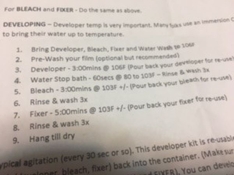
Second, I have attached the package instructions, but the main confusing FPP step is, after the developer "Water stop bath - 60 secs @ 80-103F - Rinse and Wash 3x"

I interpreted this as shown below in my overall procedure:

  • DEVELOPER 3 minutes at 106 deg F. Four inversions every 30 seconds
  • ILFOSTOP (fresh) 60 seconds at 80-103 deg F. Four inversions every 30 seconds
  • Rinse 1: 60 seconds at 80-103 deg F. Four inversions every 30 seconds
  • Rinse 2: 60 seconds at 80-103 deg F. Four inversions every 30 seconds
  • Rinse 3: 60 seconds at 80-103 deg F. Four inversions every 30 seconds
  • BLEACH 3 minutes at 103 +/- deg F. Four inversions every 30 seconds
  • Rinse 1: 60 seconds at 80-103 deg F. Four inversions every 30 seconds
  • Rinse 2: 60 seconds at 80-103 deg F. Four inversions every 30 seconds
  • Rinse 3: 60 seconds at 80-103 deg F. Four inversions every 30 seconds
  • FIXER 5 minutes at 103 +/- deg F. Four inversions every 30 seconds
  • Rinse 1: 60 seconds at 80-103 deg F. Four inversions every 30 seconds
  • Rinse 2: 60 seconds at 80-103 deg F. Four inversions every 30 seconds
  • Rinse 3: 60 seconds at 80-103 deg F. Four inversions every 30 seconds
  • Ilford wetting agent. 30 seconds
  • Hang and dry.
I did not pre-wash.

I am new to C41 so I don’t really have notes to compare and my test was on film I have not used before. The results seemed normal. The drying took much longer than I am used to with black and white (Ilford DDX and Rodinal 1+24).

Am I reading the instructions correctly? Do I need my rinse steps 3-5 if I have used the Ilfostop? Should I use less inversions based on the 30 second agitate intervals.
 

Attachments

  • FPP Developing Instructions 10-10.jpg
    FPP Developing Instructions 10-10.jpg
    113.5 KB · Views: 184
  • 2022-10-09 Lomo400 N2020 FPP 004.jpg
    2022-10-09 Lomo400 N2020 FPP 004.jpg
    479.8 KB · Views: 155
  • 2022-10-09 Lomo400 N2020 FPP 015.jpg
    2022-10-09 Lomo400 N2020 FPP 015.jpg
    348.1 KB · Views: 133
  • 2022-10-09 Lomo400 N2020 FPP 027.jpg
    2022-10-09 Lomo400 N2020 FPP 027.jpg
    277.1 KB · Views: 153
First, the FPP Fixer a.k.a. Fedele Fix package itself says about two minutes at 65-75 deg. F. The FPP kit instructions indicate 5 minutes at 103 +/- F. Which is correct?

Either will probably work. Rapid access bleaches are quite fast. Since fixing goes to completion, time isn't very critical (neither is temperature) provided it's long enough.

"Water stop bath - 60 secs @ 80-103F - Rinse and Wash 3x"

Assuming a decently buffered, mildly acidic bleach, the stop bath in C41 isn't very critical, nor is a wash after a stop bath. It mostly serves to extend the usable lifetime of the bleach, which tends to be the most expensive component. To be honest I often don't rinse after stop, and when I do, it's only once and for 30 seconds or so.

All the thorough washing in that process description won't hurt anything, but it's a lot of work and most if it isn't really necessary.

Since fixer is generally fairly cheap, I use it one shot and evidently don't wash before it because why bother if it's discarded after a single use anyway. I do mix the rapid access C41 fix at e.g. 1+10 instead of the indicated dilution (I think 1+4 for my particular product) because when used one shot, it can be diluted further than if it's re-used and replenished.

Should I use less inversions based on the 30 second agitate intervals.

No, C41 is essentially intended to be a continuous inversion process. Agitate as much as possible, I'd say.

Of course, your chemistry clearly departs from C41 standards given its off-standard processing time and temperature for the developer. That doesn't have to be a bad thing at all, btw, although it generally makes me a little weary of a chemistry manufacturer apparently doesn't get the job done at 100F for 3:15. Both Kodak and Fuji, and I think Champion too, have developers that work at these standard parameters. Why the need to deviate from them? It suggests tinkering on the part of the chemistry manufacturer - hopefully they tinkered to a good result. Fingers crossed.

Your images look mostly OK; the landscape is slightly dodgy as contrast seems rather high, but this might very well be the result of the scanner software doing an automatic adjustment. Mind you, this might also hide any processing errors, so scans like these don't tell the full story. On the other hand, if this is your usual output procedure, then basically who cares what happens in the process as long as you like what comes out, right? If you really want to figure out how you're doing, shoot a color checker one in a while and either scan using a calibrated scanning procedure or optically print onto RA4 to spot any problems. Not sure if that's the way you'd like to head into though. Boring testing can take the fun out of it, too.
 
Thank you! I chose the FPP kit in order to have separate bleach and fixer, which a lot of people recommend. I was surprised to see the developer temperature and timing. Onward through the fog!
 
I would interpret the first rinse as 60 seconds long with 3 changes of water. (ie every 20 seconds.) although 3 changes of water should not hurt. Ilfostop is for B&W so I would be hesitant to add that anywhere.
 
I would interpret the first rinse as 60 seconds long with 3 changes of water. (ie every 20 seconds.) although 3 changes of water should not hurt. Ilfostop is for B&W so I would be hesitant to add that anywhere.

+1. Did the kit say use a stop? I think plain water rinse is the stop, just as it for say (pyro chemicals) and a chemical stop, even if simple acetic acid, might not be called for.

BTW, is this the new C-41/ECN2 combined kit?
 
Last edited:
C41 does fine with an acidic stop. The only precaution is to use acetic acid and not citric acid - I don't know why exactly but PE repeated this several times. He also didn't recall why exactly. I have used citric acid stop in RA4 processing and saw no ill effects; haven't tried it with c41 though. I always use acetic acid with c41 and that of course works perfectly.

I think plain water rinse is the stop, just as it for say (pyro chemicals)
That's a debatable issue to begin with and besides, c41 really is a different process, even though there are some parallels.
 
+1. Did the kit say use a stop? I think plain water rinse is the stop, just as it for say (pyro chemicals) and a chemical stop, even if simple acetic acid, might not be called for.

BTW, is this the new C-41/ECN2 combined kit?

Yes the kit is for both. I used a chemical stop because I read somewhere that it was a quicker stop and that water alone might actually allow developing to continue to some extent beyond the set time. Based on an earlier comment I don't think it hurts to do both, but frankly I would rather just do the chemical stop alone. That being said, the first water rinse after the chemical stop was definitely colored so I would guess that it is a cleaner operation to have the three rinses remove everything prior to the bleach cycle. Any thoughts on that? BTW Ilfostop is citric acid based, so if that raises any red flags I obviously need to know! I did read online that someone was happily using Ilfostop for C41. He was also using the Ilford Rapid Fixer but I did not need it since the fixer was in the kit. The kit instructions were not clear. Yesterday I heard from FPP that their instructions referred to water only. He did not opine on using a chemical stop yet.
 
Last edited:
That being said, the first water rinse after the chemical stop was definitely colored so I would guess that it is a cleaner operation to have the three rinses remove everything prior to the bleach cycle.

Those are sensitizing dyes washing out of the film. You'll find that even with wash steps in-between the other steps, there will still be some dye that washes out after fixing. Don't worry; the dyes won't do any harm in the bleach or fixer. In the bleach, they're more or less invisible because its own color is dominant. Your fixer may/will colorize unless used one shot of course.

BTW Ilfostop is citric acid based, so if that raises any red flags

Hmmmwelll, red flags would be a bit harsh, but I'd recommend using an acetic acid stop instead. Either get some acetic acid concentrate or just use unscented cleaning vinegar from the supermarket diluted 1+9 or so with water. The dilution isn't critical in the least.

Note that your kit, it it's combined C41 and ECN2, won't process either or both films to spec, since the ECN2 bleach is a different one than the C41 one. Evidently the developer is also different, but I assume/hope the kit ships with a separate developer for both processes. If they use one developer and simply adjust time and/or temperature for the process, the kit isn't worth its salt IMHO. ECN2 requires a different developing agent than C41 and you can't combine them in the same bath.
 
C41 does fine with an acidic stop. The only precaution is to use acetic acid and not citric acid - I don't know why exactly but PE repeated this several times. He also didn't recall why exactly. I have used citric acid stop in RA4 processing and saw no ill effects; haven't tried it with c41 though. I always use acetic acid with c41 and that of course works perfectly.


That's a debatable issue to begin with and besides, c41 really is a different process, even though there are some parallels.

Please see my reply to bags27 - Ilfostop is citric acid. So now I see a split opinion (here and online) on using it with C41. I did mix it fresh, with no previous usage with any b&w processing. I wonder if that would make a difference. Also, I wonder if the prolonged drying time might be due to that, or is C41 known to take longer to dry.?
+1. Did the kit say use a stop? I think plain water rinse is the stop, just as it for say (pyro chemicals) and a chemical stop, even if simple acetic acid, might not be called for.

BTW, is this the new C-41/ECN2 combined kit?


My negatives were not completely dry (i.e., somewhat sticky) after three hours.
Those are sensitizing dyes washing out of the film. You'll find that even with wash steps in-between the other steps, there will still be some dye that washes out after fixing. Don't worry; the dyes won't do any harm in the bleach or fixer. In the bleach, they're more or less invisible because its own color is dominant. Your fixer may/will colorize unless used one shot of course.


Hmmmwelll, red flags would be a bit harsh, but I'd recommend using an acetic acid stop instead. Either get some acetic acid concentrate or just use unscented cleaning vinegar from the supermarket diluted 1+9 or so with water. The dilution isn't critical in the least.

Note that your kit, it it's combined C41 and ECN2, won't process either or both films to spec, since the ECN2 bleach is a different one than the C41 one. Evidently the developer is also different, but I assume/hope the kit ships with a separate developer for both processes. If they use one developer and simply adjust time and/or temperature for the process, the kit isn't worth its salt IMHO. ECN2 requires a different developing agent than C41 and you can't combine them in the same bath.

I am following up on that but you may have a really good point. If I want to keep doing separate bleach and fixer is there another 1 liter reusable kit available? I believe CineStill, Unicolor, and Arista are all Blix. Kodak's Flexicolor kit is for 5 liters
 
I don't know about the citric acid stop, really. Like I said, PhotoEngineer warned against it but never gave any details why. Since he was a color materials engineer at Kodak, I tend to take his advise seriously.
The stop bath doesn't have anything to do with the drying times, in any case. That's probably just a combination of environmental factors and the film you used.

Sorry, I'm not up to speed when it comes to 1 liter kits. I always just buy bulk Fuji chemistry, mix it all up, store well and use one shot. It's by far the cheapest way to do C41, you don't waste much time ordering and mixing chemistry and the results are always top notch. For these reasons I don't bother with 1 liter kits which work out as very expensive, even if reused (which has its own risks associated with it).
 
Sorry, I'm not up to speed when it comes to 1 liter kits. I always just buy bulk Fuji chemistry, mix it all up, store well and use one shot. It's by far the cheapest way to do C41, you don't waste much time ordering and mixing chemistry and the results are always top notch. For these reasons I don't bother with 1 liter kits which work out as very expensive, even if reused (which has its own risks associated with it).

I apologize if you've already said this. But how many rolls of color film do you process in a given time period? The Fuji seems like a great kit, and I know that some have reported the developer remaining good for many months, if sealed tightly in smaller bottles. It's just hard to wrap my head around so much chemistry when I shoot at least as much B&W.
 
But how many rolls of color film do you process in a given time period?

Maybe a couple a month. Let's say up to 50 a year - in a good year. That does include some 120 and some 4x5 sheets. Those consume on average a bit more chemistry than 35mm rolls.

The developer does keep very well in full, glass bottles. Many months, at least.

Small kits can make sense if you only shoot a handful of rolls per year. Save them all up and then run a color batch once or twice a year. I don't have that kind of patience so I do it differently.
 
I don't know about the citric acid stop, really. Like I said, PhotoEngineer warned against it but never gave any details why. Since he was a color materials engineer at Kodak, I tend to take his advise seriously.
The stop bath doesn't have anything to do with the drying times, in any case. That's probably just a combination of environmental factors and the film you used.

Sorry, I'm not up to speed when it comes to 1 liter kits. I always just buy bulk Fuji chemistry, mix it all up, store well and use one shot. It's by far the cheapest way to do C41, you don't waste much time ordering and mixing chemistry and the results are always top notch. For these reasons I don't bother with 1 liter kits which work out as very expensive, even if reused (which has its own risks associated with it).

I just ordered the Kodak stop base to be safe.
 
Maybe a couple a month. Let's say up to 50 a year - in a good year. That does include some 120 and some 4x5 sheets. Those consume on average a bit more chemistry than 35mm rolls.

The developer does keep very well in full, glass bottles. Many months, at least.

Small kits can make sense if you only shoot a handful of rolls per year. Save them all up and then run a color batch once or twice a year. I don't have that kind of patience so I do it differently.

I as well shoot at least 50 rolls (135 and 120)/year, maybe more, so I'm going to spring for the Fuji next. Thanks!
 
I've used professional lab Dip 'N' Dunk C41 machines as well as a 350mm wide roller transport machines for C41 developing. Plus, I have never seen any of the squillions of store front mini-labs doing their C41 process with a pre-wash back when almost every store had a C41 mini-lab near their front door. In the commercial world, it never happened. Plus I did my own C41 Jobo rotary process, both roll and sheet film for close to 25 years and never used a pre-wash.

That doesn't mean a pre-wash may be good, but I have yet to see a benefit.

C41 first bath is generally 3'15", at least every C41 process I have done at home and in roller transport machines has been 3'15". Dip 'N' Dunk machines though had a slightly longer process, 3'30" as every 3'15" the racks were lifted from their baths, moved forward to the next bath, then dunked into that next bath. This took 15" to do, hence the 3'30" time frame for C41 in the Dip 'N' Dunk process.

C41 process is a quite strict 37.7ºC (100ºF) which is for colour accuracy of all layers to prevent colour crossover and other possible problems and is, as far as I know, why the strict temperature requirement is in place for the first bath (developer bath).

To save my bleach (as it is the most expensive part of the C41 process) I always used a 2% Acetic acid stop bath. 30" is all that is needed and with filling and emptying the tank taking up close to another 30 seconds. Once you have stopped the development with a stop bath, you can relax and take your time with the next baths.

C41 bleach will do approximately double what the fixer bath is capable of, which is a good reason to have bleach and fix steps, instead of a combined bleach/fixer bath. Saves money big time and you purchased a developing process that incorporates separate bleach and fixer baths. You may wish to re-halogenate your bleach bath between processing sessions using a simple fish tank aerator then adjust your pH to the correct level and you are good to go.

Although some people tout this possibility as an endless bleach bath, that isn't so. Photo Engineer did mention that in the long run it wasn't a viable approach. Short term re-halogenating to double the bleach bath life wasn't considered too bad an approach by Photo Engineer, but he had caveats about it. I used re-halogenation of my bleach bath, quadrupling its output for close to 20 years, using this method.

You don't mention anything about a preservative (stabiliser), which in the original C41 process was the last step before drying. Is there any mention in the literature about where, or which bath has the stabiliser included?

Your included images look quite good, if you are happy with what you are producing, keep on doing it.
 
You don't mention anything about a preservative (stabiliser), which in the original C41 process was the last step before drying. Is there any mention in the literature about where, or which bath has the stabiliser included?

Thanks for all the information. The FPP kit does not include a stabilizer before drying. Out of B&W habit, I used the Ilford wetting agent. If stabilizer is still recommended, is there a brand you recommend? I assume all stabilizers would have the surfactant.
 
I haven't bought a C41 kit for 30+ years, instead I mixed my own chemistry.

My C41 Stabiliser formula is:-

400ml water.
37% Formaldehyde 1.5ml
Wetting Agent 6ml.
Water to 500ml.

I placed the 500ml into a plastic jug for 135 and 120 roll films. This allowed me to take the film off the reel and drop the roll into the jug. Gentle swishing was done to circulate the bath around the film, while at the same time keeping bubbles and froth to a minimum.

For 4x5" film I held the film between my open hand with the emulsion up and moved it back and forth, a full 30" is all I've ever done.

Not really temperature critical, anything above 20C is fine.
 
Concerning the stabilizer: the dyes in today's C41 films don't require it. There can be benrfit in a final rinse with a biocide and a surfactant to prevent fungal growth and drying marks, respectively. Formalin acts as both a stabilizer and a biocide. Photoflo could be used as a surfactant. I only use a surfactant these days.
 
Concerning the stabilizer: the dyes in today's C41 films don't require it. There can be benrfit in a final rinse with a biocide and a surfactant to prevent fungal growth and drying marks, respectively. Formalin acts as both a stabilizer and a biocide. Photoflo could be used as a surfactant. I only use a surfactant these days.

Many thanks, I did remember something had happened with regard to a stabiliser requirement in the process, but memory is starting to fade......
 
BTW, is this the new C-41/ECN2 combined kit?

Really it's just a ECN2 kit. You can obviously cross process and get usable negatives, but it's pretty lame of them to say it's somehow a both kit. It's either in spec for one or the other (or neither lol), but it cannot be both. They have a video attached to the sales page that shows how to use the kit and you can see a little bag labelled CD-3 which is a dead giveaway it's just an ECN2 kit. The processing time and temperature are also that of ECN2 (3 minutes @ 106f).

dsf.PNG
 
Last edited:
Thank you all for your information. It appears the only FPP kit dedicated to C-41 and not ECN2 uses blix so I will look around for a different kit for the next round.
 
I had the FPP kit. I thought I remembered seeing that it used CD3 instead of CD4.
Proper development for ECN2 films (Vision3) - but not optimal for C41.
Probably OK kit for the film kids that only scan their C41 film, but if you're hoping to print to RA4 paper in the darkroom, this could lead to weirdness in printing. Or if your super fussy, color critical.
When I used it, I thought the results OK, but maybe not what I hoped for.
 
Photrio.com contains affiliate links to products. We may receive a commission for purchases made through these links.
To read our full affiliate disclosure statement please click Here.

PHOTRIO PARTNERS EQUALLY FUNDING OUR COMMUNITY:


Ilford ADOX Freestyle Photographic Stearman Press Weldon Color Lab Blue Moon Camera & Machine
Top Bottom