Just some thoughts that struck me today....
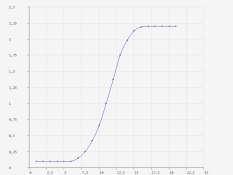
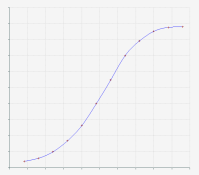
1. Yes, EK uses a cubic spline to describe all curves for all products. We used either DEC or HP computers in a room full of automated Densitometers. They were plotting curves from several precision 1B Sensitometers. . . . . In all of my work I have never seen the spline fail!
PE
This is speculation, and I'm sure that PE will correct me if I am wrong, but I suspect that the EK protocol is/was something like this:
1. For a given film/developer (or paper/developer) combination, a standard curve is generated by using very accurate, closely spaced data and fitting a cubic spline to the entire curve. As discussed earlier, the spline is made up of many small segments, each of which fits four points perfectly.
2. For quality control (and fine tuning purposes), data are measured for an emulsion batch and the data fit using the full spline as a "function" that is adjusted with a small number of parameters that shift the position and gradient of the curve. This is the procedure that is described in a paper (by Kodak engineers) that was discussed earlier in this thread:
Description of d-log E curves by specifically chosen parameters
1961, Bayer et al. in
Photographic Science and Engineering Vol 5, No. 1, Jan.Feb
They don't explicitly mention cubic splines, but it would make a lot of sense to do it this way for this purpose. The parameters derived from the fitting procedure would be directly interpretable in terms of speed and contrast, relative to the "standard" curve that is used to construct the spline.
I'm not sure that this a practical approach for amateur sensitometrists (if such people can ever be considered practical) but I would be quite interested in knowing if this is the actual procedure.
David