• Welcome to Photrio!
    Registration is fast and free. Join today to unlock search, see fewer ads, and access all forum features.
    Click here to sign up

Film Acceleration Issues - Watched my pictures appear and disappear

Recent Classifieds

Forum statistics

Threads
201,182
Messages
2,820,082
Members
100,572
Latest member
kasn
Recent bookmarks
0

brianboston

Member
Allowing Ads
Joined
Mar 14, 2024
Messages
4
Location
New York
Format
Hybrid
Hey Everyone,

Having grown bored of cross processing my slide films in C-41 I have recently jumped into "accelerating" them - some more information on this process is here: https://www.flickr.com/groups/begreataccelerate/

This process worked with a roll of Velvia 50 expired in 2003; gave me some wonkier colors than a typical cross process but still the same sort of results - purple negative base.

I recently dug out some Fujichrome 50 (probably expired late 80's - early 90's) that I had stand developed in Rodinal and figured I'd try the acceleration process to get some more info out of the negatives.
These Fujichrome 50 negatives were dark gray and hard to work with. For comparison - my Velvia had been milky white and the positive images were sort of clear to see (even had some faint colors) coming out the BW fixer (before bleaching and running thru C41).

I can't recall if I read that one can do the acceleration process in room light after the initial BW process or if I made that information up. This is crucial here as I bleached, washed, and ran the Fujichrome 50 through C41 in open trays in room light, whereas the Velvia was mostly in a Patterson tank besides some brief checks in room light to make sure things were moving along.

During initial bleaching, I watched the film turn from dark gray to white and my exposures slowly disappeared. During C41 development and bleaching the film turned blue. When I put it in the fixer I watched my images appear in vibrant colors and very quickly disappear - maybe in a matter of 20-30 seconds. Now I'm left with some dark green negatives that are mostly blank. Is this a result of room light exposure? Should future acceleration experiments be carried out with film entirely in darkness?


For some context on the film, I purchased 4 rolls of this exact stock and they have given me nothing but issues.
- First test run I shot at box speed and developed in standard E6, which yielded an almost entirely clear roll with very faint pieces of images that required lots of computer editing to view. Notably, a picture of a neon sign came out with the most detail.
- Second test run I shot in a rinky dink point n shoot and cross processed in C41. The roll came out almost entirely dark green (a bit darker than my acceleration experiment), except for one frame where a part of a reflective traffic sign was visible. I am assuming this is from the flash and was probably the most light that hit any part of the roll. This also raises another question - I thought that slides were better off underexposed than overexposed, even if expired. Should I be compensating for heavy base fog and overexposing this film?

I've got one roll left from this batch and another roll of Fujichrome that expired in the late 70s. Any advice for shooting and processing them going forward? I don't particularly care if my colors are whacked out, I would just like to get some sort of usable images for scanning and RA4 printing.
 

koraks

Moderator
Moderator
Joined
Nov 29, 2018
Messages
26,067
Location
Europe
Format
Multi Format
I can't quite explain why your images would appear colorful at first and then disappear very rapidly. The dyes in E6 film are quite stable and aren't attacked easily by fixer.

One thing does come to mind: did you use an acid fixer? If so try soaking your film in a weak solution of sodium carbonate or even sodium sulfite or anything else slightly alkaline (not just tap water). E.g. 1% sodium carbonate would do. Then wash the film thoroughly.

There's a chance that this brings back the colors; old color film dyes may turn colorless at a very low pH.

It's a bit of a long shot, but it's all I can think of given that the image appeared at first and then disappeared.

For RA4 printing I'd really just shoot C41 film; it makes the whole darkroom printing experience a lot more fun if the material just works, IMO. With these off-standard approaches, it always turns into a battle, I find. YMMV as they say. Still, interesing experiments.

And welcome to Photrio!
 

Rudeofus

Member
Joined
Aug 13, 2009
Messages
5,110
Location
EU
Format
Medium Format
One more comment to this: if you have old film, it's typically foggy. If you develop such slide film with regular E-6 process, then the resulting slides will be extremely light. In a negative process, as you have chosen, the film would get quit dark. If you also boost development to the utter limit, as this "acceleration process" seemingly does, then you will amplify this even more: reversal process will give you blank slides, negative process very dark slides.

But I also agree with @koraks : this does not explain, why the image would appear and then quickly disappear. Maybe his image restoring method works.

PS: I sure hope, you didn't load the film while the red dark room safe light was on ...
 
OP
OP

brianboston

Member
Allowing Ads
Joined
Mar 14, 2024
Messages
4
Location
New York
Format
Hybrid
Thank you both for your replies and advice here, I'll give the alkaline bath a try for posterity. I was using Flic Film C-41 Fixer which according to the datasheet is ~90% ammonium thiosulfate and ~5% each sodium sulfite and sodium metabisulfite, which I believe should be an alkaline solution anyways.

I suppose my question was more one whether I caused some sort of re-exposure of the color dyes in the acceleration process. For a more detailed run down:

Stand processed the slides for an hour in dark tank at a 1:50 ratio of Rodinal, fixed with some very old Heico NH-5 that has lots of precipitate in the bottle but still works - not sure if the age would have caused a big change in pH.

Bleached the slides in potassium ferricyanide bleach for about 15 minutes in room light.
Then developed, bleached, and fixed as a normal C41 process in open trays in room light.

The silver images from BW developed slowly disappeared during the initial bleaching which I had experienced in the past run of acceleration, but never came back. I got bursts of color images when I put the film in the final C41 fixer for ~30 seconds. Also some changes in color during the C41 development but those were hard to see through the color of the solution.
 

koraks

Moderator
Moderator
Joined
Nov 29, 2018
Messages
26,067
Location
Europe
Format
Multi Format
Hmm, interesting. A few thoughts:

* The acidity doesn't seem to be the problem given the more or less neutral fixer you've used.

* Ferricyanide is kind of aggressive. I don't know if the dyes in your film were designed to survive it.

* Using a fixer with precipitate means you've worked some elemental sulfur into the process. I would expect this to give a minor amount of fogging, but who knows what else might happen.

Still no clear explanation of the phenomenon you've witnessed, sorry!
Out of curiosity, what does the final film look like after your experiment? Any chance of getting a good photo up that shows the film against a light box or something?

some sort of re-exposure of the color dyes in the acceleration process

It may be worthwhile reading up the basics on how color film works; it'll help you to understand and plan your own experiments a little better. For instance, dyes don't need to be exposed to light - they're not the light sensitive element in the film. In short, what happens in a color process is the following:
* A suitable developer develops exposed silver halides into an inherently b&w metallic silver image.
* The oxidation product of the developer links up with partial and colorless dye molecules that are present in the gelatin emulsion.
* The combination of the oxidized developer molecules and the partial colorless dye molecules creates the actual colorful dyes you see in the final image.
* You then bleach away the silver image as well as the remaining silver halides so that just the dyes remain. Unreacted colorless dye couplers also remain present in the emulsion, but they're invisible.

A reversal process is nothing more than first developing the silver halide negative image with a B&W developer that doesn't do anything with the dye couplers, then bleaching this silver image away and afterwards developing the remaining silver halide in a color developer. The process is then more or less the same as for the basic negative process outlined above.

When you "accelerate" a film, all you do is use a b&w process to first develop a weak image, then redevelop it one or several times to create a more dense/contrasty silver image. You then bleach this away and redevelop that same image with a color developer so the dyes are formed. This can be done in a negative process or a positive process.

So the light-sensitive element is always a silver halide. In itself it doesn't produce color.
The dyes are formed out of colorless dye couplers that wait in the emulsion until they're married to a suitable partial molecule, typically an oxidation product of the color developer. It's technically possible that a similar, suitable molecule drifts by and creates a colorful dye, although a regular color process is of course engineered so that this cannot happen.

It's conceivable (and actually a well-known problem) that if you use a ferricyanide bleach and there's some carryover of a color developer into this bleach or vice versa, the color developer is oxidized instantly and its oxidation products will help create colorful dyes. However, these dyes are the same and just as stable as the regular/intended dyes, so it still wouldn't explain how you first see an explosion of color, and it then disappears - unless of course you see a color image being developed first, and then it's fogged all over with non-image dyes due to an unintended chemical reaction. Hence the question to show us the result, because the film would look kind of dense if this is what's happening.
 

Rudeofus

Member
Joined
Aug 13, 2009
Messages
5,110
Location
EU
Format
Medium Format
Stand processed the slides for an hour in dark tank at a 1:50 ratio of Rodinal

This may the explanation for some of the strange behavior: Rodinal already creates a weak color image, but not one which would necessarily last through your follow up process steps.

Also: even if the Rodinal based color image disappeared, the C-41 CD should have created something colorful. Something's still odd here.

One more thing: Did the whole film turn white after the first bleach, or just the initially developed areas?
 
OP
OP

brianboston

Member
Allowing Ads
Joined
Mar 14, 2024
Messages
4
Location
New York
Format
Hybrid
Sorry for the late reply here.

I always use an indicator stop bath followed by 5-7 water rinses in my C41 process, and my bleach had only been used a handful of times prior to this so I don't think (or at least would not hope) that developer carryover would be the problem here.

One more thing: Did the whole film turn white after the first bleach, or just the initially developed areas?
Almost immediately after the beginning of the first bleach bath, only the initially developed areas turned white and the exposed portions were in black (or vice versa, I can't really remember at this point). Within about a minute or two, all of my film strips turned white. I still left them in for a few minutes as per the processing chart published by film accelerationists on flickr.

Within the C41 developer bath and the subsequent bleaching (the film was bleached twice), colors changed all over. I know that the silver would not be "re-exposed" in light per-se, but had no ideas regarding if the silver/dyes would become sensitized in the bleach bath or C41 developer bath in open light conditions.

All while conducting open tray processing, I shuffled my film strips around as they had already been cut down for prior scanning (maybe 7 or 8 strips of ~3/4inches). As a result, some strips would be underneath others for periods of 20-30 seconds. When I'd bring them back to the top, there was what looked like images of sprocket holes from the films above them in different colors - it looked like "re-exposure" to me as my ceiling light would beam down and project the sprocket holes and edges of top film strips onto those beneath. Then as I agitated the bath and kept shuffling, these marks would change color and disappear and others would appear on the strips beneath until an eventual "exhaustion" - all strips were uniform color. Could this have been the emulsion side of one film sticking to the glossy side of another?


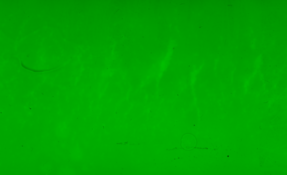
Attached is an image of one of the strips against a white wall with sun behind it. They are almost entirely green with some ugly splotches across the image areas - I didn't take too much care in drying them properly or washing after my permawash bath. If you look closely at them in direct light, you can still faintly see edge markings of FUJI RVP and numbering.

Also attached is a scan of part of the image area - EPSON V600 used on transparency settings. No color alterations.


IMG_5648.jpeg
 

Attachments

  • Screen Shot 2024-04-22 at 12.49.54 PM.png
    Screen Shot 2024-04-22 at 12.49.54 PM.png
    328 KB · Views: 23
Photrio.com contains affiliate links to products. We may receive a commission for purchases made through these links.
To read our full affiliate disclosure statement please click Here.

PHOTRIO PARTNERS EQUALLY FUNDING OUR COMMUNITY:


Ilford ADOX Freestyle Photographic Stearman Press Weldon Color Lab Blue Moon Camera & Machine
Top Bottom