
-
Welcome to Photrio!Registration is fast and free. Join today to unlock search, see fewer ads, and access all forum features.Click here to sign up
You are using an out of date browser. It may not display this or other websites correctly.
You should upgrade or use an alternative browser.
You should upgrade or use an alternative browser.
Exposing and developing for Pt/Pd printing?
-
A
- Thread starter pkr1979
- Start date
Recent Classifieds
-
Want to Buy Rapid Rectilinear lens for 8x10 or larger
- Started by blee1996
-
Free GONE French lens probably early XIXcentury
- Started by Gaston 012
-
Sold Ilford 4x5 FP4+ (Expired June 2023)
- Started by CreationBear
-
Sold Beseler Audible/Repeating Enlarging Timer w/ foot switch
- Started by CreationBear
-
For Sale Tanks n hangers
- Started by CreationBear
Forum statistics
I would say it depends on the format you are using and if you are enlarging the original negative to make the pt/pd print. Personally I expose and develop to make a silver print and scan and enlarge to make the negative for the pt/pd print. Slightly less exposure but slightly more contrast. Since I’m not into the nitty gritty math aspect of photography I have learned to eyeball what works for me with the mix I use. I probably haven’t helped you much but there is a lot of information out there and courses if you’re interested. You might check with Bostick and Sullivan for supplies etc.
As a general rule of thumb, a negative that prints well on silver gelatin at about contrast grade 1 will print well on pt/pd. Much depends on what film/developer combo you're using but, as a general guideline, increasing your normal developing time by 30 - 50% should get you in the ballpark. I'd recommend starting a 30% more development, then work up from there. If you have a means to measure negative density, then you should shoot for about a 1.7 density range for pure palladium. Not sure if DR would be different if tossing in platinum to the mix as I print with only palladium.
Thanks @Alan9940 - do you expose at box speed?
Hardly ever. Depending on age and speed of the film (got a lot of film in my freezer), I'm typically at 1/3 - 1 stop less than box speed. Developer formula I plan to use affects this decision, too. For example, if I plan to develop with a pyrogallol-based developer, I'll generally be at 1/2 box speed.

I find FP4+ developed in Ilford Universal PQ Developer to be a good combination for platinum printing.
I expose as I would for most processes -- exposing my shadows I want detail in on Zone III. For example, a 11x14 pt/pd work print I made last night: Pentax spot meter readings gave me a 3 and a half stop range with some darker areas too small to read...4 to 7.5...exposed at 6 (f45@30 seconds). However, I made no adjustment for resiprocity failure to allow the shadows to drop relative to the mid-tones and highlights to increase contrast. At box speed.
I print pt/pd with no contrast agent (just ferric oxalate, pt salt and pd salt), so I develop the negative to match that contrast rather than change my coating solution. The above example was developed with the PQ Universal at 1:9 at 68F for 10 minutes (tray, constant aggitation). Negative is a little high in contrast...perhaps 8 minutes might have been sweeter. The test print is slightly dark, so the jury is still out on it. The image might sweeten up when I hit the right exposure.
I also printed an 11x14 negative last night that was developed in Pyrocat HD. That is also a wonderful developer for negs to be printed with pt/pd. And if the scene does not need the extra push that the active PQ developer has, Pyrocat HD treats the highlights especially well.
I expose as I would for most processes -- exposing my shadows I want detail in on Zone III. For example, a 11x14 pt/pd work print I made last night: Pentax spot meter readings gave me a 3 and a half stop range with some darker areas too small to read...4 to 7.5...exposed at 6 (f45@30 seconds). However, I made no adjustment for resiprocity failure to allow the shadows to drop relative to the mid-tones and highlights to increase contrast. At box speed.
I print pt/pd with no contrast agent (just ferric oxalate, pt salt and pd salt), so I develop the negative to match that contrast rather than change my coating solution. The above example was developed with the PQ Universal at 1:9 at 68F for 10 minutes (tray, constant aggitation). Negative is a little high in contrast...perhaps 8 minutes might have been sweeter. The test print is slightly dark, so the jury is still out on it. The image might sweeten up when I hit the right exposure.
I also printed an 11x14 negative last night that was developed in Pyrocat HD. That is also a wonderful developer for negs to be printed with pt/pd. And if the scene does not need the extra push that the active PQ developer has, Pyrocat HD treats the highlights especially well.

djdister
Subscriber
I print pt/pd with no contrast agent (just ferric oxalate, pt salt and pd salt), so I develop the negative to match that contrast rather than change my coating solution. The above example was developed with the PQ Universal at 1:9 at 68F for 10 minutes (tray, constant aggitation). Negative is a little high in contrast...perhaps 8 minutes might have been sweeter. The test print is slightly dark, so the jury is still out on it. The image might sweeten up when I hit the right exposure.
Did you mean to insert an image?
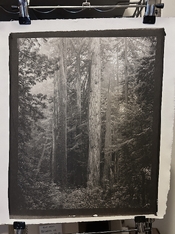
No -- it was a written example. But here is a iPhone image of the print. The actual print is darker with less contrast. It is an interesting situation -- the fog moved in swiftly during the 30 second exposure and giving the image two areas of different contrast.
I just need to work with the negative and process a little more. I'm a little rusty with printing pt/pd 11x14. I have a roll of HPR and it even took me awhile to remember which side to coat. I need to increase the amount of solution and fine-tune the Tween.
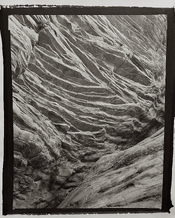
I also attached the other print I made -- film developed with PyroCat HS (Zion NP)
I just need to work with the negative and process a little more. I'm a little rusty with printing pt/pd 11x14. I have a roll of HPR and it even took me awhile to remember which side to coat. I need to increase the amount of solution and fine-tune the Tween.
I also attached the other print I made -- film developed with PyroCat HS (Zion NP)
Attachments
Last edited:

Depending on how you enjoy working, you could either do formal film testing (e.g. BTZS) or an empirical testing (a.k.a. trial and error). Personally I prefer the latter – find a friendly subject, expose a sheet of film, develop it, and print the negative. Repeat adjusting exposure and development until you're happy with the results. Over time you'll learn to recognise under/over exposure and under/over development.
For what it's worth, I expose FP4+ at EI 100 and tray develop in W2D+ for 13 minutes.
For what it's worth, I expose FP4+ at EI 100 and tray develop in W2D+ for 13 minutes.

Thanks @Ian Leake - I am probably more trial and error than formal film testing. @Andrew O'Neill - I am most likely opting for FP4+ like Ian for this, but was intending to use an off the shelf developer instead of a staining one.
FP4 is an excellent choice. I use staining developers and non-staining. Just be sure that you are developing long enough to fit the process. I have a 4x5 back for my 8x10, and routinely test on the smaller format, before moving up to 8x10 sheets. 8x10 ain't cheap!
FP4 is an excellent choice. I use staining developers and non-staining. Just be sure that you are developing long enough to fit the process. I have a 4x5 back for my 8x10, and routinely test on the smaller format, before moving up to 8x10 sheets. 8x10 ain't cheap!
True! How do you usually expose FP4 and develop it for non-staining developers?
I usually exposed FP4 at EI 80, in conventional developers like XTol, D-76. My experience is not with pt/pd, though. Kallitype (which is pretty similar), Carbon transfer, Salt, Ferroblend, and a couple more...

| Photrio.com contains affiliate links to products. We may receive a commission for purchases made through these links. To read our full affiliate disclosure statement please click Here. |
PHOTRIO PARTNERS EQUALLY FUNDING OUR COMMUNITY:  |