• Welcome to Photrio!
    Registration is fast and free. Join today to unlock search, see fewer ads, and access all forum features.
    Click here to sign up

Eugene Atget Appreciation

Forum statistics

Threads
203,442
Messages
2,854,796
Members
101,845
Latest member
azak
Recent bookmarks
0
the_work_of_atget-6070.jpg

The US postal service just dropped off these beauties on my front porch. Speaking of reflections, my modern "digital" polarizing filter did nothing to reduce the shiny reflections from these plastic covers. And I was too eager to look inside the books to mess around with proper lighting.

My wife asked me if Atget's photos are all "sepia toned" -- can we assume the rich brown tones as reproduced in the books are approximately the same as when the prints were new, and that was an intentional choice by Atget -- or have the prints possibly browned with age? (Sorry if that is explained in the text of the books, which I have not yet read.)
 
From reflections, he seems to be beside the camera when he takes the photo. There's nothing to see under the cloth.
Of course! Silly me.
And that guy on the left does look like the cart driver. So he could've been a jumpy guy.
I reckon he was one of those annoying pratts that has to be seen.
 
Thank goodness Atget himself never had a polarizer! That would have spoiled everything that made Atget Atget. I hate polarizers myself, and indulge in untamed glare and reflection. An exception would be the copystand with anything shiny involved, like copying a Cibachrome or Fujifles Supergloss print.

Per the books - they tend to make Atget's images look more modern and punchy than the originals. The brown toning in the reproductions seems pretty accurate; but some images seem a bit too cold black to be dead-on accurate. I don't really care. That set of books is absolutely lovely to thumb through, and gives a better impression than any other books I've run into.
Signs of aging I've seen in his actual prints were mildew (foxing) and some yellowing of the paper in certain cases. The sepia tone was inherent to his chosen print medium, there all along.
 
View attachment 421895
The US postal service just dropped off these beauties on my front porch. Speaking of reflections, my modern "digital" polarizing filter did nothing to reduce the shiny reflections from these plastic covers. And I was too eager to look inside the books to mess around with proper lighting.

My wife asked me if Atget's photos are all "sepia toned" -- can we assume the rich brown tones as reproduced in the books are approximately the same as when the prints were new, and that was an intentional choice by Atget -- or have the prints possibly browned with age? (Sorry if that is explained in the text of the books, which I have not yet read.)

Wow, I would love that set of books and I believe most of his images were gold toned.
 
1776455575093.png
 
I'll volunteer if someone pays my travel and film expense. But Sceaux is apparently a significant tourist attraction now. The mansion is now restored, and restoration of the gardens began a year ago, so it would probably be a bad time to photograph the outdoor portion the moment, with landscaping still going on. Seems to be quite a bit of history behind it. It dates back to 1670. The original main building was destroyed during the French Revolution, and the smaller chateau which replaced it, and was recently renovated, dates back to the mid-19th C. The entire grounds, "as is" became a public park in the 1920's. So Atget apparently photographed it during its season of neglect prior to that.

Current pictures of it all certainly look quite restored. They want 4,000 Euros per wedding for a day's use of a portion of both the gardens and castle, and it seems to be heavily booked in advance. Otherwise, tours of the castle are free, and somewhere on the property there's an important art museum.

I'd prefer to see it rundown and in solitude myself, just like Atget did. I was married on my own little ranch for free, and did the gardening myself; lots of wildflowers and photogenic weeds, rocks, and trees - hillbilly Sceaux, certainly not rundown, but with a lot still left up to nature.
 
Last edited:
I'll volunteer if someone pays my travel and film expense. But Sceaux is apparently a significant tourist attraction now. The mansion is now restored, and restoration of the gardens began a year ago, so it would probably be a bad time to photograph the outdoor portion the moment, with landscaping still going on. Seems to be quite a bit of history behind it. It dates back to 1670. The original main building was destroyed during the French Revolution, and the smaller chateau which replaced it, and was recently renovated, dates back to the mid-19th C. The entire grounds, "as is" became a public park in the 1920's. So Atget apparently photographed it during its season of neglect prior to that.

Current pictures of it all certainly look quite restored. They want 4,000 Euros per wedding for a day's use of a portion of both the gardens and castle, and it seems to be heavily booked in advance. Otherwise, tours of the castle are free, and somewhere on the property there's an important art museum.

I'd prefer to see it rundown and in solitude myself, just like Atget did. I was married on my own little ranch for free, and did the gardening myself; lots of wildflowers and photogenic weeds, rocks, and trees - hillbilly Sceaux, certainly not rundown, but with a lot still left up to nature.

Yes, I'd seen the online photos of modern Sceaux. I just thought then-and-now was an obvious exercise for someone interested in Atget (or in the restoration of Sceaux) to have done, like Michal Hejna and Petr Pazour did for Sudek's panoramic photos of Prague.

The sense of solitude, and the ravages of time, are the main elements of Atget's appeal for me.
 
Yeah, I thought so, too. Looks like a rather well-executed project, a nice exercise and I like how he presented the results as well. In particular I like how he removed the toning and adjusted the contrast to 'normal' of the Atget images so the emphasis is placed back on the images themselves and their composition, facilitating also the comparison with his modern interpretations. The latter is handy for the project, but the former (i.e. seeing the images without the fading, potential discoloration, water marks etc.) I also find refreshing and in my view removes a lot of unnecessary distraction.
 

Thanks for posting that link, I really enjoyed looking at the Then & Now photos.
---

Comparisons between the Then & Now photos really emphasize something about Atget's photos which I have noticed before, but I don't understand. Why are distant, and even not-so-distant buildings in Atget's photos so often hazy, foggy, and atmospheric?

I suspect Atget often chose to work on misty days because he liked this effect(?)

But was there something else going on, as well? Maybe the air was thick with smog from burning coal? Or was there something about the spectral sensitivity of his emulsions that exaggerated atmospheric haze?

NOTE: that is Atget's photo on the left, which demonstrates the atmospheric effect I have been noticing in a lot of his photos.

Screenshot 2026-04-21 at 8.03.06 AM-small.jpg
 
Last edited:
Why are distant, and even not-so-distant buildings in Atget's photos so often hazy, foggy, and atmospheric?

Most of what you're seeing is rather poor halation control in the medium (film, glass plates) he used combined with the characteristic curve that tends towards compression and thus low highlight contrast/separation.

The other effects you mention are likely at play as well; fog, atmospheric conditions and possibly orthochromatic emulsions.
 
Unquestionably all the above. The urban air quality was poor and hazy, and Atget employed both that and deliberate lens flare to achieve a particular atmospheric look. Why are photographers today so afraid of atmosphere? Atget's example of the posted street corner gracefully recedes into the background; the modern example with its modern "improved" lens is just plain cluttered and compressed, boring in fact.
 
Most of what you're seeing is rather poor halation control in the medium (film, glass plates) he used combined with the characteristic curve that tends towards compression and thus low highlight contrast/separation.

The other effects you mention are likely at play as well; fog, atmospheric conditions and possibly orthochromatic emulsions.
Although panchromatic emulsions became available during Atget’s later life, I would bet he never used them, because he was accustomed to develop by inspection under safelight, and of course panchromatic emulsion requires developed in complete darkness. We’ve already discussed his safelights, and he was clearly conservative by nature!
 
Given Atget's general tendency towards the archaic, I bet he didn't use panchromatic film or plates much, yes. He seemed to be dragging a few decades behind photographic technology; a bit like many of us here as well. Perhaps also for similar reasons; that in itself would be an interesting question.
 
Both his materials and camera gear were behind the times. That has been frequently noted and discussed. But the point is, it did what HE wanted it to - why change? ("If it ain't broke, don't fix it"). Who wants to break in a new pair of boots if the old ones are still comfortable?

As far as plate sensitivity, one could peruse his images to see how greenery responded. But from the look, I suspect he used blue sensitive plates all along, and not ortho. Atmospheric effects are accentuated by blue due to more light scatter encountering particulates. Just do a comparison test on pan film, blue filter versus red filter,
and then vs green filter.
 
Last edited:
Was Atget behind the times when he started - in the late 1880s - or ever, really? The camera he used was likely new when he bought it. The whole "old-fashioned" idea seemed to come from the surrealists (who, as anyone should know, were very much of-the-time and, at that time, young). So Atget was using a large format camera and dry plates in the 1920s. What was he supposed to be using to make that size prints? He needed detail in the prints to satisfy his market (artists). Keep in mind this was all before 1927 (when he died). There were no panchromatic dry plates before 1906 - well into his established method of working.
 
If I wanted to reproduce some of the atmospheric effect seen in Atget's photo in post #662, please help me rank the following from the most likely to be effective to the least effective:
1. Shoot in foggy / misty weather
2. Use a blue sensitive film. Is there any such b&w film available today in 120 size?
3. Use a film with poor halation control and/or poor highlight contrast/separation? Is there any such b&w film available today in 120 size?
4. Use an uncoated lens, possibly combined with backlight to introduce flair
5. Use a blue filter -- but which blue?
6. Something else?

Is this getting too far off-topic? Maybe I should move it to a new thread?
 
Last edited:
long thread but fast to read.

few points about Atget:

- there is no comprehensive dedicated biographic book about Atget in French, because he was a regular guy, not a celebrity with a timeline of contacts, events with other celebrities. He was not a professional photographer with a studio, doing picturialist work, portraits for the bourgeoisie and upper class, exhibitions. Known photographers of the time didn't know about him and had probably dismissed him.

- among several biographic summaries, a good one was a small text published in the local bulletin of Bièvre Photoclub. They publish a small magazine, La Pelloch'. Pelloch' or pelloche or péloche, is slang for pellicule ie. film. https://www.photo-bievre.org/actualites/pelloch/ but there on their site oldest small bulletins ancestors of the magazine are missing. The one of 2000 about Atget attached here, pdf at the bottom - Another good biographic overview here: https://sites.google.com/site/grandsphotographesdu20eme/atget-eugène

- he touched photography on the side of a try at becoming painter in 1887-88. Among illustrators, painters, architects he saw the need they had for documents and decided to photography landscapes, tree, architecture, monuments. That was a stream of revenue. Another one was trying to sell to shops owners, photographies of their fronts. Some of his customers among painters were Utrillo, Derain, Fujita, Vlaminck.

- he provided cultural institutions with views of disappearing street jobs, and then photographies of everything pre-Haussmann in the city, from 1897 to his death 1927. So city and state cultural institutions were another stream of revenue. Also real estate business and architects.

- the brothel's nudes photographies was an order for illustrator and painter André Dignimont, who had an erotic fetish

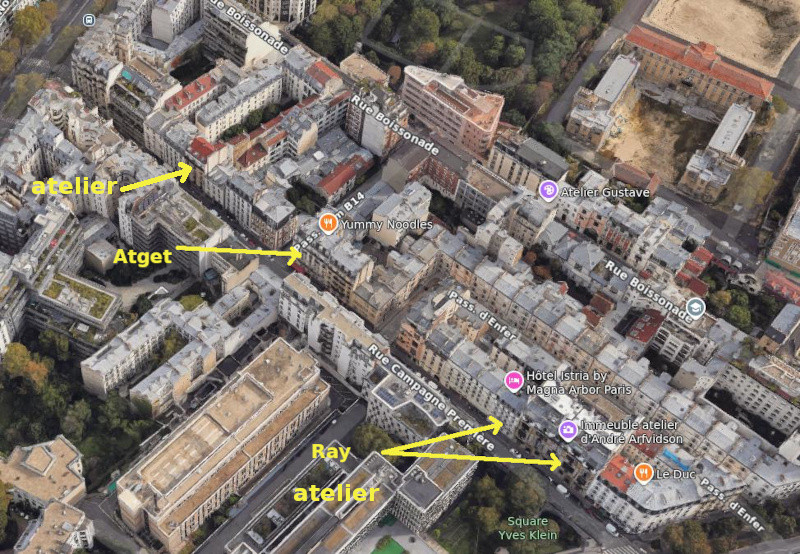
- reasons Atget became famous post-mortem. He lived in Montparnasse from 1899. The location is key. Rue Campagne Première, a small street. He lived at the 17bis until his death in 1927. Around the years 1910, Montparnasse became the area of several artists. At nr. 9 in the street a house with ateliers was set:


another atelier was at nr. 31, and at nr 29, there is a hotel, Istria, where several artists and writers stood some time. The 31 was where Man Ray had his atelier.

seen on a street panorama, left to right: 9, 17bis, 29, 31

Atget-Ray.jpg


Ray met Atget, Abbott who worked with Ray was impressed. and overseas in New World, Atget photographies brought by Abbott may have been felt as views of an exotic past.

A French, an European in general, would feel nothing special because well any city in France (Italy, Spain, etc) has kept a Middle Age core and the older onion structure. For instance Saint-Jean in Lyon, or Lille or Dijon, or Angers, or Le Puy or Avignon or Béziers, or etc, that is something, but Paris, seriously?
Also Atget used dry plates, printed a lot, but not only, on albumine paper. Abbott met a guy from the past.

what was old in Paris was not so much some chunks and streets that survived Hausmann destructions, but the social structure of the population. There was still a proportion of pre-industrial street trades: wandering glass/windows repairers, rags pickers, cigar butts pickers, baskets repaired, knives sharpeners, chimneys sweepers, coal delivery, water delivery, etc.

As for Man Ray, he was the one who made Atget work known among the other surrealists, but just as artifacts among others in esthetic process of surrealists.

the link to the first publication with some Atget photographs. onm BNF site: "La Révolution surréaliste" nr. 7 1926:
La Révolution surréaliste

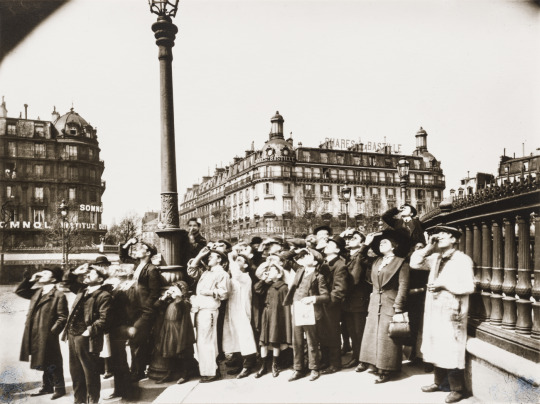
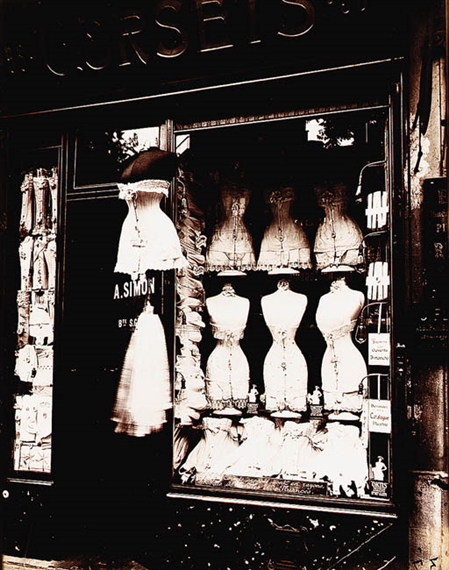
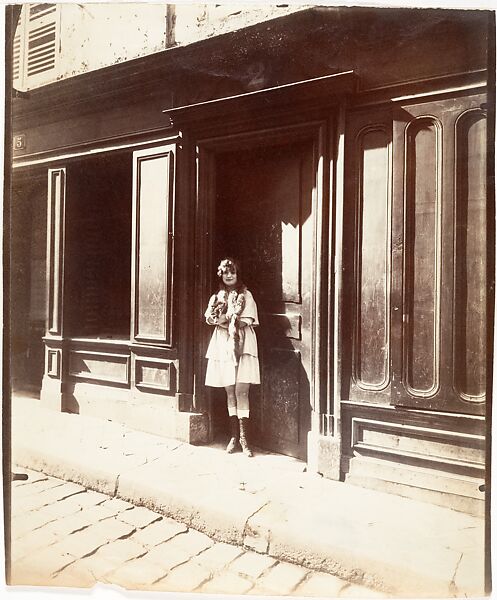
the cover picture (people gathered to observe an eclipse) , page 6 with the text of Marcel Noll (corset front shop), page 28 with the text of René Crevel (prostitute by entrance of brothel):

eclipse.jpg


corsets.jpg


maison-close.jpg


these photographies, contrary to all other works in the revue, have no author name. A letter was kept of Atget telling Man Ray that he didn't want to be cited, because these photographies were just documents, not artwork...

btw, it was Man Ray, who put in contact Atget with Dignimont, who ordered the serie about prostitutes nudes.

In this issue of Révolution surréaliste, photographies of Man Ray are composed, the ones of Atget are just used as random slices of life, as per the theory of random objects being able to trigger esthetic feelings, dream, unconscious associations. But Atget had nothing to do with surrealists, had no clues about their theories and works.

A staple in classes of literature, when in lycée, is (or was?), not in a mandatory way, but among several options, a book of André Breton, "Nadja". It uses several photographies. Typical of surrealist works of the 20's. First photographie (Hôtel des grands hommes) is not credited, so could be from Atget:
André Breton - Nadja

 

Attachments

  • pelloch29.pdf
    81.2 KB · Views: 5
Thanks so much for posting this, @srardnec - it’s very helpful.

I started reading the Pelloch article the lazy way, via translator. But when it translated “carrossier” as “body builder”, I realised that my schoolboy French was actually good enough!
 
I started reading the Pelloch article the lazy way, via translator. But when it translated “carrossier” as “body builder”, I realised that my schoolboy French was actually good enough!

:smile: a pitfall I guess for some machine translators. Carrosse is a full coach (roofed, doors). Wondering if English car derives also from the same latin word carrus, that makes carro in Italian and Spanish.
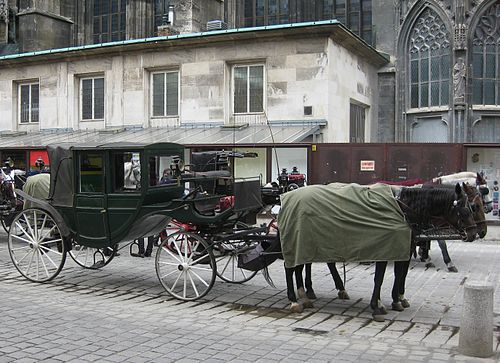
this:
500px-Wien-Fiaker-geschlossen-Stephansdom-20100930.jpg


smaller, no roof, for summer, version: calèche. Fiacre is a rented calèche or carrosse, ie. a taxi.

Man Ray and Abbott probably didn't know the Paris of fiacres. These were phased out in the 1910's with some still working until 1920/1921.

in English this kind of carrossier, coach builder?

by derivation, carrossier now is for car body repairman/technician/shop

in 1969 there was a survivor, cheese merchants who went to their market spot in Paris by coach:

 
Photrio.com contains affiliate links to products. We may receive a commission for purchases made through these links.
To read our full affiliate disclosure statement please click Here.

PHOTRIO PARTNERS EQUALLY FUNDING OUR COMMUNITY:


Ilford ADOX Freestyle Photographic Stearman Press Weldon Color Lab Blue Moon Camera & Machine
Top Bottom