• Welcome to Photrio!
    Registration is fast and free. Join today to unlock search, see fewer ads, and access all forum features.
    Click here to sign up

Enlarger alignment and grain focusing

Valencia

A
Valencia

  • 0
  • 0
  • 45
Tied to the dock

D
Tied to the dock

  • 4
  • 0
  • 89

Recent Classifieds

Forum statistics

Threads
203,092
Messages
2,849,722
Members
101,659
Latest member
Dirksen
Recent bookmarks
1
A few thoughts -

With the Parallel and glass carriers, I'm up to 30" prints now, corners and center all sharp, wall-projection. My horizontal "easel" has three alignment points, using bolts and drum brake screws. I bungee-cord the Parallel to it.

With the MXT, you have three "adjustment screws" at the lens stage, used to attach the turret - you can put foam under them, but there's not much range. Get or make a "Besalign" board - here's a PDF I made on building one. The MX doesn't have anything like that and needs an adjustable board.

You can shim the lens board, but it's a pain and you'll be re-doing it often. An alignable board is the shizz.

If the baseboard isn't level, it doesn't matter - since the other 2 stages attach to the board, you can get everything leveled. A warped baseboard would be another story, but as long as the three planes are parallel, you're good - we wouldn't be able to print horizontally if that weren't true.

A see-into-the-corners grain focuser is necessary if you want to see grain into the corners. The Micromega is a good one, I find with the Parallel, I don't really need it, but it's nice to verify.

I use a glass carrier with plain (not ANR) glass - zero issues.

Great tip for the Parallel - look through your junk filters or get some crap filters from eBay that match your enlarger lens threads. Tape a square of paper to the center of the inner filter surface. No more messing with that ridiculous rubber-band setup, just screw in a filter to laser the lens. I store mine with the Parallel.

Grab your lens (when installed) and wiggle it. I find the MXT doesn't really lock the lens board in place. So find the spot where it seems to seat the best, and change apertures gently or you'll throw alignment off. This is a good use for shims though, you can shim it to where it doesn't budge, but it takes some muscle to get the boards on and off!

I find the MXT can go out of alignment from simply raising or lowering the head, so once you get through test prints, align it. I keep the two wrenches (and an allen wrench for the Besalign boards) handy; I can align it in 30 seconds or so. Getting the proper wrenches is quicker than using an adjustable wrench.

 
Too check the corners of the field on the baseboard you need a magnifier with a tilting head relative to a front surface mirror, like the Peak Critical Focus one. And of course, full glass sandwich-style carriers are essential to any consistently in-focus results anyway.
 
Last edited:
When I was shown a grain focuser, it became much easier to focus much faster and sharper.

I dont know about a grain focuser, but switching the dichro head to the setting i want to use for contrast control seems to give alot betterhelp with focusing the small details.. like leaves on a tree.
 
I dont know about a grain focuser, but switching the dichro head to the setting i want to use for contrast control seems to give alot betterhelp with focusing the small details.. like leaves on a tree.

I have only used a grain focuser with a dichroic head.
 
A few thoughts -

With the Parallel and glass carriers, I'm up to 30" prints now, corners and center all sharp, wall-projection. My horizontal "easel" has three alignment points, using bolts and drum brake screws. I bungee-cord the Parallel to it.

With the MXT, you have three "adjustment screws" at the lens stage, used to attach the turret - you can put foam under them, but there's not much range. Get or make a "Besalign" board - here's a PDF I made on building one. The MX doesn't have anything like that and needs an adjustable board.

You can shim the lens board, but it's a pain and you'll be re-doing it often. An alignable board is the shizz.

If the baseboard isn't level, it doesn't matter - since the other 2 stages attach to the board, you can get everything leveled. A warped baseboard would be another story, but as long as the three planes are parallel, you're good - we wouldn't be able to print horizontally if that weren't true.

A see-into-the-corners grain focuser is necessary if you want to see grain into the corners. The Micromega is a good one, I find with the Parallel, I don't really need it, but it's nice to verify.

I use a glass carrier with plain (not ANR) glass - zero issues.

Great tip for the Parallel - look through your junk filters or get some crap filters from eBay that match your enlarger lens threads. Tape a square of paper to the center of the inner filter surface. No more messing with that ridiculous rubber-band setup, just screw in a filter to laser the lens. I store mine with the Parallel.

Grab your lens (when installed) and wiggle it. I find the MXT doesn't really lock the lens board in place. So find the spot where it seems to seat the best, and change apertures gently or you'll throw alignment off. This is a good use for shims though, you can shim it to where it doesn't budge, but it takes some muscle to get the boards on and off!

I find the MXT can go out of alignment from simply raising or lowering the head, so once you get through test prints, align it. I keep the two wrenches (and an allen wrench for the Besalign boards) handy; I can align it in 30 seconds or so. Getting the proper wrenches is quicker than using an adjustable wrench.


I am not a fan on relying on squeezing foam for permanent alignment.:sad:
 
Bungee cords are great in earthquakes; helps all your gear shake even worse. A fun time to fine focus too! That's why houses are attached to their foundations with bungee cords - great engineering! Let's see.. we've had Richter 3.6, 6.3, and 4.5 quakes here in NorCal the past two weeks. Odd that I bolt everything down using structural steel braces instead of rubber bands and duct tape.
 
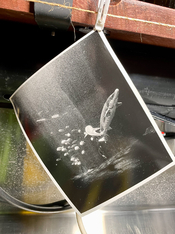
To bring some closure to this thread here is the print I was working on when I asked for advice. It was shot with a Nikonos III using Delta 3200 at 6400.
Will try glass carrier sometime soon. Thanks for the focus slack fixing tip. And thanks @M Carter for the DIY adjustable lens board!
Thanks to all for the inputs!
 

Attachments

  • sans titre, 1.jpg
    sans titre, 1.jpg
    892.4 KB · Views: 108
To bring some closure to this thread here is the print I was working on when I asked for advice. It was shot with a Nikonos III using Delta 3200 at 6400.
Will try glass carrier sometime soon. Thanks for the focus slack fixing tip. And thanks @M Carter for the DIY adjustable lens board!
Thanks to all for the inputs!

Your underwater photographs with your Nikonos III are better than mine with the Nikonos V.
 
Your underwater photographs with your Nikonos III are better than mine with the Nikonos V.

Thanks a lot!
I adopted a simple and lazy method in this case. I was shooting with ambient light in a low light environment. I just shot wide open at 1/30 the whole time and did a stand development in DDX. Kind of auto-iso P&S.
 
Instead of the laser thingy, can try a pair of mirrors for alignment
 
Photrio.com contains affiliate links to products. We may receive a commission for purchases made through these links.
To read our full affiliate disclosure statement please click Here.

PHOTRIO PARTNERS EQUALLY FUNDING OUR COMMUNITY:


Ilford ADOX Freestyle Photographic Stearman Press Weldon Color Lab Blue Moon Camera & Machine
Top Bottom