• Welcome to Photrio!
    Registration is fast and free. Join today to unlock search, see fewer ads, and access all forum features.
    Click here to sign up

Drywall Finishing in the Darkroom...

Recent Classifieds

Forum statistics

Threads
203,065
Messages
2,849,364
Members
101,630
Latest member
Proxboss
Recent bookmarks
0
This is after working it with a wet sponge:
file-9.jpg
 
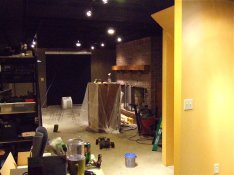
This is a picture as it stands now. Nearly complete except for the floor:
file-7.jpg
 
Of course they sand drywall... always! I think there is a lot of confusion here between drywall technique and plastering, which is a more acquired skill using somewhat different tools and materials, and fairly rare in new construction. True plaster is almost pure gypsum (unless something is deliberately added for texture or binder). Here they tend to use Diamond plaster on blueboard, except on true historical restorations, which obviously start with whatever is there. The plaster has to be very fresh. A little bit of moisture of humidity in the bag will ruin it. Drywall is a much more plebian trade, and more realistic for a do-it-yourselfer. It makes a mess unless you have expensive dust containment equipment. Sponge sanding can alleviate this is smaller projects like a darkroom. Doing true smoothwall is far tricker than hiding your errors with texture, and requires dimensionally stable framing behing the rock, but will provide an easier surface to sponge down for dust control in the darkroom. Around here, you can always tell a true plasterer from a drywall contractor, because the plasterer drinks Guinness,
while the average drywall dude drinks Redhawk or some other cheap rotgut.
 
Here is an area on which I was practicing. This is dry plaster. Realize this is a test to see if it would be at all possible to smooth that bad of an area with the sponge...


With the correct float you should be able to get it smooth before it dries without the sponge or sanding.

Note that whilst I know how to do this, I'm not very good at it!

Of course they sand drywall...

In England you would be asked to leave any building site you were working on and not return if you sanded plasterboard joint compound!

Plus you Americans seem to run most of your joints horizontally instead of the proper vertical method. Probably for the same reason you rotate 5x4 film to make it 4x5!

Around here, you can always tell a true plasterer from a drywall contractor, because the plasterer drinks Guinness, while the average drywall dude drinks Redhawk or some other cheap rotgut.

Now you're making more sense!


Steve.
 
Last edited by a moderator:
Steve- as usual, it is always interesting to learn about different terminology and trades where you are. True plastering is a distinct "niche" trade here, largely related to the renovation of lovely older homes. I personally hate it when someone modernizes those contoured ceilings up above the perimeter mouldings with something like boring flat drywall. Out in the "burbs", however, everything is just some kind of huge flimsy sheetrock box. Real plastering, just like true smoothwall and related faux finishing, can be quite a good income, and it's nice to see a few younger guys learning it from the old pros. I did some back when I did faux finishing myself on restorations, but soon found out I could avoid
the fumes and headaches by shifting that experience into a combination of architectural consultation and arch. photog. It was nice for awhile, but now I'm too old and lazy for either, so just sell the supplies and equipment, which is hectic enough!
 
There are three distinct ways of finishing a wall here. Traditional plastering puts a 1/2" mortar render on the wall first followed by a thin, smooth plaster coat. Many amateurs don't know about the mortar render and try to put up 1/2" to 3/4" of plaster in one go and wonder why it falls off the wall or if it stays there, why they cant get it flat.

As far as plasterboard (or drywall) is concerned, it is either joint filled or given an all over skim coat about 1/16" to 1/8" thick.

I prefer the all over method but a lot of people don't do it properly. I don't know about your drywall sheets but plasterboard has two surfaces. One is called the decorating surface and has the bevels to allow for flush jointing and filling and the other side should be used if a skim coat is to be applied - however, hardly anyone uses the rear for skim coats. I have been in houses trying to fit radiators to the wall and have had large sheets of plaster fall off.

I have a friend who is a plasterer by trade and when I asked him about the two surfaces for different uses he said that I was probably the only person he knew apart from himself who even knew about it as it is usual now to fit plasterboard bevel side out regardless of the intended finish. Something he will not do himself.


Steve.
 
Here it is quite difficult to market old-world trades in any manner sufficient to making a living. There are just layers and layers of building codes
(seismic, fire, acoustic, mold abatement) - all kinds of materials they never heard of, including newer techniques that don't fit into any category we've discussed so far. It' really a trade best passed on from someone who has already developed a niche following to an apprentice. Drywall itself is quite different here in the city - some very complex strict rules - from again, out in the burbs, Midwest, or Southern US, where rules
practically don't exist until a hurricane or earthquake does show up, and make it pretty damn graphic why construction standards are needed.
The best of the best true plasterers worked alongside people like my aunt, when a lot of the big public frescoes were being made back in the
30's - everything in the application and drying - the whole timing - had to be perfectly synchronized. And of course, had to be dead smooth
right then and there. Gotta admire that kind of skill.
 
With the correct float you should be able to get it smooth before it dries without the sponge or sanding.

Note that whilst I know how to do this, I'm not very good at it!

I think in this century of 'big box' stores one needs to develop additional savvy. For example, when buying small quantities of mixed plaster, due to my route home from work, time of day, and store availability, it seemed each tub I used came from a different manufacturer. Each had slightly different mystery characteristics when being spread. Thus the need for some sort of final smoothing technique.
 
Photrio.com contains affiliate links to products. We may receive a commission for purchases made through these links.
To read our full affiliate disclosure statement please click Here.

PHOTRIO PARTNERS EQUALLY FUNDING OUR COMMUNITY:



Ilford ADOX Freestyle Photographic Stearman Press Weldon Color Lab Blue Moon Camera & Machine
Top Bottom