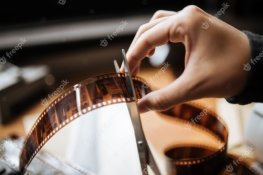
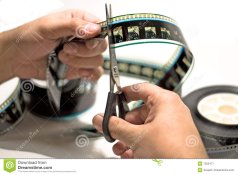
I'm looking to getting a splicer for our community darkroom because my ability to get the scissors right in between the frames is diminishing. I didn't realize they were as costly - used, not to mention new. Is there a one-size-fits-all or must one (myself) get a 35mm or medium/large format ?
I am puzzled. A pair of scissors is to divide things, a splicer is to connect things.
A filmstrip may be cut by a device used to cut off frames to make slides. Here there are models where one can move the filmstrip by a sprocket or friction wheel.
I thought so too. A splicer cuts off the leader and cassette first, before connecting the strips. But for amateur use it would be overkill and I would not know how to use it just for slicing.
Maybe the OP refers to a basically very simple device of 35mm cine-splicer, which cuts and connects strips.
Problem here may be the non-standard frame-stand of exposed film in still photography, which just would be hampering what he actually is trying to achieve.
I use a scrap booking paper trimmer over my light box. It works well it's easy to line up whatever gap you have between frames on the cutter path, 10 or 15 USD from chain art store.
I use a small pair of scissors. Including the handles, they're about 4" long. The working part of the blade is about 2" or less. The bigger the scissors, the tougher it is to be accurate.
I use a small pair of scissors. Including the handles, they're about 4" long. The working part of the blade is about 2" or less. The bigger the scissors, the tougher it is to be accurate.
Yes the longer the scissors the less accurate you can be. A new sharp short scissors used only for neg cutting is, IMO, the best solution. Trimmers and cutters, unless professional-grade, will only cause scratches and bad cut marks.
I also think the way you grip the negatives is important. Hold the negatives, by the edge, between your thumb and fore finger.
Like this.
I use scissors. Locate your eye in the cutting plane of the scissors, the plane where the two lades meet, and visualize where that intersects the film. If and when the cut is properly started, the edge of the partly-cut film can used to guide the scissor blade to continue along the same line. Works for me.
I bought one of the small, hand-operated 35mm cine splicers, specifically to use in putting leaders on unexposed rolls for my RB67 pano use -- and haven't ever used it. As noted, for cutting processed negatives, the fixed distance from perf to cut is a problem for still camera negatives, since still cameras don't have a fixed perf location relative to the frame gate. Not to mention some of my cameras don't have perfect spacing anyway (both of my 35mm folders and at least one of my Kiev 4).
BUT the OP stated that he is loosing the ability to hold the scissors right. Thus we should come up with some mechanical aid.
If a respective slides-cutter, as hinted at above, turns out to be scratching the strip, one could modify some miniature guillotine cutter to lead the strip on guides just at the edges. As the film strip is lightly warped, this might not even be necessary.
The device linked above is probably the right tool, but it shouldn't be difficult to 3D print something that does the same job. I won't get around to designing one in the near future, though, too much on that plate already.
I cut it w/ scissors too after taking it down from drying. Then the negs go right into the print file w/ the date, type of film, what camera, development, etc. For me. it helps to have good lighting when you cut the negs w/ scissors. I would imagine that one could set up a little jig w/ a box cutter to cut it as well, but I just use the scissors and eyeball it.
Photrio.com contains affiliate links to products. We may receive a commission for purchases made through these links. To read our full affiliate disclosure statement please click Here.