• Welcome to Photrio!
    Registration is fast and free. Join today to unlock search, see fewer ads, and access all forum features.
    Click here to sign up

do you look to painters for inspiration? (especially landscape)

Bookcase detail

A
Bookcase detail

  • 0
  • 0
  • 13
Cone and Hoop

A
Cone and Hoop

  • 1
  • 0
  • 39

Forum statistics

Threads
202,762
Messages
2,845,242
Members
101,512
Latest member
FastFred
Recent bookmarks
0
I visited the National Palace museum in Taipei and was introduced to a painter called Chiang Dai Chien. He paints landscapes by blowing paint on canvas. His style reminded me of Ansel Adams prints. The mural of a mountain scene in the lobby was awe inspiring.

I believe he spent a fair amount of time I in exile in Brazil during the Cultural revolution.

You have got to look at his work if you do landscape.
 
I didn't find anything about his paintings that reminded me of Ansel Adams landscapes. Maybe I don't have a "cultural" eye for it.
 
(there was a url link here which no longer exists) this guy knows how to pain !
 
I guess my taste in art is different.
 
When it came to portraits I was inspired the most by Rembrandt and Vermeer...especially Rembrandt.

Yes, indeed; especially Vermeer. While artists of that time served long apprenticeships learning their materials and tools, they were masters of light. Now, in complex studios, we seem more concerned with eliminating every possible flaw than with using simple lighting to honestly present the subject. Photographers can show off their bag of tricks and mastery of contemporary styles, or can let the subject, not the technique, dominate the photograph.
 
Last edited by a moderator:
Yes, indeed; especially Vermeer. While artists of that time served long apprenticeships learning their materials and tools, they were masters of light. Now, in complex studios, we seem more concerned with eliminating every possible flaw than with using simple lighting to honestly present the subject. Photographers can show off their bag of tricks and mastery of contemporary styles, or can let the subject, not the technique, dominate the photograph.

How true.
 
Yes, indeed; especially Vermeer. While artists of that time served long apprenticeships learning their materials and tools, they were masters of light. Now, in complex studios, we seem more concerned with eliminating every possible flaw than with using simple lighting to honestly present the subject. Photographers can show off their bag of tricks and mastery of contemporary styles, or can let the subject, not the technique, dominate the photograph.

Personally I don't find the comparisons real helpful. Touted artists of days gone by lived in a time where very few people were "pretty" and not for long. Most people lost their teeth, none but the aristocracy wore makeup and the artists painted what was expected of him. If he was doing commissioned work he probably tarted up the people to some extent one way or the other (height, weight) etc.

In today's world, commissioned photographers will enhance the subject for marketing purposes, for vanity purposes and because people actually look better than the "old" days.

People who photograph for themselves or for photojournalist work, can do what they want as to visual enhancement. And that being said the craggy old man or the wrinkled old woman is a bit of cliche as well.

Painters had the use of photoshop in their heads, photographers, have the luxury and the burden of making their subjects look various ways and the learning of technique is important in both. In photography, the more dramatic the lighting the less flattering it generally is on people and the more retouching is needed. Unless again, you're going for the craggy wrinkled look, which is accentuated by dramatic lighting. The bottom line is, the lighting defines the drama, and the photographer has to decide if that's too harsh for the subject. A painter could use the dramatic lighting and back off the "trauma" it caused.
 
Last edited by a moderator:
I think Jim was referring to a more naturalistic image with less intervention of effects to give a skewed or personal interpretation dictated by the image maker.
 
I think Jim was referring to a more naturalistic image with less intervention of effects to give a skewed or personal interpretation dictated by the image maker.

Yes but the "effects" the painter used was his head and his brush. Both are/were interpretations that were used by the "artist". I thinks it's foolish to argue that highly regarded painters of their day, just "painted what was there". In fact the subject, WAS the technique. Every image no matter how it's made is interpreted by the author.

I mean if we're talking about goofballs over use of gimmicks, that's so prevalent it's obnoxious, but we are talking about top notch painters, so the comparisons should probably be with top notch photographers.

I'm sure there were plenty of hack painters in their day too.
 
Last edited by a moderator:
It doesn't necessarily have to be people to develop a "painter's eye". Who knows for sure what people looked like back in 1580 or 1650. All we have to go by is what we see in paintings. Were all women ugly, toothless wretches back then? I sort of doubt it. When they started looking better is anyone's guess. I think this article pretty well sums it up about being able to "see" as a painter may see.

http://www.nikonians.org/reviews/developing-a-painterrsquos-eye
 
It doesn't necessarily have to be people to develop a "painter's eye". Who knows for sure what people looked like back in 1580 or 1650. All we have to go by is what we see in paintings. Were all women ugly, toothless wretches back then? I sort of doubt it. When they started looking better is anyone's guess. I think this article pretty well sums it up about being able to "see" as a painter may see.

http://www.nikonians.org/reviews/developing-a-painterrsquos-eye

I didn't register so I didn't get the whole article, but the theme seemed more directed to composition than anything else. And I think it could be argued that composition is not a generational, or methodology of how a work is made (camera vs painting, digital vs analog) but instead it's a sort of agreed upon human appreciation for how elements are arranged in the world. The rule of thirds, the golden mean, and other "rules" were pretty much adopted because they "just felt right" for human consumption. Basically we liked them, and how they ordered our world. Almost primal.

So to me learning composition, whether studying paintings or just learning it, it's basically the ABCs of the language of art.

The study of paintings, to me is one way to learn it but, there are lots of shitty painting too.

Perhaps just learn it. And it can be taught with both great photographs and great paintings and drawings.
 
I didn't find anything about his paintings that reminded me of Ansel Adams landscapes. Maybe I don't have a "cultural" eye for it.

I guess you had to see the mural he did on display at the museum. It is a mountainscape about 20 feet tall and 50 feet wide. The image is almost monochrome.
 
Not really landscape, but I have spent quite a bit of time studying the works of Avigdor Arikha. Very interesting use of color, but what really intrigues me are his compositional choices that affect the edges of the painting. Edges are something I struggle with in my photos from time to time.

-Jim
 
I'm looking into Domenico Campagnola and Pieter Bruegel the Elder now :smile:
 
Painting and photography are very similar in some ways, vastly different in others. In my school of thought, you discover a photograph, and
then try to communicate it through the print. If you are good at it, you learn the limitations of your film and paper. A painter has much greater control over specific hues, arrangements etc. People who try to paint with photographic media, esp nowadays with the proliferation
of Fauxtoshop etc would basically be wretched painters. Too many options, too easy, leads to mediocrity. Less is more.
 
Painting and photography are very similar in some ways, vastly different in others. In my school of thought, you discover a photograph, and
then try to communicate it through the print. If you are good at it, you learn the limitations of your film and paper. A painter has much greater control over specific hues, arrangements etc. People who try to paint with photographic media, esp nowadays with the proliferation
of Fauxtoshop etc would basically be wretched painters. Too many options, too easy, leads to mediocrity. Less is more.

s
I often times use photoshop to colorize image, mostly paper negatives, bleached vyanotypes or negatives
from simple box cameras. I don't use too many colors, the images aren't over the top. I add just enough.
a Kurdish friend told me one day the trick to making great tea is adding just enough water ... the whole idea of just
enough is alive and well in photography ... even photoshop .. ... even people doing darkroom work, or shooting
chromed forget about that concept .. they over do the burning and dodging, they shoot excessive chromed
where the palet of colors is more garish than anything else ...
it isn't just fauxtoshoppers
 
I studied art history for 4 years and architectural history for 6 years ...
the main inspiration found in painting, sculpture, site planning and architecture isn't specific to the
subject matter in the "work" ( at least for me ) but it is all about composition, use of light and dark,
negative and positive space ... and hints made after he 1870's even more because they made up new
rules... because that is all image making, photography (portrait making, landscapes, still lifes&c)
whatever you want to call it is about, making things that are pleasing to the eye...
eddie's gallery that I linked to does it all. and even more so his last dozen posts.
sometimes one needs to go beyond subject matter and look at composition and construction , even if it is a "genre" that is out of ones comfort zone ...

or not YMMV
 
Color photographers should spend more time learning about color from serious painters. Instead they seem to join finger-painting classes in
Kindergarten. Anybody can make colorful pictures. But that's just like eating honey and jam atop sugar cubes. Doesn't take long before your
taste buds get fatigued and you can't stand it any longer. What people call sticky sweet. Nor does going bland cure that, like eating boiled
potatoes without any salt. Takes the right blend of spices and opposite flavors. Try eating Cinnabon for every meal. Pretty soon just the thought of that will make you nauseated. That's the way I feel about most color photography. No nuance.
 
But how do you realy feel about color photography?:D
 
I suppose color has it's place. Of all the weddings and portrait sittings I've done no one asked for B&W. Fortunately, B&W is my preference. I don't do flowers.
 
We can learn things from all artistic disciplines. Being visually literate will help any photographer.
 
I suppose color has it's place. Of all the weddings and portrait sittings I've done no one asked for B&W. Fortunately, B&W is my preference. I don't do flowers.

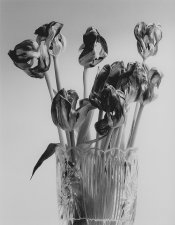
Too bad - you might be missing out:
 

Attachments

  • Dead_tulips-01c.jpg
    Dead_tulips-01c.jpg
    359.3 KB · Views: 99
why are all you photographers so self deprecating? what makes you think that painters don't look at photographers work to help them with subject selection and composition?

Are you all numpties that hold photography in lesser regard than painting.

I live in small town, 5000 people or so. A long time ago when I was just begining to understand the importance of excellent composition in landscape photography, I would visit the two or three little art galleries in my local town. Most of what was on display then (and now) was local landscape paintings. They were at best very average. I then put a handful of my B+W landscape images in the local camera club exhibition. The other members were very sniffy about my pricing which was way above what they were charging for their images. I sold more than anyone else. I even had other photographers who said they didn't recognise my images of very well known local beauty spots. I figured they had been to these places but never actually looked at them.
The following year quite a few of the local artists had started producing compositions like my landscape compositions which I had never seen them do in any of the local galleries before (this could just be my imagination but I don't think so).

Fact: Just becasue artists paint doesn't mean they have any talent in seeing and selecting compositions from the landscape or anywhere else.
Fact: Composition is critical to achieving good landscape (and other) images.
Fact: Learning to see and pick out good compositions is hard, very hard, and requires practice. You simply can't do it by looking at other peoples work for the simple reason that every subject is different and the composition will be different. Othewise you will end up with formulaic bland compositions which don't set off the subject to best effect in the resulting print.
 
Last edited by a moderator:
Fact: You can even learn things from poor paintings/photos/ sculptures/etc., if you're willing to take the time to analyze why they're no good.
 
Photrio.com contains affiliate links to products. We may receive a commission for purchases made through these links.
To read our full affiliate disclosure statement please click Here.

PHOTRIO PARTNERS EQUALLY FUNDING OUR COMMUNITY:


Ilford ADOX Freestyle Photographic Stearman Press Weldon Color Lab Blue Moon Camera & Machine
Top Bottom