• Welcome to Photrio!
    Registration is fast and free. Join today to unlock search, see fewer ads, and access all forum features.
    Click here to sign up

Do you crop your photos?

Recent Classifieds

Forum statistics

Threads
202,675
Messages
2,843,964
Members
101,461
Latest member
Spechti
Recent bookmarks
0
Cropping is lame and serves to fit an agenda.

...and I could as easily argue that "Not cropping as principle is pretentious, borderline narcissistic, and serves to fit an agenda."

Problem is, both statements amount to zilch. There are great cropped photos, and there are great un-cropped photos. In the end, nobody gives a damn. Even worse: the medium itself doesn't care what you and I think about the subject. And it's a good thing too. Photography survives and keeps evolving regardless of all the nonsense, all the principles, rules and regulations that you, or I, or anybody else - including Cartier-Bresson - try to impose upon it.
 
It is beginner amateur talk, always has been. Always adressed in photo-101 classes, rarely beyond.

as an artist, obe should aim for in-canera crop. As a pro, one should not care.
 
I crop the shit out of it, if it's beneficial. But working with slides has taught me to [wishfulthinking] frame well [/wishfulthinking]

It's photography. YOUR photography. Crop it, sharpen it, change your tones - whatever.
Roll it up and eat it for all I care :smile:
 
Always adressed in photo-101 classes, rarely beyond.

My point exactly. Once you've got to "Some people do, some people don't, makes no difference, do want you want", you move on to more important matters.

as an artist, one should aim for in-canera crop

Totally agree with the "one should aim for". Gives rigor to the method - which is, contrary to general thinking, what artists should strive for - without making it an absolute rule.

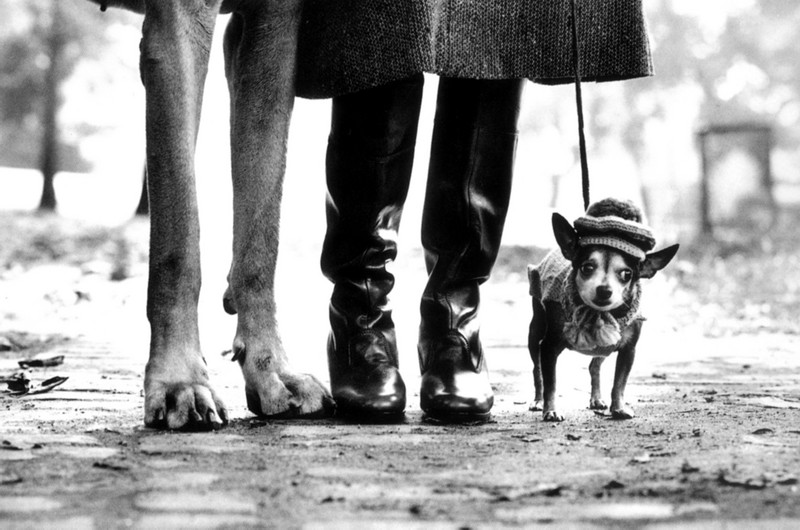
I think the Elliott Erwitt example is more indicative about how photographers think than you believe. To me, it shows that he probably already had the crop in mind when taking the picture. He was interested in the dog and certainly wanted to make it the focus of the photograph - well, not only the dog, but the humorous combination of tiny dog and what looks like huge legs and feet by comparison. He also know he did not have the lens for the shot. So it's a possibility he did, as you say, "aim for in-camera crop", but within the larger frame given to him by the lens.

It's interesting to compare it to another "dog and legs" photo of his. The contact sheet here shows that he had a 35mm camera and (most probably) lying on the ground not too far from the subject. No crop here.

cani___ph__elliott_erwitt_800_800.jpg
 
I agree. The composition comes first. But that created a problem for me and maybe others if they want to standardize a group of pictures for consistency……

Yes, that is a challenge and decisions are made in the process that can favor format vs. subject.

On a related note to all of this, for the past few years I have been volunteering as an “installer” at two local galleries, one at my university and one at our regional art museum. The majority of the works are paintings and they are in every conceivable size and aspect ratio. It makes me wonder, did the artists “crop” what was in their imaginations when they created these pieces? Would someone suggest they were wrong in doing so by not showing everything they could?

And, as I have learned in my volunteer capacity and in a “gallery practices” class I took last year, there are “guidelines” when it comes to displaying art, particularly flat work that is hung on a wall. It’s not simply a matter of pounding in a nail and hanging the piece on it. There is much consideration given to how the pieces work together taking in their content, the media, their size, etc. Once those decisions are made (usually not by me) the installers get out their tape measures and start doing the arithmetic that determines where those nails are placed.
 
Cropping is lame and serves to fit an agenda.

Also, I’m not sure what the Eliott Erwitt crop aims to prove. To me, it only proves 2 things: his camera couldn’t focus closer, and that he missed the shot. Besides, I fail to see what’s so great about it that it always has to come up as an example.

We all know that the media, documentaries and publications crop all the time, what’s so new about this? But you, as an artist, the more you crop the more you are showing to yourself your own lack of skills. I certainly wouldn’t be proud of myself to constantly need to improve my shots after the fact. But again, for publication or to fit an agenda, I totally not care what an editor does with my pics, his agenda has to be met.

Where’s the skill in composing after the fact?? LOL
None of us are perfect. Believe me, I've tried. Cropping makes up for that.
 
Yes, that is a challenge and decisions are made in the process that can favor format vs. subject.

On a related note to all of this, for the past few years I have been volunteering as an “installer” at two local galleries, one at my university and one at our regional art museum. The majority of the works are paintings and they are in every conceivable size and aspect ratio. It makes me wonder, did the artists “crop” what was in their imaginations when they created these pieces? Would someone suggest they were wrong in doing so by not showing everything they could?

And, as I have learned in my volunteer capacity and in a “gallery practices” class I took last year, there are “guidelines” when it comes to displaying art, particularly flat work that is hung on a wall. It’s not simply a matter of pounding in a nail and hanging the piece on it. There is much consideration given to how the pieces work together taking in their content, the media, their size, etc. Once those decisions are made (usually not by me) the installers get out their tape measures and start doing the arithmetic that determines where those nails are placed.
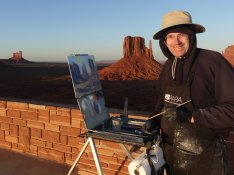
Vince, When my wife and I did a car tour of the Southwest visiting all the natural parks, we stayed a couple of nights in Monument Valley on the Utah-Arizona border in the Navajo Nation. I caught this artist who was painting one of the Mittens and other monuments. What struck me is how he condensed the distance from reality between the various structures, something of course I could not do with my camera. Artists really have an advantage that we poor photographers lack. After cleaning it up and cropping it when I got home, I emailed him the picture. He asked me if I'd mind as he wanted to use it on his business card.
 

Attachments

  • DSC01995.jpg
    DSC01995.jpg
    960.8 KB · Views: 140
Cartier-Bresson is a lot like Glenn Gould: a genius and virtuoso whose brain was wired in a very particular way, but who couldn't quite understand why the rest of the world wasn't wired the same way. They are unique, immensely original, but their method is rigid to the extreme - same piano and bench for Gould for his entire recording career, and, if you listened to Cartier-Bresson, you would only use a Leica, a 50mm lens, never crop, and only shoot "The Decisive Moment", the way he defined it, i.e., "the simultaneous recognition, in a fraction of a second, of the significance of an event as well as of a precise organization of forms which give that event its proper expression," that last part, he explained elsewhere, meaning things being organized in order to ressemble a letter of the alphabet (most people forget that part when talking about "the decisive moment").


True enough. But HCB gave good picture.
 
Just to make another point of the picture I took of the artist in Monument Valley in my last post. While I cropped it a little at home, I had to compose the angle properly in the camera. I made sure that the artist's painting could be seen and that neither the painting nor the artist would block any of the background monuments. I also made sure to include all the elements in the photo that were in his painting. This is where shooting it right in the camera is important. The composing, angle, etc have to be right. Those couldn't be corrected by cropping or other editing. That's what makes photography challenging over painting. We don't have the luxury of a blank canvas.
 
... That's what makes photography challenging over painting. We don't have the luxury of a blank canvas.
I believe that is why painters think photographers have it so easy...
 
I don't know much about how painters go about making their art. I guess I assumed a painter would chose a canvas for the size of painting he had in mind. Do painters frequently make a painting and afterwards cut some canvas off if they change their mind about what they want the painting to look like?
 
None of us are perfect. Believe me, I've tried. Cropping makes up for that.

We're all perfect, Alan. It's the world that's imperfect for not fitting nicely in our viewfinders.
 
What struck me is how he condensed the distance from reality between the various structures, something of course I could not do with my camera. Artists really have an advantage that we poor photographers lack.

And this is exactly why I took up drawing a couple decades ago and what led me to the BFA degree I will complete this May. I would see something that attracted me and the resulting photograph never produced the same feeling or reaction in me. I would render the same scene in pencil or pastels and, many times, be much happier with the result. In fact, I’ve started working on a series of drawings based on past photographs.
 
I believe that is why painters think photographers have it so easy...
My friend Mel who passed last year was a commercial artist. he would paint from photos he or others shot. He even used some of mine. It gave him ideas. He wouldn't work in the field but from the photos in his home studio which is certainly more convenient in the bitter winter.
 
I sometimes "crop" my negatives all the way into the trash bin :cool:.
 
We're all perfect, Alan. It's the world that's imperfect for not fitting nicely in our viewfinders.
If they'd only standstill, not move and do what we say. It must be nice to be Steven Spielberg.
 
And this is exactly why I took up drawing a couple decades ago and what led me to the BFA degree I will complete this May. I would see something that attracted me and the resulting photograph never produced the same feeling or reaction in me. I would render the same scene in pencil or pastels and, many times, be much happier with the result. In fact, I’ve started working on a series of drawings based on past photographs.
That's great. Good luck. Post some pictures of your work so we can see.

Your complaint reminds me of the saying how a painter starts with a blank canvas and paints in his vision. It's harder for the photographer. He starts with a full canvas and has to figure out how to remove those things that impede his vision.
 
My friend Mel who passed last year was a commercial artist. he would paint from photos he or others shot. He even used some of mine. It gave him ideas. He wouldn't work in the field but from the photos in his home studio which is certainly more convenient in the bitter winter.
Cool...exactly -- he knew the photographs were the easy part.

Edit to add: All in jest...easy, hard, or whatever, is an individual thing for the artist, craftperson, or hobbiest to decide for themself. I have worked on a photograph for as long as a painter might work on a painting. Depends on the photograph, depends on the painting.
 
Last edited:
I don't know much about how painters go about making their art. I guess I assumed a painter would chose a canvas for the size of painting he had in mind. Do painters frequently make a painting and afterwards cut some canvas off if they change their mind about what they want the painting to look like?
Most painters start with sketches or studies. That allows them to determine the composition they will use for the final painting. Even then, painters will change or move elements in the process of producing the final work. de Kooning would use sketched elements on pieces of cut-out tracing paper that he would move around the canvas while working on a painting until he was satisfied they were the right elements in the right place..
 
That's great. Good luck. Post some pictures of your work so we can see.

Your complaint reminds me of the saying how a painter starts with a blank canvas and paints in his vision. It's harder for the photographer. He starts with a full canvas and has to figure out how to remove those things that impede his vision.

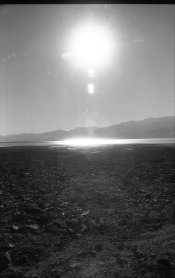
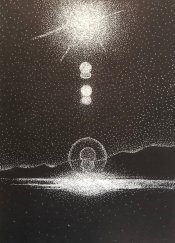
Yes, that pretty much explains it. Right now I am out of town but pulled up these two images as an example of what I’m doing with my own photos/drawings. The photo was shot in Death Valley on 35mm infrared film around 1980. This is a raw, full frame, scan of the negative. The other image is a drawing I did from that, white gel pen on black paper.
 

Attachments

  • 4EC730E5-09EC-49D9-9473-6480EB7E1E31.jpeg
    4EC730E5-09EC-49D9-9473-6480EB7E1E31.jpeg
    1 MB · Views: 138
  • 40E9403C-C1E5-401C-9FB6-8BA4F5AD7B62.jpeg
    40E9403C-C1E5-401C-9FB6-8BA4F5AD7B62.jpeg
    656.5 KB · Views: 135
as an artist, obe should aim for in-canera crop. As a pro, one should not care.

As an artist my only aim when taking a photo is that I've captured a workable image - During post I have time to further review and refine the end framing of the image, so I would rather frame slightly wide in the field when time is limited and tighten up the edge composition later at home when I have all the time in the world to decide what I actually like.

Branch renders distractingly bright at the edge of the frame? Burn it down, or just reframe and crop it out entirely.

I'm not going to risk missing a workable shot entirely to hem and haw over perfect edges and whether or not it would be better to have the camera a few mm to the left. Compose in the field for the core subject, adjust in post for the final print.

No one I would ever care about has ever awarded me any bonus points for not cropping to a final image, and no one at all has ever given me a cent extra for not cropping either.
 
Photrio.com contains affiliate links to products. We may receive a commission for purchases made through these links.
To read our full affiliate disclosure statement please click Here.

PHOTRIO PARTNERS EQUALLY FUNDING OUR COMMUNITY:


Ilford ADOX Freestyle Photographic Stearman Press Weldon Color Lab Blue Moon Camera & Machine
Top Bottom