• Welcome to Photrio!
    Registration is fast and free. Join today to unlock search, see fewer ads, and access all forum features.
    Click here to sign up

Do you crop your photos?

Recent Classifieds

Forum statistics

Threads
202,669
Messages
2,843,825
Members
101,447
Latest member
mildloop
Recent bookmarks
0
Not only do I crop, I don’t even stick to the standard aspect ratios on the final print sizes. There are no rules. The subject determines it all.
 
The idea there ever was a taboo about cropping is one of these too oft repeated myth.

If he did, in 1946, a lot of others were too, and still are:

467229c04b77e650a4a8cdb094ea6b9c.jpg

1920x4000.jpg
 
Not only do I crop, I don’t even stick to the standard aspect ratios on the final print sizes. There are no rules. The subject determines it all.
I agree. The composition comes first. But that created a problem for me and maybe others if they want to standardize a group of pictures for consistency.

That happened with me when I made slide shows that also had short video clips to show on 16: 9 monitors or 4k TV's which also have 16:9 formats. As I sequenced through the pictures, each still picture was a different size and those were different than all the videos which shoot at 16:9 and fill up the entire screen. Since the stills didn't fill up the screen, you get the black bars where there's no picture.

So, I tried cropping all the 4:3 stills to 16:9s. That created a problem. Because of the long horizontal compared to the heights, I often had to cut off people's feet, or worse, their heads. For On many, I just couldn't find the right crop to get it to 16:9 without ruining the composition.

So the next time I went on vacation, I set the camera to 16:9 format. At first, it was a little perplexing. But within an hour, finding the right composition proved no more difficult with 16:9 than 4:3 or 3:2. So now when I put together the slide show all the stills and the videos fill the full 16:9 screen.

Others who make books might want to keep the formats the same for all the pictures as well. So you ought to think about this before you shoot and select a crop that you can be consistent in. Of course, that requires a little more care that you get the picture in the camera. Otherwise, you might be chopping off feet as I did.
 
I have run across this sentiment before, usually with the implication that either you are hiding important details and misrepresenting what happened (more applicable to journalism), or not great at framing/composition/visualization (more applicable to fine art). In the worst cases it’s something about the purity of the medium blah blah blah. When we start talking about purity in anything we’re really talking about how other people would like you to behave. Such ideas may be crammed into dark locations and forgotten.

Cropping is a tool or technique like any other. I have to do it a little to fit standard print sizes. Sometimes it’s to strengthen the image. Normally it’s to clean up the edges a bit, but sometimes the interpretation of the scene can be affected to a surprising degree.

One good example I have (sorry, no scan) is a picture of my son facing the ocean with his arms raised slightly. The sun casts his shadow on the lower part of the frame. Without cropping, his shadow appears to be reaching back up towards him. A slight crop removes that effect while retaining most of the shadow. The uncropped image creates a sort of emotional tension that is lacking in the cropped version. Neither is wrong, neither is necessarily better.
 
Allan Ginsberg by Arnold Newman.

Guess what? Cropped.

image
 
Another fantastic example from Newman.

26newman5-superJumbo.jpg
 
As I remember it was HCB who launched the modern never-crop taboo, and thousands of would-be photographers followed his dictum. Something about seeing the picture in its entirety in the viewfinder.
 
Only lazy people never crop.
Even alternative processing when using a full negative to contact print I will not always run my painted on emulsion to go fully to the boarder.

No, good photographers crop when they take the photograph, the rest were lazy from the start or are not good yet.
emoji-smile.gif
 
When I used to shoot 6x6 a lot, I always imagined a photo as portrait or landscape. Of course you can keep square format also, but quite often you do not. One of the ideas behind the square format is not having to rotate the camera to take a picture.
 
  • NB23
  • NB23
  • Deleted
Following compositional rules of any kind is like keeping a wild animal in a cage.
 
  • NB23
  • NB23
  • Deleted
As I remember it was HCB who launched the modern never-crop taboo, and thousands of would-be photographers followed his dictum. Something about seeing the picture in its entirety in the viewfinder.

You should see the entire picture in the viewfinder, but you shouldn't be limited by the viewfinder's aspect ratio. Also, you cannot always get close enough fast enough to capture a decisive moment, so be prepared to crop it. The moment still occurred, so you are better off capturing it than not.
 
Following compositional rules of any kind is like keeping a wild animal in a cage.

How about compositional "guidelines" or "suggestions"? "Rules" is too strong.
 
The much missed David Vestal wrote a great article (or perhaps it was a chapter in one of his books) it basically said the the full frame is not sacred. I don’t think I’ve ever printed a photo under an enlarger that wasn’t cropped at least a tiny bit. As I get older I find I’m increasingly drawn to a square image which needs a lot of cropping from a 67 neg. Having said that, I sometimes pull out my 8x10 camera and as I don’t have an 8x10 enlarger anymore, (lost it in the divorce) I have to contact print which means full frame, film edge and all.
 
If I think the shot will gain from it, I have no qualms about cropping it.
Nevertheless, I pay close attention to what I want to capture, even while I'm taking the photograph.

Sometimes, however, unexpected possibilities arise when I try things out later. Then - see above.
 
Yes I do, why not? It concentrates attention on a particular point, can get rid of unwanted detail and overall can improve composition. Anyone who claims it isn't necessary is clearly living in a parallel universe.
 
As I remember it was HCB who launched the modern never-crop taboo, and thousands of would-be photographers followed his dictum. Something about seeing the picture in its entirety in the viewfinder.

Cartier-Bresson is a lot like Glenn Gould: a genius and virtuoso whose brain was wired in a very particular way, but who couldn't quite understand why the rest of the world wasn't wired the same way. They are unique, immensely original, but their method is rigid to the extreme - same piano and bench for Gould for his entire recording career, and, if you listened to Cartier-Bresson, you would only use a Leica, a 50mm lens, never crop, and only shoot "The Decisive Moment", the way he defined it, i.e., "the simultaneous recognition, in a fraction of a second, of the significance of an event as well as of a precise organization of forms which give that event its proper expression," that last part, he explained elsewhere, meaning things being organized in order to ressemble a letter of the alphabet (most people forget that part when talking about "the decisive moment").
 
I agree. The composition comes first. But that created a problem for me and maybe others if they want to standardize a group of pictures for consistency.

That happened with me when I made slide shows that also had short video clips to show on 16: 9 monitors or 4k TV's which also have 16:9 formats. As I sequenced through the pictures, each still picture was a different size and those were different than all the videos which shoot at 16:9 and fill up the entire screen. Since the stills didn't fill up the screen, you get the black bars where there's no picture.

So, I tried cropping all the 4:3 stills to 16:9s. That created a problem. Because of the long horizontal compared to the heights, I often had to cut off people's feet, or worse, their heads. For On many, I just couldn't find the right crop to get it to 16:9 without ruining the composition.

So the next time I went on vacation, I set the camera to 16:9 format. At first, it was a little perplexing. But within an hour, finding the right composition proved no more difficult with 16:9 than 4:3 or 3:2. So now when I put together the slide show all the stills and the videos fill the full 16:9 screen.

Others who make books might want to keep the formats the same for all the pictures as well. So you ought to think about this before you shoot and select a crop that you can be consistent in. Of course, that requires a little more care that you get the picture in the camera. Otherwise, you might be chopping off feet as I did.

Consistency can be the enemy of creativity.
 
Consistency can be the enemy of creativity.
That's me. Old habits die hard. I don't experiment enough. But that's who I am. Trying to be someone I'm not is like putting on someone else's shoes. If what I do and the way I say it reflects who I am, what's wrong with that? Should I copy someone else and be who I'm not? At some point, we have to accept who we are and go with it and not look back. Otherwise, you're always looking over your shoulder and never happy. It's Ok to be who you are.

Sorry for all the philosophy. My 77th birthday is in a couple of weeks and I've been thinking, usually a mistake.
 
The "decisive moment" usually comes quicker for a street shot than a landscape.

The whole matter has become less and less relevant: the way politics are going nowadays, we've obviously fully entered the age of "the divisive moment"... :whistling:
 
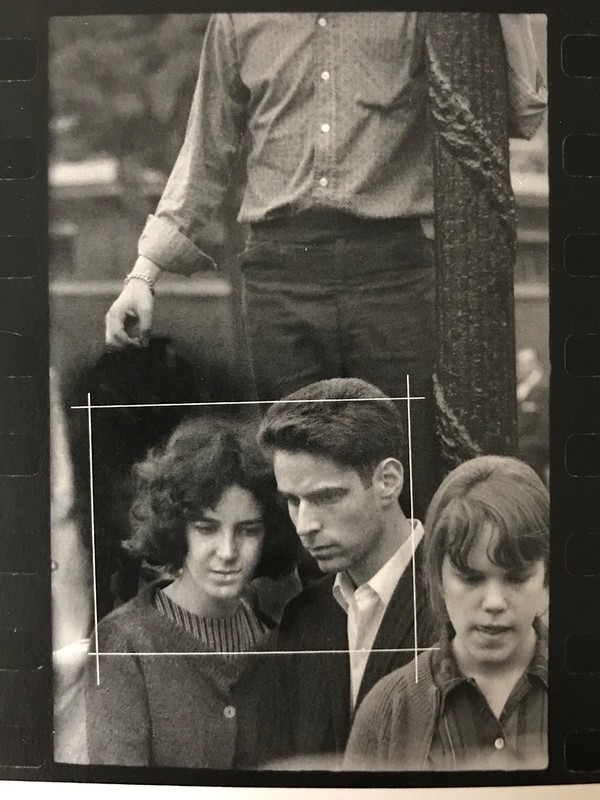
Dave Heath cropped like crazy, nearly turning 35mm into 110. Be like Dave. ;-)

32428830997_4f97f349dc_c.jpg
 
  • NB23
  • NB23
  • Deleted
Cropping is lame and serves to fit an agenda.

Also, I’m not sure what the Eliott Erwitt crop aims to prove. To me, it only proves 2 things: his camera couldn’t focus closer, and that he missed the shot. Besides, I fail to see what’s so great about it that it always has to come up as an example.

We all know that the media, documentaries and publications crop all the time, what’s so new about this? But you, as an artist, the more you crop the more you are showing to yourself your own lack of skills. I certainly wouldn’t be proud of myself to constantly need to improve my shots after the fact. But again, for publication or to fit an agenda, I totally not care what an editor does with my pics, his agenda has to be met.

Where’s the skill in composing after the fact?? LOL
 
Photrio.com contains affiliate links to products. We may receive a commission for purchases made through these links.
To read our full affiliate disclosure statement please click Here.

PHOTRIO PARTNERS EQUALLY FUNDING OUR COMMUNITY:



Ilford ADOX Freestyle Photographic Stearman Press Weldon Color Lab Blue Moon Camera & Machine
Top Bottom