

Raghu Kuvempunagar
Member
Like several of my printmaking friends in India, I was looking for a simple procedure for synthesising Ferric Oxalate for use in the Kallitype process as importing Ferric Oxalate was both complicated and expensive. So I explored several methods to make Ferric Oxalate at home for use in the Kallitype process. Pretty soon I realised that some of the well-known methods for synthesising dry Ferric Oxalate are cumbersome and not well-suited for the low volume users like me. Also, dissolving dry Ferric Oxalate is a pain taking a lot of time and effort.
After some trials, I arrived at the following simple process that allows me to make 20% Ferric Oxalate solution from scratch in about 15 minutes:
Distilled water: 30 ml
Oxalic Acid (Dihydrate): 12 g
Sodium Carbonate: 9.9 g
Ferric Nitrate (Nonahydrate): 25 g
Distilled water to make: 75 ml
Mix Oxalic Acid in distilled water and stir well. Not all of it will go into solution, but that's Ok. Next add Sodium Carbonate in small amounts to the mixture and stir well. Carbon Dioxide will be released with every addition of Carbonate and the solution will fizz. After all Carbonate has been added and the mixture has been stirred well, you get a milky white solution. Now add Ferric Nitrate and stir well. A green coloured solution forms. Top it to 75 ml by adding requisite volume of distilled water. Store the solution in a dark glass bottle tightly stoppered. When kept away from light and in reasonably cool temperature, it stays good for over three months.
The solution thus synthesised is meant be used in the Kallitype process in place of 20% Ferric Oxalate solution. I follow the Kallitype process delineated by Sandy King in his Unblinkingeye article. At 1 ml / A4 sheet, this procedure gives you enough Ferric Oxalate solution to make ~75 A4 sized prints. Of course, one make only as much sensitiser as needed for a working session as it takes not much time to make the desired volume of sensitiser from scratch.
Purists will rightly point out that the solution contains Sodum Nitrate along with Ferric Oxalate. But that doesn't do any harm to the printing. I and my friends have used Kallitype sensitiser made using the above method successfully and are quite happy with it. If you try this method, let me know how it worked for you.
After some trials, I arrived at the following simple process that allows me to make 20% Ferric Oxalate solution from scratch in about 15 minutes:
Distilled water: 30 ml
Oxalic Acid (Dihydrate): 12 g
Sodium Carbonate: 9.9 g
Ferric Nitrate (Nonahydrate): 25 g
Distilled water to make: 75 ml
Mix Oxalic Acid in distilled water and stir well. Not all of it will go into solution, but that's Ok. Next add Sodium Carbonate in small amounts to the mixture and stir well. Carbon Dioxide will be released with every addition of Carbonate and the solution will fizz. After all Carbonate has been added and the mixture has been stirred well, you get a milky white solution. Now add Ferric Nitrate and stir well. A green coloured solution forms. Top it to 75 ml by adding requisite volume of distilled water. Store the solution in a dark glass bottle tightly stoppered. When kept away from light and in reasonably cool temperature, it stays good for over three months.
The solution thus synthesised is meant be used in the Kallitype process in place of 20% Ferric Oxalate solution. I follow the Kallitype process delineated by Sandy King in his Unblinkingeye article. At 1 ml / A4 sheet, this procedure gives you enough Ferric Oxalate solution to make ~75 A4 sized prints. Of course, one make only as much sensitiser as needed for a working session as it takes not much time to make the desired volume of sensitiser from scratch.
Purists will rightly point out that the solution contains Sodum Nitrate along with Ferric Oxalate. But that doesn't do any harm to the printing. I and my friends have used Kallitype sensitiser made using the above method successfully and are quite happy with it. If you try this method, let me know how it worked for you.


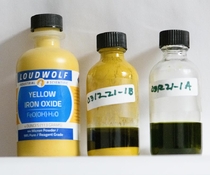
 If I have to guess, I would have wanted to make the same concentration as the commercial FO so 20% would be it. Some time ago I checked with K ferricyanide and got no blue so it seems to be stable too after all these years.
