
• Welcome to Photrio!
    Registration is fast and free. Join today to unlock search, see fewer ads, and access all forum features.
    Click here to sign up

distiller.....losing battle

Tied to the dock

D
Tied to the dock

  • 0
  • 0
  • 0
Running in the Snow

H
Running in the Snow

  • 0
  • 1
  • 3

Recent Classifieds

Forum statistics

Threads
203,075
Messages
2,849,515
Members
101,641
Latest member
Kahana
Recent bookmarks
0
I am driving challenged. Buying water that is not delivered is both impractical and costly, compared to me making it. The distiller is not primarily used for my chemistry and is needed.

I originally bought my distiller when I lived in a condo. I wasn't allowed to mess with the pipes. I live in a house now, but the distiller works too well to replace it.

I originally had issues with foma films and iron in the water. Distilled water resolved this problem.

The PH of tap water here is several points above 7. This does effect mixing developer(s).

And at the end of the day, some HCL cleaned up most of my mess.

Developers and fixers can tolerate waters beyond the range of most city supplies which vary from 4 to 9, depending on what anti scaling agents and sterilizing method is used.

HCl will add another problem! After all, Chloride is a halide and as such will affect a photographic emulsion!

PE
 
You left out the rest of the sentence! Taken out of context, it sounds like it leads to your question, but it does not.

The other two materials in that sentence are HALIDES!!!!!!!!!! Think about the comparison between the 3 please. Then post a reply. Thanks.

I don't mean to be rude, but it is totally out of context.

PE
 
Developers and fixers can tolerate waters beyond the range of most city supplies which vary from 4 to 9, depending on what anti scaling agents and sterilizing method is used.

HCl will add another problem! After all, Chloride is a halide and as such will affect a photographic emulsion!

PE

I rarely use packaged developers anymore. The developers I use I make myself and are of the order of Thronton and others of that generation. They use no agents to compensate for water quality. I am under the belief that these simple ones would be effected. I do use Ascorbic acid based ones that do include TEA and Salicylic acid. I would guess these would be protected. But what's the harm?

Sometimes I just boost (in small batches) my d-72 with ascorbic acid and don't bother with any sequestering agents because I am using DW. It makes life simple.

In a better world, I could reformulate what I do use and accommodate the agents. I am barely functioning on my high school chemistry (40 years ago and only got a 65). You have seen my questions....KISS get's me through the day.

The HCL is only used to clean the kettle, and this was the first time using it. It is thoroughly rinsed and dried before use. It worked well enough not to have to use it every time I need to clean it. The citric acid usually does a good enough job.

The water quality in this city (Montreal) varies quite a bit depending on where you are. Here it seems to be rich in silt and calcium...PH 7.4 My previous address it was low in silt but high in iron....PH 7.6 When I lived on the south shore (Montreal is an island) the water seamed good and I had no issues.

But the bottom line is when I look in my distiller after a batch, I am glad that crap is not in my water.
 
What would be the point of distilling, aside from getting the ph to 7?

You never get to pH 7 unless you run a totally closed system. Otherwise, due to CO2 in the air, the water equllibrates to about 5.5 or thereabouts.

That is the pH of naturally occurring carbonic acid.

PE
 
You never get to pH 7 unless you run a totally closed system. Otherwise, due to CO2 in the air, the water equllibrates to about 5.5 or thereabouts.

That is the pH of naturally occurring carbonic acid.

PE

B-U-U-U-U-U-U-R-R-R-R-R-P!! :smile:
 
I rarely use packaged developers anymore. The developers I use I make myself and are of the order of Thronton and others of that generation. They use no agents to compensate for water quality. I am under the belief that these simple ones would be effected. I do use Ascorbic acid based ones that do include TEA and Salicylic acid. I would guess these would be protected. But what's the harm?

Sometimes I just boost (in small batches) my d-72 with ascorbic acid and don't bother with any sequestering agents because I am using DW. It makes life simple.

In a better world, I could reformulate what I do use and accommodate the agents. I am barely functioning on my high school chemistry (40 years ago and only got a 65). You have seen my questions....KISS get's me through the day.

The HCL is only used to clean the kettle, and this was the first time using it. It is thoroughly rinsed and dried before use. It worked well enough not to have to use it every time I need to clean it. The citric acid usually does a good enough job.

The water quality in this city (Montreal) varies quite a bit depending on where you are. Here it seems to be rich in silt and calcium...PH 7.4 My previous address it was low in silt but high in iron....PH 7.6 When I lived on the south shore (Montreal is an island) the water seamed good and I had no issues.

But the bottom line is when I look in my distiller after a batch, I am glad that crap is not in my water.

I understand your problem, but don't have to cope with it as I use either pre-packaged developers or scratch mix with sequestrants and adjust pH. So, I avoid the problem. That said, your water is still probably OK, but just needs filtration. When I added a filter system there was a big improvement as it removed the tiny particulate matter that was messing things up here for me. Rust particles in particular are nasty to photochemicals.

PE
 
Many thanks to all the contributed information. I learned a few extras along the way.
 
I'd consider a filter before your distiller. I use one in the kitchen, the setup was maybe $50 and the cartridges are big & cheap and I have to change them every few years. I pretty much use that water when I want "pure" water. I'm sure it's not perfect, but our neighborhood went up in the 30's and we have big rust issues (replumbed my house form the street with PEX but still get plenty).

Reverse osmosis - as I understand it - is really wasteful, it tosses more water than it delivers. Will filtration get rid of the bulk of minerals before a distiller? Would be interesting and could be a cheap solution.
 
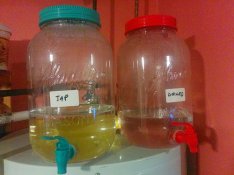
What I do now is this.....

16178212353_9303cf52c3_d.jpg

Two 10l jugs from WallyWorld. One filled with distilled water and the other with tap. Both allowed to sit, being tempered to room temp. The tap I usually only use for rinse and one shot developer dilutions. When I use sensitive film or developer, I have enough DW stockpiled that I really don't care and use that. I also use a rotary drum so the usage is low.....175 ml typical per roll.

I was thinking of making an auto-fill contraption for the tap. I guess I could also include some simple water filter at that point.

The big thing is I essentially develop film only these days as I don't have a room suitable to be a dark room that won't get me hung by the wife. Working with 20l reservoir of water lasts quite a while.
 
The most sensible way to deal with a water filter is install one of those filtered-water (drinking water-style) faucets in your kitchen, with an under-counter filter. Since you don't want to wear out your filter washing dishes and so on. We always use that faucet to fill electric kettles and humidifiers (we get almost no buildup on the ultrasonic humidifiers, when before filtering we considered those things disposable). And that's the water we drink. But I'll fill a jug or pitcher with it when darkroom work needs it.

If you're handy with plumbing, the only issue is drilling the hole for it (many people who have sinks with sprayers or soap dispensers just use that hole). In 8 years we're on our second filter.
 
Wow, it sounds like your distiller scales badly from just a single run.
Get some water sample analysis going and then pick the right filtering system, otherwise you clog your distiller with straight tap.

...or convince the wife you should relocate :D

My water here seems to be rich is calcium and silt, as those are the deposits left behind in my distiller. It's getting harder to clean and a soak with some citric acid doesn't seem to cut it anymore.

Any suggestions?
 
It's possible to collect the water run-off from an air conditioning system. The water will be dirty but it can be filtered and distilled again. It won't have any minerals in it though.
 
It's possible to collect the water run-off from an air conditioning system. The water will be dirty but it can be filtered and distilled again. It won't have any minerals in it though.

I understand that it can contain mold. How would you know?
 
It surely does contain mold and mildew. Filter it through a coffee filter then add a tiny bit of chlorine bleach and stir. Let stand for twenty-four hours so the bleach dissipates. I can't remember the correct amount of bleach to use per gallon but it's very little. You can distill it if you want but I doubt it's really necessary. I suppose there will be some contamination from air pollutants but I doubt it matters unless you live in a place like Los Angeles or Shanghai.
 
I understand that it can contain mold. How would you know?

Most high grade distillers got charcoal filters along the output chain - you can distill and filter anything.
Mold cocktail, horse pee, sea weeds puree or any kind of liquid are not an issue at all - just something that clogs one of the endpoints. :wink:
 
Aside from beating a dead horse with the question already answered.....It's a lot of extra effort getting water from an AC with little to no gain.
 
Actually, we used to give it to our cats after removal of the crap that accumulates.

We got several gallons per day. Good return for dry room.

PE
 
Collecting the condensate is easy with window or through-wall units... just add a tube to the drain hole and put the other end in a large bottle. Central A/C is a little more challenging... you must locate where the condensate line is attached to the building drain line and tap into that. Either way make darned certain any overflow is safely drained away. One could place a Y-adapter with valve on the drain line to make capturing the condensate temporary. Be mindful of any chemicals or packets your A/C drain system may be treated with.

BTW, some people collect all their A/C condensate to use in their gardens. Like PE, many folks get several gallons per day.
 
Last edited by a moderator:
Photrio.com contains affiliate links to products. We may receive a commission for purchases made through these links.
To read our full affiliate disclosure statement please click Here.

PHOTRIO PARTNERS EQUALLY FUNDING OUR COMMUNITY:


Ilford ADOX Freestyle Photographic Stearman Press Weldon Color Lab Blue Moon Camera & Machine
Top Bottom