

• Welcome to Photrio!
    Registration is fast and free. Join today to unlock search, see fewer ads, and access all forum features.
    Click here to sign up

Dish Soap

Ferns

H
Ferns

  • 0
  • 0
  • 17
between takes

H
between takes

  • Tel
  • Mar 21, 2026
  • 2
  • 0
  • 35

Recent Classifieds

Forum statistics

Threads
202,866
Messages
2,846,767
Members
101,578
Latest member
Reaton
Recent bookmarks
1
The active ingredient in Photo-Flo is a surfactant Triton X-100. This chemical does not readily mix with water and so Photo-Flo also contains a glycol to help getting the X-100 into water solution. Also present is an antifoaming agent to prevent bubbles. X-100 can also be mixed with isopropyl alcohol to make a highly concentrated wetting agent. Triton X-100 can be oblained from www.thechemistrystore.com and is quite reasonable so you can make swimming pools of Photo-Flo solution if you wish. A substtitute formula is in the archives.
 
Last edited by a moderator:
Photo Flo 200 is TX-100 + Propylene Glycol. Photo Flo 600 is TX-100 + Ethylene Glycol. TX-100 is water soluble. Triton X 200 is insoluble in water and is a rare type of surfactant being both anionic and cationic. It is sold as a milky dispersion of the inner salt in water. I have bottles of both and have used them in making coatings.

PE
 
Didn't see this one earlier. Now y'all went and hacked Ron off. :wink:

As inexpensive as PhotoFlo is, why run the risk of staining/damaging film with dyed dish soap?
 
Chris;

You are supposed to ANSWER this type of question!!!!!!!!!!!!!!!!

But it is a good question. One I keep asking myself too.

PE
 
2F/2F said:
Um, since Photoflo is cheap, purpose made, and a bottle lasts for years, no.

Ditto. You'll accidentally spill your Photo-Flo all over the place long before you use it up. Trust me.

Has anyone ever used a whole bottle?
 
Has anyone ever used a whole bottle?

I have never used a whole bottle from beginning to end; I have spilled pretty much each one of them before finishing them. The exception is the one that I mixed 1:4 with water thinking it was HCA...until I started stirring and got huge suds. (I had my HCA stock in a similar bottle.) It's funny, because I cannot recall ever spilling any other chemical so badly, but it has happened about four times with Photo Flo.
 
"Triton X" is possibly the coolest sounding chemical out there.
 
Has anyone ever used a whole bottle?
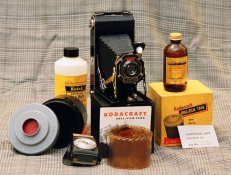
Yes, but it took more than a decade:smile:. You can see it in this MSA submission I made 3.5 years ago (it is on top of the Kodacraft Roll Film Tank box).
 

Attachments

  • portals-apug-2007-12.jpg
    portals-apug-2007-12.jpg
    114.7 KB · Views: 144
Has anyone ever used a whole bottle?

I have a gallon bottle of Photo-flo 2100...might have bought it 8 or 10 years ago. It might last until I retire from the university darkroom. And since I have three 14-year-old boys and will be 61 when they graduate from High School and go to college, retirement will not be anytime soon...

I use 7oz of the 2100 to make a gallon -- then an ounce of that to make a gallon of working solution.

People keep dropping off bottles of Photo-flo 200...I got a mess of them..some with some pretty old labels. And a gallon bottle of Photo Flo 600 somewhere.

Vaughn
 
..................People keep dropping off bottles of Photo-flo 200...I got a mess of them..some with some pretty old labels. And a gallon bottle of Photo Flo 600 somewhere.

Vaughn

Maybe you could pass some of that Photo-flo to some of the people that think they can use dish soap and save a few pennies.
 
Didn't see this one earlier. Now y'all went and hacked Ron off. :wink:

As inexpensive as PhotoFlo is, why run the risk of staining/damaging film with dyed dish soap?

Because common sense suggests that there is no risk in view of the dilution used and it saves having to buy and store another bottle.
 
Maybe you could pass some of that Photo-flo to some of the people that think they can use dish soap and save a few pennies.

Actually, that is a nice idea. But the bottles do not belong to me, but to the university, so I can not take money for them. Next time at work (if I remember) I'll see what I actually have and perhaps work out some trades...rolls of 35mm or 120 film to give to the students or something.

Vaughn
 
I have about 1/2 gallon of PF-600 here somewhere that I could divide up and send out, but the cost of postage would be more than the stuff is worth.

PE
 
And if I remember a previous thread, you said the PF 600 is a bit more toxic than the PF 200 (and, I believe, the PF 2100).
 
I have about 1/2 gallon of PF-600 here somewhere that I could divide up and send out, but the cost of postage would be more than the stuff is worth.

PE
Maybe you could use it to wash dishes. :D
 
Photo FLo 600 contains Ethylene Glycol and is quite toxic causing liver damage. Photo Flo 2100 contains Poly Ethylene Glycol and as such is less toxic but still not good. Photo Flo 200 contains Propylene Glycol and is quite a bit less toxic. PG has been approved in the dairy industry for refrigeration, it is considered so safe. The MSDS sheets and further information are on-line if you wish.

PE
 
Photo FLo 600 contains Ethylene Glycol and is quite toxic causing liver damage. Photo Flo 2100 contains Poly Ethylene Glycol and as such is less toxic but still not good. Photo Flo 200 contains Propylene Glycol and is quite a bit less toxic. PG has been approved in the dairy industry for refrigeration, it is considered so safe. The MSDS sheets and further information are on-line if you wish.

PE
I don't know about that Ron. The EPA has just listed milk as a hazardous material, now anyone that handles it must be trained in hazardous waste response, dairies must pay for the local fire dept to have a response and clean up team and truck drivers must have a Haz Mat endorsement.
 
Oh, that is due to the Photo Flo content of milk, I'm sure :D .

Back in the olden times, it was lead contamination. You see, states mowed grass along the interstates and sold the grass clippings to dairy farms. The lead in gas at that time contaminated milk and led to lead poisoning in some states. There was quite a scandal that led to conversion to lead free gasoline.

PE
 
I just bought PF's Form A Flo and looking at the MSDS it does not list the type of surfactant used. Is it ionic or non-ionic? Thanks everybody.
 
Photoflo is cheap per-use, but the initial cost is more than developer! So I ask again: if you don't need archival results, and you don't mind lemon-scented negatives, wouldn't a drop of "Ajax" in a quart of water suffice as a wetting agent?
 
Photoflo is cheap per-use, but the initial cost is more than developer! So I ask again: if you don't need archival results, and you don't mind lemon-scented negatives, wouldn't a drop of "Ajax" in a quart of water suffice as a wetting agent?

My guess is black and white negatives are resistant to dish soap. Whether it would work properly is anyone's guess. Surfactants can reduce froth or increase. Everything from foam insulation to anti-gas antacids.

I use Photoflo.
 
The gunk they add to dish soap is likely to increase the amount of unwanted residue on your negatives.
You want them to dry clean!
 
Photrio.com contains affiliate links to products. We may receive a commission for purchases made through these links.
To read our full affiliate disclosure statement please click Here.

PHOTRIO PARTNERS EQUALLY FUNDING OUR COMMUNITY:


Ilford ADOX Freestyle Photographic Stearman Press Weldon Color Lab Blue Moon Camera & Machine
Top Bottom
