• Welcome to Photrio!
    Registration is fast and free. Join today to unlock search, see fewer ads, and access all forum features.
    Click here to sign up

Digital Printing

Toby's Bar

H
Toby's Bar

  • Tel
  • Apr 25, 2026
  • 0
  • 0
  • 18
Barber

A
Barber

  • 0
  • 0
  • 39

Recent Classifieds

Forum statistics

Threads
203,486
Messages
2,855,479
Members
101,866
Latest member
Afadjato
Recent bookmarks
0
Not possible any more.
Possible - sure. Feasible - not really for most of us.
There's a few more, but these people currently seem best positioned to produce in a commercially viable way (within this tiny niche)

The whole horse of "we don't know how archival X or Y is" has been beaten to death. There's data out there and at the same time, the arguments against its validity and reliability are inherent to the methodology. So that's one puzzle we're never going to solve - not even in 40 years' time. I see no progress in that discussion even though it has popped up here several times. Then there's the question for how many of us long-term stability (decades, centuries) of a print is really a pertinent issue.

Let personal choices be just that. What I find interesting about them is to hear about personal motives. What I find decidedly less interesting and more iffy are attempts to make universal claims about what's inherently better in one way or another. I don't think it works that way.
 
@cliveh how many digital prints will you be making or getting made? What are they for?

I'd like a good inkjet printer but can't justify it - I wouldn't use it enough.
 
@cliveh how many digital prints will you be making or getting made? What are they for?

I'd like a good inkjet printer but can't justify it - I wouldn't use it enough.

I wasn't thinking about making any digital prints myself, but paying a printer to do it for me should I find something I want to print.
 
Digital printing is now so good that I think it surpasses what can be achieved in a darkroom. For that reason I intend to use the physical integrity of film, but scan and print through digital. Others may not agree, but I am a taker and have little interest in darkroom printing.

Have fun in your new rabbit hole. I tried, and now my Epson is in the dumpster, and I'm back in the darkroom several thousand dollars poorer.
 
Have fun in your new rabbit hole. I tried, and now my Epson is in the dumpster, and I'm back in the darkroom several thousand dollars poorer.

Did you do quite a bit of printing using digital negative? The reverse of what the OP wanted to do? But for me I keep analog analog, digital digital neither is better or worse I keep them in their own space.
 
I wasn't thinking about making any digital prints myself, but paying a printer to do it for me should I find something I want to print.

That's a sensible approach, since a good printer is expensive and really needs to be used pretty regularly. You'll likely also get better quality that way.
 
Digital printing is now so good that I think it surpasses what can be achieved in a darkroom. For that reason I intend to use the physical integrity of film, but scan and print through digital. Others may not agree, but I am a taker and have little interest in darkroom printing.

I print both inkjet and wet prints in colour and black and white, I like both methods of printing and kind of disagree with cliveh a bit , IMO he is not wrong that for the casual printer it is easier to make a better print using digital methods, basically I could train my puppy Milly to hit auto contrast - auto colour and then have her move the levels slider to achieve a good if not surprisingly great inkjet print.
What I cannot do is train Milly the concept of colour theory , range of tonalities and contrast required to operate an enlarger or better yet multilayered colour image over palladium.


The difference in visual presentation can be equal and this is where I agree with cliveh , the difference between a well executed tri gum vs an inkjet is basically the physical texture of the prints, but in my opinion the most important factors are the uniqueness of making a print with brushes , light , water , paper , crushed stone, tree sap and actually seeing a print that can equal the values that an inkjet can achieve, and also the knowledge that if one uses Palladium and Blue Wool Scale pigments of high scale the print by hand has the potential to last for many centuries, I have yet to meet an authority other than the marketing departments of Epson tell me what to expect with their inks.

thats it- hand craftsmanship and longevity is the answer for me and if these two values do not matter to the artist then I totally agree with cliveh to keep in the inkjet lane.
 
{Other Moderator's addition:
@koraks post below reflects a concern shared by many of us respecting a number of responses in this thread.}


It saddens me that there's apparently still people who believe we need to draw crude divisions in the community based on choice of technology. What a silly position to take. And what little justice does it do to the choices others make. There can't be much honor or satisfaction in that. A bleak outlook, for sure.

ditto
 
I loved Ilfochrome prints that I made in the darkroom myself, and displaying them on my wall. OTOH, I could not print a 20" x 60" color print on canvas in the darkroom, I could easily achieve that and mount it on my living room wall with digital printing. by using a commercial digital print-making service. Different strenghs for different purposes...there should not be comparison, there should be taking advantage of what each brings!
 
I like analog prints. I think they have aesthetic qualities that are distinct. It’s not a technical debate for me. When I look at a contemporary darkroom print, I experience it in a similar way to looking at a 100 year old darkroom print, because it’s basically the same thing. I would characterize that experience as connected to an unconscious understanding of how it has come into being (how it was made). I would loosely characterize the prevailing thought as scarcity - something rare.

With an educated eye it’s usually fairly obvious when looking at prints to determine whether they are darkroom prints or inkjet. I don’t get the same experience described above with inkjet prints. It’s not a question of technical superiority or inferiority, but they are different. When I look at an inkjet I don’t see it in the same way I see a 100 year old darkroom print, because it’s obviously different.

inkjets are amazing. But in my mind they are more closely associated with advertising/ point of sale stuff. Or signage. That in itself isn’t a diss. Much of the greatest most innovative photography was commercial to the bone. But I think of my work in dialogue with the historical work that inspires me, and in that sense inkjet doesn’t really work.
 
Last edited:
there should not be comparison, there should be taking advantage of what each brings!
Hear, hear!
To add - I do personally think comparing as such is fine if it's about understanding the pros & cons of each medium/process, which evidently helps greatly in deciding how to print a particular image or project. It's only when/if the comparison has a normative undertone, my heart invariably sinks.
Anyway, enough said!
 
Digital printing is now so good that I think it surpasses what can be achieved in a darkroom. For that reason I intend to use the physical integrity of film, but scan and print through digital. Others may not agree, but I am a taker and have little interest in darkroom printing.

if interested in a paper print,the wet darkroom print on FB paper is unbeatable. If a digital file is the desired outcome, it's best to start with digital and stay away from crossing technologies.
 
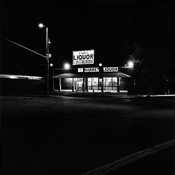
I recently needed a print for a show and did not want to send my sole silver gelatin print. I had a very good shop scan and print it, and they did an excellent job, pretty much indistinguishable from the original. The printer did tell me it was a challenge, though. Just as an illustration, here is the image. Whatever you see on your screen isn't close to the original.

Eddies Liquor_edit_Cleaned_Final_Mids_lift_Final_Crop copy.jpg
 
Saves you from having to use a computer with a lens on it take pictures.

I wouldn’t describe my Rollei Hy6 as a computer with a lens.
The 1000s of captures is pray and spray and the editing is making. Sounds to me like the opposite of zen art.

My motor-driven film cameras shoot at a faster rate than my MF digital gear.
 
I made similar decisions as Cliveh about 3 years ago. I have been a lifelong analog photographer (since 1957) with my last printing recipe being Ilford Multigrade FB, Ethol LPD, cold light Aristo head with a filter drawer, doing multiple exposures with different filters, burning, dodging, etc. For decades I was in the graphic arts business, using PShop, which was a benefit.
I also use Filemaker pro to track all of my rolls of film, negs, images, prints, and various submittals to galleries, shows, etc.
When I started scanning (Epson V850 pro with Silverfast on a Mac), my process - scan to tiff, open in camera raw, do basic adjustments, including sharpening (much more sophisticated than PShop). All adjustments (burning and dodging, etc) with gradient masking and all in layers, the original scan remains unchanged at the bottom layer.
For printing, I worked with various printers and papers and have arrived at a local art school Canon 60" 12 color printer, with Hahnemuhle fine art barita paper, which I buy and keep there.
When I started coming close, I made the best prints I could, comparing them with my best wet prints, done recently. There was no comparison, in terms of control - the dynamic range was not noticeably different. By adding a very small amount of red to a Black and White image files (2% at the top and bottom) in an RBG file. I work in grayscale, but convert to RGB to print. The small addition of red resembles selenium toning.
Benefits - I can't come close burning and dodging to what I can do in PShop.
A print (1 x 22 - yes full frame and proportions - try that with 16 x 20 paper) is about $25.
If I print 3, they are all identical (if I enlarge to 16 x 20, I have to make 2 or three, after multiple test strips, to ensure one perfect one.)
6 months later, if I change my mind about the image, I can tweak the file and print again.
The grain looks just like the grain on the analog print, depending on differences in contrast between the digital curve application and grade selection in the darkroom. This is done by tweaking the sharpening in Raw.
After processing film (Ilford HP5 or FP4 in Rodinal), in an hour or two at the scanner, I will pursue many more of the images on a roll, than I could in the darkroom (and my scanned contact prints are 30" wide, much easier to evaluate on the computer.)
I really didn't feel good about giving up printing in the darkroom, but I have no regrets - and I have more time to shoot. (I'm 78).
 
If I print 3, they are all identical (if I enlarge to 16 x 20,

This is where I diverge.

Once I've done small test prints and then printed the final print - I delete all the masks and adjustments leaving only the original source file.

That way if I print another, it will also be unique just as it would if traditionally hand printed with an enlarger in a darkroom.
Only the original camera output survives , never work or print files.
 
This is where I diverge.

Once I've done small test prints and then printed the final print - I delete all the masks and adjustments leaving only the original source file.

That way if I print another, it will also be unique just as it would if traditionally hand printed with an enlarger in a darkroom.
Only the original camera output survives , never work or print files.

Why make things hard on yourself? While I can understand the need to maybe look at an image/file with fresh eyes as time passes, I keep notes on printing in the darkroom so I have a starting point if I decide to print differently. I consider adjustment layers in a digital file the same way--something I could keep, alter or remove if I wish to re-interpret the image.
 
Digital printing is now so good that I think it surpasses what can be achieved in a darkroom. For that reason I intend to use the physical integrity of film, but scan and print through digital. Others may not agree, but I am a taker and have little interest in darkroom printing.

digital printing has its own hurdles. I've been down that path. In the end, I scrapped the printer and gave up on printing altogether and started using printing services.
 
Why make things hard on yourself? While I can understand the need to maybe look at an image/file with fresh eyes as time passes, I keep notes on printing in the darkroom so I have a starting point if I decide to print differently. I consider adjustment layers in a digital file the same way--something I could keep, alter or remove if I wish to re-interpret the image.

I do keep notes about what I did, as well as scribbles on the original unedited work print showing where I'll going to dodge and burn.

Basically, the same as I used to do with darkroom printing.

It means that every print I release is 100% unique.
 
digital printing has its own hurdles. I've been down that path. In the end, I scrapped the printer and gave up on printing altogether and started using printing services.

Same here. I have an inkjet printer that I use for promo cards and work prints, but use a trusted digital printing service for anything large or important.
 
My general feeling on these things is that I do what I want to do because I want to do it regardless of what you want to do. You should do that as well. If you are trying to convince me, especially since I don't care what you want to do, that your way is superior or that I should do it like you, then you don't really know what you want to do and I am probably not going to be interested in what you are doing anyway because you don't know what you are doing...

When I look at your images I don't care how you made them, only why and if they are good images.

I still shoot black and white film and print in the darkroom because that is what I want to do. I generally shoot color film but some digital too for color. Even though I prefer color darkroom prints, I have been using stinkjets since '97 so that is what I do when I want to print something in color. If I had a color darkroom I would pursue that, but it isn't worth setting one up since I rarely want to shoot color. For alt processes I use the stinkjet to make negs even though I could make enlarged negs in the darkroom. That is what I want to do. You may do things differently and that is ok. Just make good images.
 
Photrio.com contains affiliate links to products. We may receive a commission for purchases made through these links.
To read our full affiliate disclosure statement please click Here.

PHOTRIO PARTNERS EQUALLY FUNDING OUR COMMUNITY:



Ilford ADOX Freestyle Photographic Stearman Press Weldon Color Lab Blue Moon Camera & Machine
Top Bottom