• Welcome to Photrio!
    Registration is fast and free. Join today to unlock search, see fewer ads, and access all forum features.
    Click here to sign up

Diffusing condenser enlarger

Forest Light

H
Forest Light

  • 0
  • 0
  • 0
Bacon Fest 2013

A
Bacon Fest 2013

  • 0
  • 3
  • 60

Forum statistics

Threads
203,428
Messages
2,854,430
Members
101,830
Latest member
gussie54
Recent bookmarks
0

Cybertrash

Member
Joined
Nov 1, 2012
Messages
242
Location
Stockholm, Sweden
Format
Multi Format
I've currently got a condenser enlarger that I'm interested in converting to a diffusor. It's an older enlarger so no replacement heads are available. But I was wondering if it was possible to simply place some sort of diffusion material (such as a sheet of opal glas) just under the condensor to diffuse the light source? I'm mainly interested in doing this to reduce the appearance of dust and scratches, as I'm finding it difficult to keep my equipment 100% dust-free.
 
Tell us what the enlarger is.

Some condenser enlargers are quite diffuse to start with, myn Dursts were. Having said that I've acquired a 5x4 Johnsons V45 with a condenser head, my olde one (same model) had been adapted (by me) to have a cold cathode head. So I'm thinking of an LED head, will have to be custom built.

Ian
 
May I ask why you wish to convert?
 
Tell us what the enlarger is.

Some condenser enlargers are quite diffuse to start with, myn Dursts were. Having said that I've acquired a 5x4 Johnsons V45 with a condenser head, my olde one (same model) had been adapted (by me) to have a cold cathode head. So I'm thinking of an LED head, will have to be custom built.

Ian

It's an old Liesegang Rajah V, not quite sure how old it is, but it looks similar to enlargers from the 50s or 60s.


May I ask why you wish to convert?

I experience a lot more dust issues with this enlarger than what I did with my old diffuser Durst enlarger, now this may of course be due to other factors, but I've heard that diffuser enlargers are a little more forgiving with dust and defects.
 
May I ask why you wish to convert?

Cybertrash is correct a diffuser enlarger is more forgiving when it comes to dust, scratches etc, but illumination also tends to be more ven.

I process my negatives to print on Grade 2 with a diffuser enlargers although they'll still print well with a condenser enlarger, I'm thinking though of a variable contrast LED head. Initially though it's a spare anyway so I could add a diffuser like ic-racer suggests.

Ian
 
I've had bad luck getting illumination that was even enough converting a condenser enlarger to diffusion. You will find at least two issues: evenness of illumination and brightness. Just putting a diffusion sheet under the condensers does not work optimally in my experience.

I built a variable contrast LED light source for my Durst. It's relatively easy to build a white light LED head, as it's just a power supply (constant current driver) and a few high power LEDs arranged in the right pattern above a diffusion sheet. Do a search here as there have been a lot of threads.

I've used opaque plexiglass as the diffusion material, but I hope to try some of the newer Makrolon LD, which is discussed here: http://www.largeformatphotography.i...ble-Contrast&p=1056250&viewfull=1#post1056250 This might help you get a brighter and more even result.
 
I have an early Gnome enlarger (35mm) and that uses a diffuser above a single condenser, it got broken unfortunately but was just a circular piece of ground glass. The diffuser was needed because the enlarger used a clear 12v car (automobile) bulb and they don't give even illumination. I've not used the enlarger for many years but will restore it soon and make a new diffuser.

I'll probably make a ground-glass diffuser for the Johnsons enlarger at the same time as a test and see what effect it has above the two condensers.

Ian
 
Thanks for the answers everyone.

The idea of building a LED-head intrigues me, but I was wondering, wouldn't that mess with variable contrast grades?
 
There have been a few thread in the past on here about home-brew LED heads - The general consensus is if you can find suitable LEDs in the ultraviolet/blue spectrum, hitting the harder grades isn't too difficult.
 
It's an old Liesegang Rajah V, not quite sure how old it is, but it looks similar to enlargers from the 50s or 60s.


I experience a lot more dust issues with this enlarger than what I did with my old diffuser Durst enlarger, now this may of course be due to other factors, but I've heard that diffuser enlargers are a little more forgiving with dust and defects.

You heard correctly,butworking a bit harder on cleanliness is all that's needed;adding diffusion material will cause a significant loss 0f light;it might be easier to get a newer Durstfor example.If you are in Germany,you can also look for Kaiser or Meopta.If all fails call Kienzlethe or Heiland .They may produce custom madeproducts that will fit your enlarger and are extremely helpful in general.:smile:
 
Long ago I used custom cut frosted glass with an Omega B-22. I placed the diffuser above the condensers. At best the method halfway worked. It did slow down the print speed which was desirable. If serious about your prints and deciding on a diffused light source find a good color enlarger vs trying to rig some diffusion Mylar to 1950s enlargers. If you are only enlarging 135 get a Leitz Focomat...they have the best engineered semi-diffused light.
 
Last edited by a moderator:
Thanks for the answers everyone.

The idea of building a LED-head intrigues me, but I was wondering, wouldn't that mess with variable contrast grades?

I found the warm white LEDs had roughly the same contrast as an incandescent bulb. They respond about the same to contrast filters as well, so there will be minimal contrast changes. You can also use blue and green LEDs and build a variable contrast system. There you have control over the contrast by varying the ratio of blue and green light through dimming. I get ISO grades of about 50 (~grade 4.5) to 160 (~grade 0) with green and royal blue LEDs on Ilford paper.
 
I found the warm white LEDs had roughly the same contrast as an incandescent bulb. They respond about the same to contrast filters as well, so there will be minimal contrast changes. You can also use blue and green LEDs and build a variable contrast system. There you have control over the contrast by varying the ratio of blue and green light through dimming. I get ISO grades of about 50 (~grade 4.5) to 160 (~grade 0) with green and royal blue LEDs on Ilford paper.


I would probably just go with a white light to begin with.

Correct me if I'm wrong, but simply stated it's mostly just a matter of arranging a bunch of LEDs behind some sort of diffusion glass, and place that contraption over the negative carrier somehow, correct?
 
I would probably just go with a white light to begin with.

Correct me if I'm wrong, but simply stated it's mostly just a matter of arranging a bunch of LEDs behind some sort of diffusion glass, and place that contraption over the negative carrier somehow, correct?

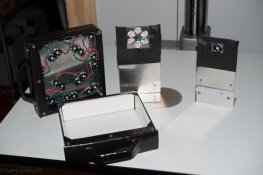
Yes, that's it. The pattern of the LEDs is important. Just putting them in a grid will result in a hot center. That's what I did for my first head, based off rmann's work in this (there was a url link here which no longer exists). It wasn't optimal and I needed make a mask above the diffusion screen. For the VC head I looked at http://www.huws.org.uk and then modeled the output pattern with gradients in Photoshop. I could then arrange the LEDs virtually in Photoshop. It came out very close to Huw's results. You can see the pattern I used for 5x7 in the array on the left (for white you would only need one of the LEDs where there's a pair in my head since it's VC). 20130712-202857.jpg

Rmann's thread above describes the wiring pretty well, and I can confirm that it worked very well. The biggest issue is the LED pattern.
 
Photrio.com contains affiliate links to products. We may receive a commission for purchases made through these links.
To read our full affiliate disclosure statement please click Here.

PHOTRIO PARTNERS EQUALLY FUNDING OUR COMMUNITY:


Ilford ADOX Freestyle Photographic Stearman Press Weldon Color Lab Blue Moon Camera & Machine
Top Bottom