

• Welcome to Photrio!
    Registration is fast and free. Join today to unlock search, see fewer ads, and access all forum features.
    Click here to sign up

Dichroic filters on Durst CLS 500

Recent Classifieds

Forum statistics

Threads
201,759
Messages
2,829,627
Members
100,927
Latest member
Rudy Bachelor
Recent bookmarks
0

damiafix

Member
Allowing Ads
Joined
Oct 30, 2016
Messages
13
Location
Italy
Format
Multi Format
Hi guys,

I have recently bought a Durst Laborator 1200 enlarger equipped with a Durst CLS 500 color head. Since that the former owner held it in a wet space for a couple of decades it needs some restoration. So, a few days ago I disassembled the head and I extracted the dichroic filters in order to clear them - BUT - just some minutes later I realized that they have a specific orientation.

On the web I didn't find so many informations. The only document which allowed me to do some practical test and some progress is the following:
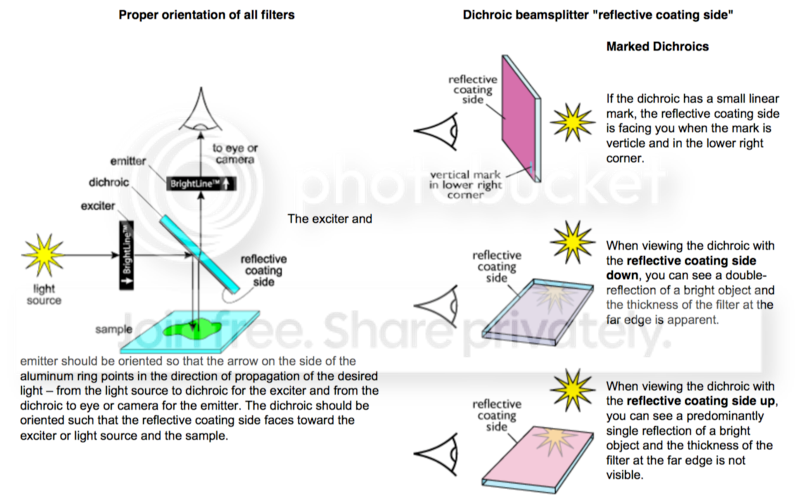

So, assuming that the presence of a double reflection of a source, on the surface of the filter, indicates that it is the rear of the reflective coating side, I made some experiments getting the following results (I apologize for the poor quality of the photographs):
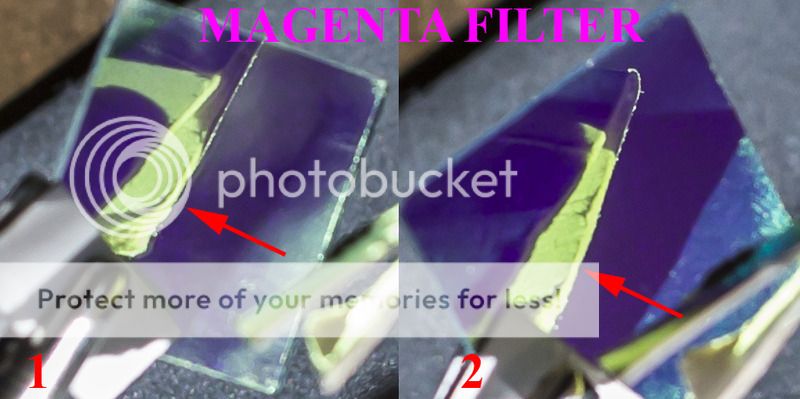

The Magenta filter and the Cyano filter both show to have a similar and clear behaviour so I decided to post just the test for the Magenta.
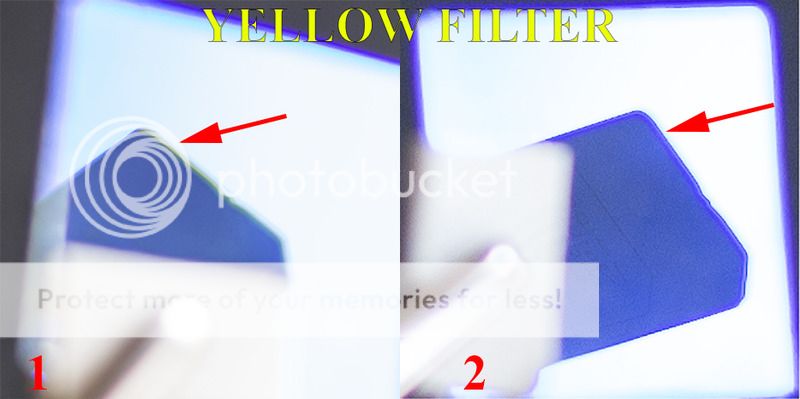
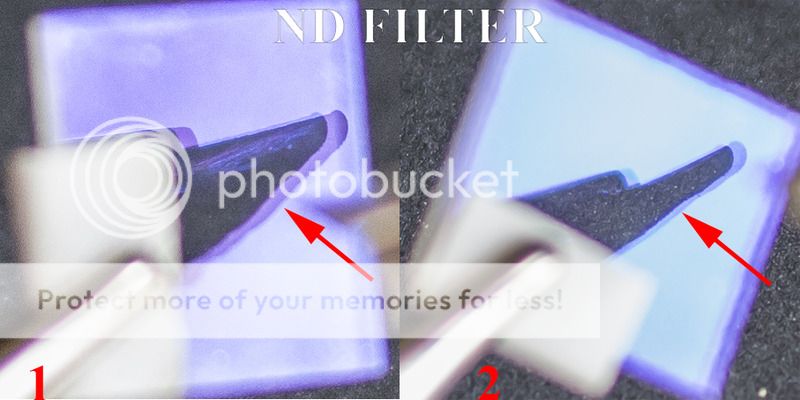

As you can notice, in the cases of the Yellow filter and the ND filter, we get a double reflection on both the sides. Regarding the Yellow filter it is not so clear but if you have a look at the picture n.2 you will notice an inner Blue reflection. On the picture n.1 you will find an outer Yellow reflection.

If we adopt the double reflection as parameter to identify the reflective coating side we can easily find the answer for the Magenta and for the Cyano but not for the Yellow and the ND. It is possible that those latter filters are not dichroic filters? Does it make sense?

My simply question is: how may I determine, without doubts, the side which has to be oriented to the light source of the enlarger head?

Thank you in advance for your help!

All the best.
D.
 
Last edited:

AgX

Member
Allowing Ads
Joined
Apr 5, 2007
Messages
29,972
Location
Germany
Format
Multi Format
It does not matter.

The instructions above relate to a case where the dichroic filter is part of the imaging optics. In such case you have the old mirror issue of double reflection.

For lighting optics the orientation does not matter. In case of doubt just mount it in a deliberate direction, meter the colour density with your enlarging colour-meter, then reverse the filter and meter again. In case there should be a difference post it here.
 
OP
OP
damiafix

damiafix

Member
Allowing Ads
Joined
Oct 30, 2016
Messages
13
Location
Italy
Format
Multi Format
Hi,
thank you so much! I am a novice and unfortunately I don't own an enlarger light meter. I will probably buy it in the next few days if I can successfully use it in my workflow. Any suggestion for an affordable and reliable model?

Anyway, I did some tests exploiting the reflected light from the dichroic filter to the ceiling of the room, in order to visually understand if there are any differences. They follow some photographs which I took keeping the parameters of the camera constant (aperture, shutter speed, iso). Pictures 1/2 are referred to the side of the relative dichroic filter:

Magenta%20filter.jpg

Cyan%20filter.jpg

Yellow%20filter.jpg

ND%20filter.jpg


At to be honest I can't notice any difference in terms of light between the first and the second photograph but, obviously, without a proper tool I perfectly understand that we can't get all the features of the reflected light.

What do you think about?

In relation to the ND filter, as you can see, it reflected a soft violet/pink dominant. Is it normal?

Thank you for your time.

Best.
D.
 

AgX

Member
Allowing Ads
Joined
Apr 5, 2007
Messages
29,972
Location
Germany
Format
Multi Format
Welcome to Apug!
I overlooked that you just joined.

Concerning your comparisons, I'm biased, and thus do not see a difference. On this laptop screen I likely could not if there was a difference...
But in the past when I twisted them on visual inspection I did not see a difference either.
 
Last edited:

jlbruyelle

Member
Allowing Ads
Joined
Jul 20, 2016
Messages
69
Location
Lille
Format
Multi Format
Hi!

As regards the reflections, it is perfectly normal that you see a coloured edge if you hold the filter with the dichroic side towards the reflected object, and not if you hold it with the "plain glass" side towards it: it is the very principle of a dichroic filter to reflect all the wavelengths it doesn't let pass, so the treated side of, let's say the yellow filter will give a blue reflection (complementary of yellow), while the reflection coming from the other side downstreams will be yellow because it is only reflecting the wavelenghts that the treatment lets pass. This effect is shown on all your images. In the applications that use semi-transparent reflection filters, the other side of the filter is coated to prevent these reflections from happening - but of course your filters are made to be used in transmission, not reflection, so the other side does not need an anti-reflection treatment. In summary, you don't need to worry about it, it is perfectly normal.

As regards your images of reflected light, I can only say that any difference would be caused by this phenomenon. But then I don't see any difference, which makes perfect sense since an untreated glass surface reflects only a few percents of the incoming light whereas the dichroic side reflects 100% of all the wavelenghts that it doesn't let pass: that's a huge difference, so the effect on the colour is minimal. I can't tell the colour of the reflection on the ND filter from your photos, but it is perfectly normal for a filter to yield coloured reflections, if it has received any kind of treatment, and it has no influence on the colour of the transmitted light - the front lens of your camera, or its multicoated protective filter, are other examples.

As regards enlarging light meters, a common cheap model is the Ilford EM10. You can probably find it for a couple of dozens of euros. For more sophisticated use, determining the paper contrast and so on, you could look at RH designs Zonemaster. I bought mine used for 75 € or so, but the usual price is higher than that, let alone the price of a new one.
 
Last edited:
OP
OP
damiafix

damiafix

Member
Allowing Ads
Joined
Oct 30, 2016
Messages
13
Location
Italy
Format
Multi Format
Hi,

thank you all so much for the explanations. They are clear and make sense to me. Anyway, I have just received an email by DURST who I had contacted some days ago in order to get their official opinion about the dichroic filters. They are in line with your answers about the orientation of the filters in relation to the lamp. That's what I received:

In the Durst color heads the light reach the filters from 0 angle, and as scattered light from the lamp reflector.

When a Dicro filter is used at 0 angle it does not matter which side us up and which side is down.

Only if you use the filter at 45 degree angle does the orientation matter. But if you use a filter in 45 degree angle it will be the complementary filter. So if a yellow filter is used in 45 degree it will give/reflect blue light and let yellow pass. If used in an enlarger you are only interested in the yellow light and therefore 0 angle and no orientation is important.


Thank you once again.

All the best.
D.
 

AgX

Member
Allowing Ads
Joined
Apr 5, 2007
Messages
29,972
Location
Germany
Format
Multi Format
The reply by Durst is contradictory in itself:

The say the light reaching the filter is scattered light from the reflector [the mixing chamber].
Thus it reaches the filter at various angles.
But they say it enters at 0 degrees.

The effect of a dichroitic filter varies with the angle of incidence.

Of course that has nothing to do with with your issue, as those angles do not vary when twisting the filter.
 

jlbruyelle

Member
Allowing Ads
Joined
Jul 20, 2016
Messages
69
Location
Lille
Format
Multi Format
Yes it's true, their reply is unclear to the point of being misleading. "0 degrees" should read "transmission", "45 degrees" means "reflection" - no matter the angle. If you make these corrections, then the text is correct.
 
OP
OP
damiafix

damiafix

Member
Allowing Ads
Joined
Oct 30, 2016
Messages
13
Location
Italy
Format
Multi Format
Hi,

thank you all so much. I am going to reply them in order to ask for clarification about the first part of the text, that one related to the scattered light. It is just in the interest of full disclosure, nothing more. I will obviously keep you posted!

Have a good day.
D.
 

flavio81

Member
Allowing Ads
Joined
Oct 24, 2014
Messages
5,241
Location
Lima, Peru
Format
Medium Format
Damiafix,

I think the orientation should matter in something: UV filtration.

If the light from the halogen lamp passes through the "glass" part of the filter, then UV content will be reduced once it reaches the "dichroic film" part of the filter. This ought to prolong its fading resistance.

Greetings,
Flavio.
 

AgX

Member
Allowing Ads
Joined
Apr 5, 2007
Messages
29,972
Location
Germany
Format
Multi Format
Dichroic filters will not fade anyway.
At least that is what several filter manufacturers say. And as these are metallic coatings it is very plausible.

BUT on lamps I experienced dichroic coatings to flip off.
 

flavio81

Member
Allowing Ads
Joined
Oct 24, 2014
Messages
5,241
Location
Lima, Peru
Format
Medium Format
Damiafix,

I think the orientation should matter in something: UV filtration.

If the light from the halogen lamp passes through the "glass" part of the filter, then UV content will be reduced once it reaches the "dichroic film" part of the filter. This ought to prolong its fading resistance.

Greetings,
Flavio.
 

DREW WILEY

Member
Allowing Ads
Joined
Jul 14, 2011
Messages
14,857
Format
8x10 Format
The filters are engineered per coating and position relative to a specified lamp, so that the angle of incidence of the light is correct when it reaches
the filter. Dichroic filters do not fade, since these are optical coatings. But with excessive heat over a long period of time, they can spall off bits of coating. Subtractive CMY filters are never pure. A bit of white light contamination gets through them even brand new. But if some of the coating fails,
even more white light passes and affects all three dye layers in a color print rather than just one, so the purity of the final hues is compromised. But if you are simply printing VC black and white papers, you'd need quite a bit of coating failure to become a serious problem. Typically UV filters or coating are the first casualty, since they're the front line of defense. For this reason, old filters need to be handled and cleaned very very carefully.
 

ic-racer

Member
Joined
Feb 25, 2007
Messages
16,725
Location
USA
Format
Multi Format
One might also try to make the case the glass might last longer if the dichroic filter side is first in the path. The answer to the original question is way back in post #2.
 

DREW WILEY

Member
Allowing Ads
Joined
Jul 14, 2011
Messages
14,857
Format
8x10 Format
Durst typically placed a fixed UV filter by itself slightly in front of the movable color filters; in other words, between those and the light source, in order to protect longevity of the main filter set. But so many variations and generations of Durst colorheads were made that it's difficult to generalize.
 

flavio81

Member
Allowing Ads
Joined
Oct 24, 2014
Messages
5,241
Location
Lima, Peru
Format
Medium Format
Durst typically placed a fixed UV filter by itself slightly in front of the movable color filters; in other words, between those and the light source, in order to protect longevity of the main filter set. But so many variations and generations of Durst colorheads were made that it's difficult to generalize.

This is true. My colorhead (for the Durst M670) has the UV filter in front of the dichroic lamp.
 

DREW WILEY

Member
Allowing Ads
Joined
Jul 14, 2011
Messages
14,857
Format
8x10 Format
Well yes, sometimes they'd simply use the UV filter directly in front of the bulb, not only to fully filter all the light output, but to secondarily act as a
shield from any decomposition of the bulb coating itself. In this position, the UV filter was relatively easy to clean or replace. But even low-voltage
halogen display bulbs are often fitted with optional UV filters.
 

AgX

Member
Allowing Ads
Joined
Apr 5, 2007
Messages
29,972
Location
Germany
Format
Multi Format
Last generation of Halogen bulbs have got a inherit UV-filter.
 

flavio81

Member
Allowing Ads
Joined
Oct 24, 2014
Messages
5,241
Location
Lima, Peru
Format
Medium Format
Yes, but the bulb specified for my enlarger does not come with any UV filter, by design. And it has a warning of high UV content on the box.
 
OP
OP
damiafix

damiafix

Member
Allowing Ads
Joined
Oct 30, 2016
Messages
13
Location
Italy
Format
Multi Format
Hi,

thank you all for the interesting contributions. Regarding my Durst CLS 500, just in front of the bulb, before the ND filter and the three dichroic filters (Y/M/C), there are two other filters.

It follows a photograph of the two filters (the bulb is placed in front of the filter N.1):


N.2 should be the UV filter which you were talking about.


Filter N.1 is composed by 2 elements: a unit of 9 small glass columns which are right in front of the bulb and, on the other side, a square glass plate (the side showed above is opposite to the bulb).

In my case, you can easily recognize some circular halos which are on both the sides of the plate (have a look at the spot on the left of the last photograph). In particular, I tried to touch the central one and it is very rough. Any suggestion?

Is it possible to clean it or, maybe, would it be better to replace the plate? I guess it is not so easy to find a proper replacement. Is there any schematic/manual of the Durst CLS500 (or 501) on Internet? It would be extremely useful for the identification of all the parts in the disassembling/assembling phase and in order to find replacements if necessary.

Thank you for your time.

All the best.
D.
 
Last edited:
OP
OP
damiafix

damiafix

Member
Allowing Ads
Joined
Oct 30, 2016
Messages
13
Location
Italy
Format
Multi Format
Hi guys,

in relation to the previous post, I would like to clarify the function of filter n.2. In accordance with the manual of my Durst Laborator 1200, on the section related to the head, there is a mention about the command (49) which is supposed to be used to activate/deactivate that filter. Even though the head is a Durst CLS 501, it is different from mine, the function should be the same.

Have a look at the following photograph which is an extract from the mentioned manual:


The relative description:


It seems to be quite clear. What do you think about?

Any suggestion for the cleaning of filter n.1 would be warmly appreciated.

Thank you for your time.

All the best.
D.
 
Last edited:

AgX

Member
Allowing Ads
Joined
Apr 5, 2007
Messages
29,972
Location
Germany
Format
Multi Format
That filter is called here "mask substitute filter".
 
OP
OP
damiafix

damiafix

Member
Allowing Ads
Joined
Oct 30, 2016
Messages
13
Location
Italy
Format
Multi Format
That filter is called here "mask substitute filter".

Thank you so much AgX! Do you know what kind of filter is it? I mean in constructive/behaviour terms.

All the best.
D.
 

flavio81

Member
Allowing Ads
Joined
Oct 24, 2014
Messages
5,241
Location
Lima, Peru
Format
Medium Format
Thank you so much AgX! Do you know what kind of filter is it? I mean in constructive/behaviour terms.

All the best.
D.

From the look of it, it appears that it is a filter to add (yellow) masking to non-masked color negative films. So they print correctly.

I'm just guessing!! -- and that's what the Durst manual above say.

DURST --- accept no substitutes (except for LPL, Kaiser, Leitz, Omega...)
 
Photrio.com contains affiliate links to products. We may receive a commission for purchases made through these links.
To read our full affiliate disclosure statement please click Here.

PHOTRIO PARTNERS EQUALLY FUNDING OUR COMMUNITY:


Ilford ADOX Freestyle Photographic Stearman Press Weldon Color Lab Blue Moon Camera & Machine
Top Bottom
