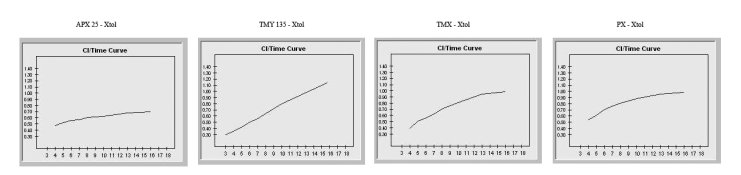
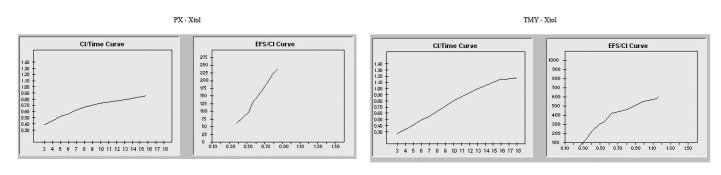
Regarding the curves, if you look at the extrapolation of the straight line back to a value below Dmin, they all intersect. This is a "true" speed point indicative of the "best" speed of the emulsion. You can only change the apparent speed beyond this by changing gamma.
That said, gamma infinity is, to a large extent, controlled by antifoggants, restrainers, levels of finish, grain type and most importantly on the amount of Silver Halide coated. I've left a lot out here, but you can see that from this list, gamma infinity and indeed any measurement of a film and developer is only valid for one film and one developer. See the figures in post #6 for validation of this. Of course, this only holds for B&W as all color films are designed to eliminate this problem. However, try to push, pull or use split development with color and you get the same type of problem, one film, one process condition.
Most spectacularly, gamma infinity and that speed point can be controlled by varying the Silver Halide level coated. A low silver limit gives a low gamma and slow rate compared to a high Silver film. And the intercept with the (below the) X axis moves with Silver level, moving left with more Silver and right with less. The dD/dt (density vs time) and dG/dT are often spectacularly boosted with silver level. This is wasteful in Silver though and also gives abnormally short development times. And, it is not the type of experiment most of you can do. I have coated silver levels from about 5 mg/ft square up to 100 mg / ft square and done B&W and color times of development to do this myself for development work.
The form the developed silver takes is influenced by crystal habit and developer. This can make some rather large changes in the curves you might see in post #6.
So, one film and one developer can be compared. Comparisons across films or developers can be misleading.
Just some thoughts on this subject.
PE