• Welcome to Photrio!
    Registration is fast and free. Join today to unlock search, see fewer ads, and access all forum features.
    Click here to sign up

Development Constants

Chose vue

A
Chose vue

  • 0
  • 0
  • 26
Chose vue

A
Chose vue

  • 0
  • 0
  • 33

Recent Classifieds

Forum statistics

Threads
202,109
Messages
2,835,208
Members
101,119
Latest member
Photrizen
Recent bookmarks
0
Joined
Jan 7, 2005
Messages
2,743
Location
Los Angeles
Format
4x5 Format
This is a subject that gets no coverage. Developmental constants have to do with the relationship between the development rate of a film/developer combination and gamma infinity. Attached are two documents that cover the topic. One document is from Theory of the Photographic Process 3th ed and the other is my take.
 

Attachments

  • Development Constants.pdf
    671.4 KB · Views: 211
  • Development Constants 9.2011.pdf
    15.4 KB · Views: 157

Lee L

Member
Joined
Nov 17, 2004
Messages
3,287
Format
Multi Format
Where "e" in the equation from Theory of the Photographic Process 3th ed is Euler's number?

Lee
 
OP
OP
Stephen Benskin
Joined
Jan 7, 2005
Messages
2,743
Location
Los Angeles
Format
4x5 Format
I've attached the two pages referenced. Hopefully, they will answer the question; however, I don't believe understanding the equation is critical to understanding the concept of the development constant.
 

Attachments

  • Pages 351 and 352.pdf
    488 KB · Views: 175

ffg

Member
Allowing Ads
Joined
Aug 12, 2011
Messages
10
Location
Hannover, Ge
Format
Multi Format
In the first document (from the book) the author states that gamma_infinity is a property of the film not affected by the developer(at least not greatly.) In your document (nr. 2) you say that it is a property of the film/developer combination. Which is correct? Can you give a physical explanation of why gamma_inf should not be very large (effectively infinite,) hence rendering the gamma/t curves linear in most cases? I know that this is not the fact when you look at published curves but you always have to include the effect of developer exhaustion in the real world application.
 
OP
OP
Stephen Benskin
Joined
Jan 7, 2005
Messages
2,743
Location
Los Angeles
Format
4x5 Format
I believe you are thinking about how once gamma infinity is reached, development no longer has an affect on the contrast. Any additional development time will not yield additional contrast. The point of contrast that gamma infinity reaches is a product of the film/developer/mechanism of development combination.

Someone like Ron would be better at explaining the developmental mechanism that causes gamma infinity.

Eventually all film/developer combinations will have a gamma infinity, it's just that many reach it beyond the test times. Just because the curve is linear doesn't mean it isn't going to shoulder off at some point.

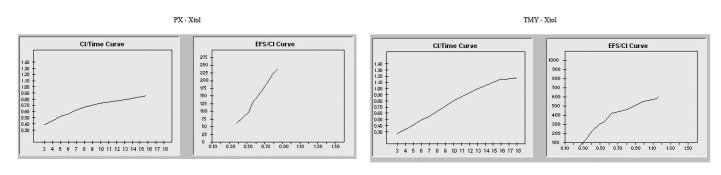
One thing that neither document really discussed was how much additional information an Effective Film Speed / Time Curve adds (attached).

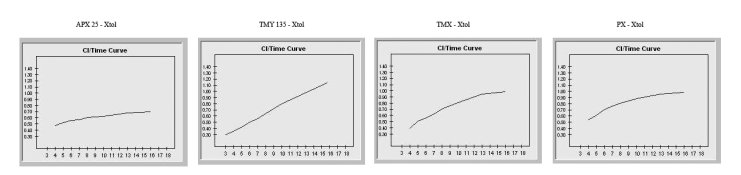
I've attached a few Time/CI Curves. Notice the high velocity of TMY. Do you think this might be why it has the reputation of being "touchy"? APX 25, on the other hand, hardly moves. It takes ten minutes to go from normal to +1.
 

Attachments

  • Time CI Curve Examples.jpg
    Time CI Curve Examples.jpg
    144.3 KB · Views: 102
  • Time CI Curve and EFS Time Curve Examples.jpg
    Time CI Curve and EFS Time Curve Examples.jpg
    138.3 KB · Views: 120

ic-racer

Member
Joined
Feb 25, 2007
Messages
16,752
Location
USA
Format
Multi Format
What to you think, is it worthwhile to share values of 'k'?

It seem that the 'bathroom darkroom' folks that would benefit most from a 'temp du jour' calculation of development time based on temperature would be the least likely to be able to determine their own 'k' value.
 

ffg

Member
Allowing Ads
Joined
Aug 12, 2011
Messages
10
Location
Hannover, Ge
Format
Multi Format
Yes I understand that the contrast/time curves can shoulder (and have seen it in data-sheets) but I am trying to understand the physics behind it. Usually when you are doing some kind of data fitting it helps greatly to know the asymptotics from physical principles so that the fitting is more accurate.

I thought that contrast of virtually any film could be (in principle of course) increased without limits, by the effect of any grain particle that gets any exposure would, if developed for long enough, be completely reduced. This is most probably wrong and I would like to know why.
 
OP
OP
Stephen Benskin
Joined
Jan 7, 2005
Messages
2,743
Location
Los Angeles
Format
4x5 Format
ffg,

Hopefully someone like Ron will be able to answer your question. Otherwise, sounds like a research project to me.

interestingly, an early version of DIN speed required the film to be processed to gamma infinity.
 

Photo Engineer

Subscriber
Allowing Ads
Joined
Apr 19, 2005
Messages
29,018
Location
Rochester, NY
Format
Multi Format
Regarding the curves, if you look at the extrapolation of the straight line back to a value below Dmin, they all intersect. This is a "true" speed point indicative of the "best" speed of the emulsion. You can only change the apparent speed beyond this by changing gamma.

That said, gamma infinity is, to a large extent, controlled by antifoggants, restrainers, levels of finish, grain type and most importantly on the amount of Silver Halide coated. I've left a lot out here, but you can see that from this list, gamma infinity and indeed any measurement of a film and developer is only valid for one film and one developer. See the figures in post #6 for validation of this. Of course, this only holds for B&W as all color films are designed to eliminate this problem. However, try to push, pull or use split development with color and you get the same type of problem, one film, one process condition.

Most spectacularly, gamma infinity and that speed point can be controlled by varying the Silver Halide level coated. A low silver limit gives a low gamma and slow rate compared to a high Silver film. And the intercept with the (below the) X axis moves with Silver level, moving left with more Silver and right with less. The dD/dt (density vs time) and dG/dT are often spectacularly boosted with silver level. This is wasteful in Silver though and also gives abnormally short development times. And, it is not the type of experiment most of you can do. I have coated silver levels from about 5 mg/ft square up to 100 mg / ft square and done B&W and color times of development to do this myself for development work.

The form the developed silver takes is influenced by crystal habit and developer. This can make some rather large changes in the curves you might see in post #6.

So, one film and one developer can be compared. Comparisons across films or developers can be misleading.

Just some thoughts on this subject.

PE

 

ffg

Member
Allowing Ads
Joined
Aug 12, 2011
Messages
10
Location
Hannover, Ge
Format
Multi Format
Thanks for the answers, I think I have to find some technical book to read about the subject in more detail. Indeed I am not surprised that this is a question of film/developer combination. It is very good to know the equation for CI as a function of dev. time which only has two free parameters when one is fitting to data although I plot SBR versus time but that is roughly the inverse of CI v time. So thanks for this.

FFG
 
Photrio.com contains affiliate links to products. We may receive a commission for purchases made through these links.
To read our full affiliate disclosure statement please click Here.

PHOTRIO PARTNERS EQUALLY FUNDING OUR COMMUNITY:


Ilford ADOX Freestyle Photographic Stearman Press Weldon Color Lab Blue Moon Camera & Machine
Top Bottom