
• Welcome to Photrio!
    Registration is fast and free. Join today to unlock search, see fewer ads, and access all forum features.
    Click here to sign up

Developing color as B&W, then bring it back to color?

Sunk

H
Sunk

  • 2
  • 0
  • 44

Forum statistics

Threads
201,228
Messages
2,820,817
Members
100,601
Latest member
gamlate
Recent bookmarks
0

Kirks518

Member
Allowing Ads
Joined
Oct 5, 2013
Messages
1,494
Location
Flori-DUH
Format
Multi Format
I know that you can develop C-41 with B&W chemicals, and you'll get a B&W negative. I also know that you can develop C-41 to B&W, see how it looks, then 'finish' developing it to color. Film Rescue does it, and I'd like to try it, but I'm not sure how it's done. I realize that on old/questionable film, you may not get a good color negative, and that's why they do it that way. At least you have a good B&W negative.

Is the first developing stage (to B&W) done with B&W chemicals, or it it done with color chemistry? Have any of you done this, and what were the steps?
 

Chris Lange

Member
Allowing Ads
Joined
Aug 17, 2009
Messages
770
Location
NY
Format
Multi Format
A variant of this is called Film Acceleration. I've done it a number of times for various effects (and to varying degrees of success). There is a posting on JPGmag.com about how to do it, which you can see here: Film Acceleration: How To

Instead of bringing your film to a lab, you can of course do the C-41 part yourself, which is what I have always done.

It's an interesting process, but it's never something I would want to do on a regular basis.
 

pdeeh

Member
Allowing Ads
Joined
Jun 8, 2012
Messages
4,770
Location
UK
Format
Multi Format
I think we had this conversation in another thread, Kirk?

Yes, I've done it.

In the first instance, I developed C41 in black and white developer. I've used both Rodinal and Caffenol, but thinking about now it I might use a contrasty developer - perhaps a paper developer diluted a bit.

To recover colour from that B&W negative, you need first to bleach the film with a rehalogenating bleach - a solution of Potassium ferricyanide and Potassium bromide is as good as any, as well as simple.

Then you give it a good wash, and proceed to developing it in colour using the normal C41 process - develop, stop, wash, bleach and fix, and wash.
 
OP
OP
Kirks518

Kirks518

Member
Allowing Ads
Joined
Oct 5, 2013
Messages
1,494
Location
Flori-DUH
Format
Multi Format
I think we had this conversation in another thread, Kirk?

Yes, I've done it.

In the first instance, I developed C41 in black and white developer. I've used both Rodinal and Caffenol, but thinking about now it I might use a contrasty developer - perhaps a paper developer diluted a bit.

To recover colour from that B&W negative, you need first to bleach the film with a rehalogenating bleach - a solution of Potassium ferricyanide and Potassium bromide is as good as any, as well as simple.

Then you give it a good wash, and proceed to developing it in colour using the normal C41 process - develop, stop, wash, bleach and fix, and wash.

I think we touched on it, but I couldn't remember/find the thread.

I think I can get my hands on some PF and PB this weekend, so I may give it a go.

The reason I want to try this is I end up with quite a few rolls of 'found film', which I love developing, and if I can actually get color out of some, that would be cool.
 

Chris Lange

Member
Allowing Ads
Joined
Aug 17, 2009
Messages
770
Location
NY
Format
Multi Format
I would like to iterate that this will not really "recover" any of the color...if the latent image is weak/damaged and the dyes are past due it won't really matter what you do to the film. I would really use this method on fresh film the same way I would use x-processing to achieve a certain look...
 

pdeeh

Member
Allowing Ads
Joined
Jun 8, 2012
Messages
4,770
Location
UK
Format
Multi Format
Here it is: (there was a url link here which no longer exists)

I can't remember what concentration bleach I used and I didn't keep notes, or at least I can;t find any. I imagine 30g-50g/litre of each, but perhaps Juan Hu Nose will come along and confirm or correct.

You can make up separate solutions of KBr and K3[Fe(CN)6] and store them separately, then mix the final bleach by combining them just before use.

I think it's probably a good idea to prewet the film before bleaching, but I can't provide a rationale :smile:

Don't forget to post some results!
 

pdeeh

Member
Allowing Ads
Joined
Jun 8, 2012
Messages
4,770
Location
UK
Format
Multi Format
I would like to iterate that this will not really "recover" any of the color...if the latent image is weak/damaged and the dyes are past due it won't really matter what you do to the film. I would really use this method on fresh film the same way I would use x-processing to achieve a certain look...

With respect, it is perfectly possible to recover colour by this route.

It is certainly true that if the latent image is weak/damaged and the dyes are past it it might not give a very good result, or even any result at all ... but on the other hand you can't say with certainty that a film is "past it" unless and until the film has been developed, by whatever method.

In short, if the film is f****d, it's f****d, and if it's not, it ain't.
 
OP
OP
Kirks518

Kirks518

Member
Allowing Ads
Joined
Oct 5, 2013
Messages
1,494
Location
Flori-DUH
Format
Multi Format
I would like to iterate that this will not really "recover" any of the color...if the latent image is weak/damaged and the dyes are past due it won't really matter what you do to the film. I would really use this method on fresh film the same way I would use x-processing to achieve a certain look...


Take a look at these links:
Dead Link Removed
Dead Link Removed

I think it's pretty cool. It's a way to get an image (B&W), and then possibly get a usable color image.
 

Athiril

Subscriber
Allowing Ads
Joined
Feb 6, 2009
Messages
3,062
Location
Tokyo
Format
Medium Format
If the developed image is weak, you can continue to amplify it by rebleaching and redeveloping until the required density. The oldest colour film I have developed was Swiss Telco Telcolor, I managed to get colour images out of it.. though I developed it directly rather than this method.

It's also one of the ways you can increase E-6 density if you can use a B&W reversal bleach after first developer to remove the negative. You can developer then positive, bleach and re-develop the positive to amplify the colour positive density if it has low dMax due to age related fogging issues etc.

Haven't done it for a while though. Plan on getting some dye couplers to do it with regular B&W film and make them chromogenic.
Little Cousin by athiril, on Flickr
 

Rudeofus

Member
Joined
Aug 13, 2009
Messages
5,115
Location
EU
Format
Medium Format
Since this is film of unknown pedigree, I would suggest the following approach: start with C-41 color developer and stop bath, followed by a brief wash, then fix with Formulary's TF-5 or some fixer at pH 6.5. This gives you both a silver and a dye image, if not, you at least know your film wouldn't have worked with either C-41 or B&W processing.

If the image looks strong and contrasty, bleach and fix away the silver and enjoy your regular color negatives. If the image looks faint, use athiril's suggestion to amplify your dye image.

This way you are most likely to obtain the optimal results from whatever the film still offers.
 

Rudeofus

Member
Joined
Aug 13, 2009
Messages
5,115
Location
EU
Format
Medium Format
Since this is film of unknown pedigree, I would suggest the following approach: start with C-41 color developer and stop bath, followed by a brief wash, then fix with Formulary's TF-5 or some fixer at pH 6.5. This gives you both a silver and a dye image, if not, you at least know your film wouldn't have worked with either C-41 or B&W processing.

If the image looks strong and contrasty, bleach and fix away the silver and enjoy your regular color negatives. If the image looks faint, use athiril's suggestion to amplify your dye image.

This way you are most likely to obtain the optimal results from whatever the film still offers.
 

richyd

Member
Allowing Ads
Joined
Jul 24, 2012
Messages
211
Location
London UK
Format
Medium Format
There is a Kodak technical data document - AE31 - that describes in detail how to do this. I don't have the web reference from where you can download it but I came across is searching for a solution when a lab processed a colour film as B&W. As a test I followed the procedure and recovered satisfactory colour images.
 
OP
OP
Kirks518

Kirks518

Member
Allowing Ads
Joined
Oct 5, 2013
Messages
1,494
Location
Flori-DUH
Format
Multi Format
There is a Kodak technical data document - AE31 - that describes in detail how to do this. I don't have the web reference from where you can download it but I came across is searching for a solution when a lab processed a colour film as B&W. As a test I followed the procedure and recovered satisfactory colour images.

http://www.kodak.com/global/en/consumer/products/pdf/ae31.pdf

But it doesn't tell you how t reprocess them to color.
 

Athiril

Subscriber
Allowing Ads
Joined
Feb 6, 2009
Messages
3,062
Location
Tokyo
Format
Medium Format
Very easy to reprocess to colour.

Use a rehalogenating bleach. Like potassium ferricyanide and potassium bromide solution to bleach the negative back to silver halide, rinse, then sit it in a weak solution of sodium sulphite to destroy the left over bleach (if you have left over bleach you can stain the film when you put the developer in), rinse it out a few times, then fog the film and re-develop in C-41 or other colour developer, note you can now do this at room temperature and develop to completion (takes longer at room temp) then bleach and fix or blix etc. - Or inspect after developing, if still not enough density, rinse, sulphite bath, rinse a few times and start again from the rehalogenating bleach step to gain more colour density.

I found D-76 usually makes a poor developer choice for the B&W step, while Rodinal is good (albeit grainier than normal).
 

Rudeofus

Member
Joined
Aug 13, 2009
Messages
5,115
Location
EU
Format
Medium Format
Does fog the film means that it has to be exposed to light?

Yes. Well bleached silver won't develop unless you fog it, either chemically or with light.
 
OP
OP
Kirks518

Kirks518

Member
Allowing Ads
Joined
Oct 5, 2013
Messages
1,494
Location
Flori-DUH
Format
Multi Format
Where would one find potassium ferricyanide and potassium bromide in the states locally? Is this something that I can get at a local CVS/Walgreens, or do I need to go with a photo supplier?
 

Athiril

Subscriber
Allowing Ads
Joined
Feb 6, 2009
Messages
3,062
Location
Tokyo
Format
Medium Format
You can use sodium chloride in place of potassium bromide, supposedly you may lose a bit of silver halide density with each bleaching with it, but it's solvent action is weak, the last person who tried to make a fix with it said they used 300g/L and took several hours iirc.

In the states I would look at Art Craft Chem and Photographer's Formulary, there'd be other options for it too.
 

Jan de Jong

Subscriber
Allowing Ads
Joined
Jul 20, 2022
Messages
117
Location
Germany
Format
Analog
Even if the tread is old, I think this is an interesting topic. Since I had read once the Kodak AE31 paper and some C41 chemicals I tried this a while ago. My main reason for developing the Agfa film in black and white was that it is rather old and has strong red backing after developing due to aging.
As black and white negative I was impressed, nothing like the big grain as described often. A day later I took part of the film and reversed it with the C41 bleach, then re-developed by inspection (tray) under bright light in the usual steps.

Scans of the results below. I did not make RA4 prints of this yet, but looks ok. Not too much color correction on the scan was required.

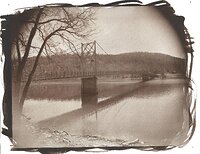
original scan from the Afga C41 film developed in Foma Retrospecial developer
scan after bleach and normal C41 re-development under light

- Jan.
 
Photrio.com contains affiliate links to products. We may receive a commission for purchases made through these links.
To read our full affiliate disclosure statement please click Here.

PHOTRIO PARTNERS EQUALLY FUNDING OUR COMMUNITY:


Ilford ADOX Freestyle Photographic Stearman Press Weldon Color Lab Blue Moon Camera & Machine
Top Bottom