
• Welcome to Photrio!
    Registration is fast and free. Join today to unlock search, see fewer ads, and access all forum features.
    Click here to sign up

Developers, Kodak T-Max 400 film, and rotary Jobo processing.

Valencia

A
Valencia

  • 1
  • 1
  • 59
Tied to the dock

D
Tied to the dock

  • 4
  • 0
  • 97

Recent Classifieds

Forum statistics

Threads
203,095
Messages
2,849,749
Members
101,662
Latest member
Kanofski
Recent bookmarks
1

Tom Kershaw

Subscriber
Allowing Ads
Joined
Jun 5, 2004
Messages
4,975
Location
Norfolk, United Kingdom
Format
Multi Format
I'm planning a comparison test with Kodak T-max 400 film and a few different developers to try and achieve a good balance between grain, speed and sharpness. I had been using Pyrocat-HD as my mainstay in the Jobo but became frustrated with its fondness for oxidation and occasionally unpredictable results. However, while I have few qualms about the reliability of my recently adopted choice of D-76 1+1 (10 min @ 20ºC, 50 r.pm.), grain is surprising high with somewhat thin shadows compared to earlier Pyrocat-HD processed negatives. To give a point of comparison, a 16x20" from a 4x5" negative is fine grained enough not to be concerned, but a 16x20" from a 6x7cm negative does show surprisingly high levels of grain.

Notes:

  • From the D-76 point of view I suspect an E.I. of 250 along with a shorter development time may help with image quality considerations, and will test to follow.

  • It's worth noting that Pyrocat-HD does seem able to achieve approximately full box speed via rotary processing (when it works).

Other options for developers:

  • Ilfotec HC 1+49. - used previously for rotary processing ILFORD HP5 Plus 8x10" sheet film with good results. - would hope for box speed but not sure about grain.

  • Perceptol substitute formula. I've used this experimentally with ILFORD Pan F Plus 35mm @ 1+3 dilution (75ml Dev + 225ml water) with good results in a Paterson tank; but I'm not entirely convinced the developer has enough capacity (4 rolls of 120 in 1000ml solution) at that dilution for the combined challenges of a faster film and rotary agitation, even assuming an E.I. of 200

  • Kodak XTOL

  • ID-68 / Microphen - not familiar with the formula, although might be helpful at improving shadow detail..

  • A commercial liquid concentrate, DD-X, Ultrafin Plus, T-max, Aculux etc.

Any Jobo & T-max 400 comments?
 
Tom-try xtol 1+2@68 degrees semi stand for 13 minutes...works very well for me
results are very un tmy400 looks
got this from a thread here which you can probably try
Best, Peter
 
Xtol is often said to be the first choice for overall balanced quality. The weakest point of Xtol stock is probably the sharpness. I don´t know if it significantly gets better when you dilute Xtol, but the grain is likely becoming coarser then.

I recently developed Tmax 400 in Perceptol stock (but not rotary). The grain is finer or as fine as with Xtol and the sharpness is very good but I cannot compare it with Xtol directly yet. I heard of a direct comparison of Xtol 1+3 and Microdol-X (should be the same as Perceptol) 1+3 where Microdol-X 1+3 developed sharper but also grainier than Xtol 1+3. Therefore I assume that Microdol-X (Perceptol) stock also would develop sharper than Xtol stock. So if film speed is not so important I highly recommend to test Perceptol with Tmax 400. A speed of 200 ASA or slightly below is a good starting point.

Andreas
 
Tom

You probably know that TMax400 and D76 1+1 is my favorite film/dev combination. I'm looking at some images right now, and at 11x14, I just don't see any grain at all. Well, maybe a hint in uniform mid-gray areas, but nothing that would bother me.

Nevertheless, if grain is your only concern, I would try Spur HRX-3 Professional. This developer gives the finest grain I've seen, but I'm afraid, you're back to fondness of oxidation.
 
Nevertheless, if grain is your only concern, I would try Spur HRX-3 Professional. This developer gives the finest grain I've seen, but I'm afraid, you're back to fondness of oxidation.

Ralph,

I would classify HRX-III as a first of all sharpness orientated developer in combination with very fine but not finest grain. I developed a test strip of Tmax 400 in HRX-3 two days ago and compared it with negatives of the same scene developed in Perceptol stock and in A49 stock. The sharpness of HRX-3 is as good as Perceptol´s and considerable better than with A49. In grain I see no difference between Perceptol and A49 but HRX-3 produced a grainier negative. So the best image quality I have with Perceptol that brought me very fine detail that I can not see with HRX-3 due to its larger grain and also not with A49 due to its reduced sharpness. On the other hand with HRX-3 and A49 you can shoot at box speed and with Perceptol only at about the half of it. So it´s very hard to decide which developer is "best". :confused: It depends on the aim that you want to use it for.

I´m looking forward to read your WBM book that I hope to get in the next few weeks.

Kind regards,
Andreas
 
Strangely enough I was looking at the Kodak info on TMax400 and the Ilford info. Surprisingly both Ilford with Perceptol and Kodak with Microdol X give times for box speed and nothing else

So either both companies were too lazy to test Tmax in their respective extra fine grain developer at other than box speed( doesn't sound likely) or both concluded that for whatever reason TMax400 like Neopan 400 are films where box speed can be maintained with both those extra fine grain developers.

pentaxuser
 
Pentaxuser, according to Kodak's tech pub for TMY2, EI200 is appropriate when developing in Microdol-X stock and EI320 at 1+3. (see table at page 2)
 
Tom

You probably know that TMax400 and D76 1+1 is my favorite film/dev combination. I'm looking at some images right now, and at 11x14, I just don't see any grain at all. Well, maybe a hint in uniform mid-gray areas, but nothing that would bother me.
.

I concur...
 
Tmax film and Tmax developer balances well for me. I would think that would be to obvious first choice for Jobo processing.

I agree, and TMax/D76 does so as well. I'm surprised by Tom's objection to the grain. I don't have the same issue. I wonder what's different.
 
I quit looking for another developer for TMY-2 when I tried XTOL. I'm developing 5x4 TMY-2 in XTOL 1:3 in a Jobo 3010 tank. A very hard to beat combination IMHO.
 
I quit looking for another developer for TMY-2 when I tried XTOL. I'm developing 5x4 TMY-2 in XTOL 1:3 in a Jobo 3010 tank. A very hard to beat combination IMHO.

Ditto, but replenished undiluted is even better.

Steve
 
Example; crop from 6x7 negative print on ILFORD MGIV RC GLOSS 8"x10" - equivalent to 24" on the long side:

67to24inchCrop.jpg


On second thoughts perhaps the grain isn't that bad.


Tom
 
Last edited by a moderator:
Example; crop from 6x7 negative print on ILFORD MGIV RC GLOSS 8"x10" - equivalent to 24" on the long side:


On second thoughts perhaps the grain isn't that bad.


Tom

Anything less and it will look digital. That said, grain is mainly visible in light and medium gray areas. Your sample doesn't have a lot of medium gray.
 
I would classify HRX-III as a first of all sharpness orientated developer in combination with very fine but not finest grain. I developed a test strip of Tmax 400 in HRX-3 two days ago and compared it with negatives of the same scene developed in Perceptol stock and in A49 stock.

I revise my statement. While checking my test I found that I had accidentally taken a negative developed in HRX-3 that was shot at ISO 800. After printing the right HRX-3 negative exposed with ISO 400 I´m absolutely with Ralph: HRX-3 produces the finest grain that is possible at least with Tmax 400. In graininess HRX-3 is the same excellent as A49 and Perceptol are. The accidentally printed ISO 800 negative was considerable grainier and led me to the wrong conclusions.

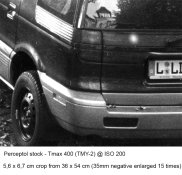
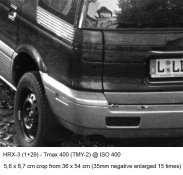
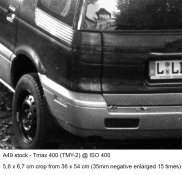
Here are three scans from prints I made from Tmax 400 (TMY-2) negatives developed in Perceptol stock, HRX-3 (1+29) and A49 stock. I enlarged the 35 mm negatives 15 times. So the size of the full prints would be 36 x 54 cm (about 14 x 21 inches). The scans show crops from the 36 x 54 cm format with a size 5,6 x 6,7 cm.

Best,
Andreas
 

Attachments

  • perceptol.jpg
    perceptol.jpg
    326.8 KB · Views: 273
  • hrx-3.jpg
    hrx-3.jpg
    327.9 KB · Views: 270
  • a49.jpg
    a49.jpg
    326.4 KB · Views: 295
I am liking the perceptol... Never tried it with anything over 100 ISO. Might have to give it another go. But if I have to go below 200 with tri-x maybe not.
 
What gives the sharpest results all the way up to 16x20" without getting grainy? I use 4x5", jobo and tmy2 as well :wink:
 
Just posted some interesting results in the gallery for anyone interested. Same camera, ISO, lighting. TMY-2 in HC110 dilution E versus Tri-X. Same agitation, slightly longer time for TMAX. Another image is TMY-2 in XTOL 1:2. Again, TMY-2 is one kick-ass emulsion but Tri-X just has the mojo in my book. Interesting to note that the HC110 images are hard to tell apart in terms of grain and sharpness. XTOL is sharper but I might as well shoot digital there because that's what it reminds me of. It's beautiful but almost too perfect. Anyway, food for thought...:smile:

And Steve, how many times do you think you posted that Kodak chart? :smile:
 
And Steve, how many times do you think you posted that Kodak chart? :smile:

On APUG? Only a couple of million times, but only because applies and it saves endless discussions. :wink:
 
Photrio.com contains affiliate links to products. We may receive a commission for purchases made through these links.
To read our full affiliate disclosure statement please click Here.

PHOTRIO PARTNERS EQUALLY FUNDING OUR COMMUNITY:


Ilford ADOX Freestyle Photographic Stearman Press Weldon Color Lab Blue Moon Camera & Machine
Top Bottom