• Welcome to Photrio!
    Registration is fast and free. Join today to unlock search, see fewer ads, and access all forum features.
    Click here to sign up

developer claim

Recent Classifieds

Forum statistics

Threads
203,035
Messages
2,848,893
Members
101,608
Latest member
Robert Taetzel
Recent bookmarks
1

rmolson

Member
Allowing Ads
Joined
Feb 23, 2006
Messages
327
Location
Mansfield Oh
Format
Medium Format
I came across a photgraphic site in the UK about a developer Spursinn HCD that is suppose to boost TRix to 25,000!!!!! Can’t seem to find out anything else about it. Anybody familiar with such a wild claim Once heard of a claim of boosting Super XX to Weston 10,000 in the early 50’s but they used mercury fumes to hypersensitize the film and then reverse the film among other techniques
 
i'd love the ability to shoot at that speed.
 
It's funny even in 2013 people are still trying to sett snake oil.
 
Which site in the U.K. and who is making the claim. A user or the maker of the developer? Thanks

pentaxuser
 
AG Photographic are selling it in the UK.

I got some to try and the fact sheet that comes with it is to say the least 'comprehensive'. It can be used in either one or two parts, and lists a bewildering range of times for various films and rendering (fine grain, prominent grain etc.). I would agree that it could well be a compensating developer repackaged, but it does make great claims for increasing film speed, not something I associate with tradtional compensating developers. Sorry but I haven't tried using it yet.

Steve
 
Actually the claim by the manufaturer for highest speed has been raised to "ISO 51200" for Tri-X and Tmax 400.

For other ISO 400 films it lies between ISO 400 and ISO 25600
 
That is why I put it in marks. They use the term ISO.
 
Spursinn certainly claim that it gives the kind of flexibility in developing the same film at different EIs that most other developers don't and the example of prints on the Spursinn site do seem to back this up. However to be fair to the company, its very comprehensive instructions do state that pull or push developing will restrict the tonal range. None of the examples shown cover very high EIs such as 12,800 and above and what such negs would be like can only be speculated about but while accepting, as Spursinn does, that pushing restricts tonal range i.e. loss of shadow detail it may be that this company has come up with a developer that is better in this respect that what we have seen to-date.

Certainly the Efke 100 film examples look remarkable. We'll only know how good it is when enough people have used it and report their findings.

The biggest benefit from what I have gathered from the website would seem to be the ability to push say a 100 speed film which might be a user's normal film up to 1600 when the light conditions demanded it so a "one film" photographer who'd prefer not to have to master and carry other films can do so.

Matt at AGphotographic is impressed enough to stock it and unless it has qualities that other developers lack I don't think it would be in his interest to stock it.

The worst thing any retailer can do is to sell a "snake oil" developer that makes the blind see, the lame walk etc when it fails miserably to come anywhere near doing this.

I don't think this developer falls into the "snake oil" category but customers' opinions will be the judge ultimately.

pentaxuser
 
When I was testing TMax 400 to see the max EI that was usable for me, I found that at EI 3200 with Xtol 1:3, the low values simply drop off. I used a grey scale for the test target, and at a bit below the midpoint, there was just nothing. The available light simply had not triggered the film to form anything.

So when a company advertises that a developer increases film speed six stops, I'd take that with a grain of salt, because what would be the midpoint at 25600 is the toe at 3200. Sure, give it a test, but that's just it: give it a real test with a real test target.

SPUR does produce some amazing stuff, like their Ortho 25 film. (This film was used by Zeiss to show one of their lenses could really do 400lp/mm.)
 
Well, Spürsinn HCD is designed (and probably made) by Spur, but not offered within the Spur own range.

That is why I called Spürsinn the manufacturer of the HCD developer.


Spur do not make own films, only chemistries. Including special chemistries to yield tonal results with high-contrast/high-resolution film. In this context with such a combo in mind one could speak of own film though.
 
Last edited by a moderator:
Certainly the most that can ever be achieved in the shadows is developing them to completion, and it should be knowable what the curve of a film developed to completion looks like, so at least in principle the information is there to confirm or deny that the claims are reasonable.

Some thoughts:
(1) Of course they should be saying "EI" rather than "ISO"; the ISO is an immutable property of the film, by definition. But people abuse this terminology all the time anyway.
(2) What EI is "achievable" with a particular development regime could mean several different things. One is quantifiable but hard to reach in practice: "the characteristic curve looks like normal development but shifted". That's the strict definition of a "true" speed increase, contra a push which acknowledgedly loses shadow detail. However, I bet they mean "pushable to 25600" rather than "six stops of true speed increase"!
(3) "Pushable" is intrinsically a judgement call: how much loss of shadow detail is too much? Depends on the image, the viewer, and the goal.
(4) It's easy enough to test a claim like this: Shoot some Tri-X in brackets from, say, EI 6400 to 51200, develop per the instructions, and see what comes out. I've seen Tri-X and HP5+ look pretty good at EI 6400, but beyond that I'd be surprised if there was anything recognizable as shadow detail...but maybe I'll be surprised.
(5) Does anyone have any idea what's *in* this stuff? Most developers aren't rocket science---there are developing agents, activators, restrainers, antifoggants, preservatives, solvents, and that's about it. Is there any reason to think Spur have put in something fundamentally new, like a developing agent not previously explored?

-NT
 
Why would you wish to do that?
 
I'd love to find a developer that does what this claims, and I'd like to test this if anyone decides to bring it in to the US.

While granting that there's no real magic in developers, some do, in practice anyway, allow shooting with good results at speeds scoffed at by some. It's funny - if someone DID formulate a developer that gave a true speed increase of, say, three stops with common films, or even one common film, as measured by the usual densitometric methods, no one would really believe it. People who needed what it could do might, might, find it and use it, and the densitometer heads would scoff at them and probably refuse to test it. Note that I'm not saying this DOES. I doubt it very much too, at least in terms of "real shadow detail speed" but I'd be willing to try it and even if "real shadow detail speed" isn't increased much I'd also evaluate it in terms of what available light photography looked like when using it.

One example I use is Diafine. People have argued for a long time about whether the speed increase is "real" but what I have found is this: when I shoot Tri-X and develop in Diafine, if I shoot it at 400 the negatives are dense, flat and grainier than when shot at higher speed. They look for all the world like they are overexposed between one and two stops. When I shoot it at EI 1250 (as high as EI 1600 as the box claims using daylight, like an overcast day, and more like 1000 under tungsten - 1250 is a good all around compromise) they look much better and print much better for my purposes. No matter what a densitometer might say, that's the final criteria.

If Diafine gets me negatives I like from Tri-X at 1250, I'm willing to entertain the notion that another developer might get equally good or better results at, say, 2400 or 3200. Above that my skepticism increases as geometrically as the film speed scale itself, but I'd be willing to be proven wrong. :wink: However, with the quality I get from Delta 3200 at 3200, I don't see the need to push Tri-X to that speed.

"Who needs it" would be me, and I suspect others. I'm always running into situations where I'd love to shoot by available light but it's just too dark, which is one of the big temptations for me to break down and finally get a DSLR.

 
What EI is "achievable" with a particular development regime could mean several different things. One is quantifiable but hard to reach in practice: "the characteristic curve looks like normal development but shifted". That's the strict definition of a "true" speed increase, contra a push which acknowledgedly loses shadow detail. However, I bet they mean "pushable to 25600" rather than "six stops of true speed increase"!

In the description of the HCD developer they have it about extentended pull & push features.
Furthermore they state
"Push processing by nature leads to a limitation of tonal values. Basically though processing with HCD yields a larger tonal range than is possible with other developers." (my translation)
 
"Who needs it" would be me, and I suspect others. I'm always running into situations where I'd love to shoot by available light but it's just too dark, which is one of the big temptations for me to break down and finally get a DSLR.

Me too. Well, I suppose "need" is too strong a word, but I face plenty of situations where EI 3200 is kind of a bare minimum.

Medium format is probably a kind of sweet spot for extreme pushing; the equipment is small enough for carrying around and shooting handheld, grain isn't nearly as big an issue as it is in 35mm, and really fast lenses are rare and bulky. A 35mm shooter can use an f/1.4 lens without extraordinary effort, and f/1.2 is fairly common; a large format shooter will be on a tripod and can do long exposures; but in MF, you're often stuck with f/2.8 or so and trying to handhold.

-NT
 
Me too. Well, I suppose "need" is too strong a word, but I face plenty of situations where EI 3200 is kind of a bare minimum.

Medium format is probably a kind of sweet spot for extreme pushing; the equipment is small enough for carrying around and shooting handheld, grain isn't nearly as big an issue as it is in 35mm, and really fast lenses are rare and bulky. A 35mm shooter can use an f/1.4 lens without extraordinary effort, and f/1.2 is fairly common; a large format shooter will be on a tripod and can do long exposures; but in MF, you're often stuck with f/2.8 or so and trying to handhold.

-NT

All true and I agree. Another factor is depth of field. I still plan, eventually, to pony up the money for an 80 1.9 for my Mamiya 645 Pro, but DOF is really shallow at 80mm and f/1.9. Otherwise, it's a great camera for available light. Even with the 2.8 lenses I have, with Delta 3200 at 3200 I get results I really like. Same with my Yashicamat 124 but that means f/3.5 and every little bit counts - the Mamiya at 2.8 is faster, handles much faster, and has exposure automation and the winder grip. (It's also a lot louder with the winder and mirror slap and thus a lot more obtrusive and like carrying a cinder block around your neck compared to the Yashicamat - no camera is perfect.)
 
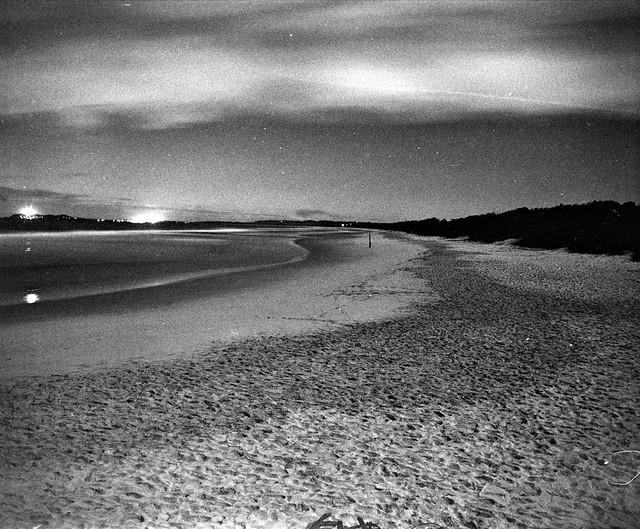
Here is an EI of 51200 for Rodinal 1:100 2 hour semi-stand, the time I was using for Tri-X for 3200-6400. This particular neg is 6x7cm, very thin, 2.5-3 stop dynamic range and very large grain. But a picture none the less.


Tri-X 51200 Test #1, Beach Night by athiril, on Flickr
 
Here is an EI of 51200 for Rodinal 1:100 2 hour semi-stand, the time I was using for Tri-X for 3200-6400. This particular neg is 6x7cm, very thin, 2.5-3 stop dynamic range and very large grain. But a picture none the less.

It looks pretty good considering. Is that a negative scan or a wet print?

-NT
 
How is one able to achieve these speeds with an average SLR? My SLR's highest speed setting is ISO 3200. How does one achieve a speed of 25600 or 51200 or even 6400?
 
It looks pretty good considering. Is that a negative scan or a wet print?

-NT

Scan.

To print like that grade 5 might be enough. Might. It was seriously thin, otherwise extending development longer, or replacing with fresh Rodinal 1+100 and stand longer may get you better printing density for the same thing.
 
How is one able to achieve these speeds with an average SLR? My SLR's highest speed setting is ISO 3200. How does one achieve a speed of 25600 or 51200 or even 6400?

Simple. If the exposure override won't offer another stop, shoot on manual and adjust. My Pentax MX oddly only goes to 1600. I shoot TMZ at 3200 in it pretty commonly. Just meter at 1600 and expose one stop less. Two stops less for 6400.
 
Athirils shot looks fairly pictorial in the varied tones but, from his description, I wouldn't enjoy printing the neg! It would have the "middle" grey right down at the bottom of the curve somewhere but at least there is still a decent variation across the image. Was there any problem with reciprocity failure with the exposure time used? (I'm assuming there was a tripod involved here :wink: )

Often the crazy-extreme-push examples one sees contain detail only in the highlights. In other words, the parts which are at least four stops brighter than the rest of the shot . . . so perhaps "push" people tend to see what they want to see regarding achievable EI. It could be interesting in medium format though, with long shutter speeds and night shots. I have tried several times to get the town lights, the river and passing barge lights all in the same exposure but the town lights over power the river traffic - the up-rating idea might be handy for this.
 
Photrio.com contains affiliate links to products. We may receive a commission for purchases made through these links.
To read our full affiliate disclosure statement please click Here.

PHOTRIO PARTNERS EQUALLY FUNDING OUR COMMUNITY:


Ilford ADOX Freestyle Photographic Stearman Press Weldon Color Lab Blue Moon Camera & Machine
Top Bottom