Jesse,
I'll take a stab at your questions, in order, and trying to point out the differences between printing and scanning that seem to have led you to some false conclusions:
You make everything sound so easy

. I've highlighted something in bold which I want a bit more explanation on. How come this is different?
First, digital capture results in a different set of tones than what is on a negative. The dynamic range is not as great and the separation curve is way different. And, most scanning software will expand or contract your the dynamic range on a negative to fit predetermined extremes of black and white. So, comparing a scanned neg with a digital capture is difficult if not pointless.
I've have a hard time to understand what is 'correct' in terms of film photography. You know in digital you just make sure you have the highlight detail you want and the shadows. You open the picture and it's "there" you can save some stuff with edits, but you don't have to figure out the right printing time.
"Correct" in photography boils down to what makes the most pleasing prints. This is not totally subjective. Manufacturers and photo scientists have done extensive research and testing over the years to come up with standards for film speed and contrast gradient that consistently produce the best negatives and prints. We need to use this as our starting point and deviate from it only when we want something different. Basically, a well exposed and developed negative (i.e., "correct") will yield a pleasing print when printed on a medium contrast grade at the minimum print exposure time to produce a pleasing black. The highlights and the mid-tones should all line up. I'm not talking about a fine-art print here, rather general rendering of information on the negative in a semi-realistic way. This is a fairly large window.
Scientists have boiled all this down into densities and sensitometer data, but you don't really need a densitometer to find this spot for yourself. Just print some negatives. Base your exposure for these tests on blacks and find the minimum time that yields a real black in your print or proof (search for "proper proof" for a lot more info). Once you have the black you want, evaluate the negative. Are the shadows to black and empty? =Underexposure. Are the highlights blown and lacking detail? = overexposed. Print had good blacks but is muddy and has no real whites even though there is adequate shadow detail? = Underdeveloped. And so forth.
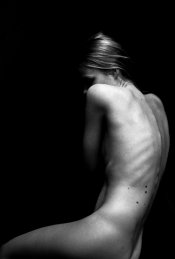
Because with film, ok you make sure you have the shadow detail, in my case I did have MORE exposure detail. Ok I know it's just a scan but check this example of my tests.
The raw scan is just the negative in the scanner. I used the same lens and aperture/shutter and ISO. I metered with my Minolta IVf and got what I aimed for on the A7. I did not need all the shadow detail on the back of the girl since it was backlit / contour shot. However on film I seem to have the detail? Is this because my development method gives this or just because of how film works? And how should I deal with it? Leave it as is and get a longer printing time in the darkroom or underexpose more so I lose the shadow detail?
I'm not sure why there is such a difference between your neg scan and your digital capture. It may be your scanning software wanting to give you a fuller range of tones or your metering or the way your A7 works differently than film. However, that's all really irrelevant. There's no reason why you can't get the same image from you negative as you got from your A7 with a little manipulation.
There are several ways to go about it: You could simply meter the shadow in the scene and place it where you want it, i.e., lower and with no detail. This equates to your "underexpose more so I lose the shadow detail," but is not really underexposure; it's knowing what you want and how to get it with film. (And, maybe your E.I. of 800 would have worked here, but you should realize that you don't really have a different film speed; you're just using the film differently for this scene than "normal.")
Or, since you're shooting roll film and don't need to risk underexposure anyway, you can just "leave it as is and get a longer printing time in the darkroom." You should still be able to get what you want in the way of a print. I "print through" extra shadow detail all the time or burn down the shadows to get areas darker and lose some of the detail that would otherwise be rendered. That's a standard procedure for most photographers. What you can't do, however, is recover lost shadows from an underexposed negative.
What you should realize is that for this subject you want black, featureless shadows and lots of highlights and not much in the way of mid-tones; in other words, not a "normal" range of tones. Your digital capture likely, since it has a smaller dynamic range and compensates somewhat in low-light situations likely did some of the work for you.
And second question
As for determing development time and exposure. Do you suggest just to find my ideal times/exposure method upon trial and error? Instead of using a densitometer? It sounds a bit more doable for me this way. Since I have to print a lot on grade 3-4 because of that, I have quite thin negs. I even had problems not having enough contrast in the darkroom with underexposed shots.
Testing and trial-and-error is not a bad way to deal with this. I have never owned a densitometer; all my tests are based on making real prints from real subjects. And, unless your equipment is defective, don't bother with the test for personal E.I. Use box speed or about 2/3 slower for more shadow detail as a starting point and nail down your development time first.
Do the few tests you need to arrive approximately where you want and then fine-tune your development times and exposure based on problems that consistently appear in your further work. I'm always tweaking things a bit based on my field notes. I'll paraphrase the Kodak recommendations again, just for emphasis: "If your negatives are consistently lacking shadow detail, increase your basic exposure. If they are consistently too contrasty, reduce your development time, and vice-versa." "Consistently" is the key word here, since there are always scenes that have contrast ranges that are way outside of "normal." Part of your job as a photographer is to recognize these situations and know what to do (or not do) to get a usable negative.
If you consistently print a lot with higher-contrast paper settings, you likely want to increase your development times a bit (unless, of course you are consistently shooting in low-contrast situations, in which case printing on higher contrast would be expected; you have to evaluate the situations for this). Err on the side of overexposure, and fine-tune your development times so that normal scenes print well on a medium contrast grade as first steps.
Hope this helps,
Doremus



 I kind of hate scanning. Takes so much valuable time that I could spend in the darkroom.. but people want their pictures right.